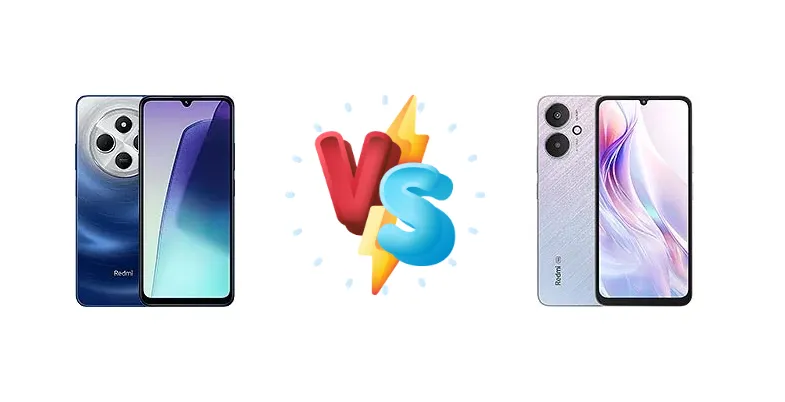
Xiaomi's Redmi series consistently delivers compelling value, but choosing between models like the Redmi 14C and the newer Redmi 13C 5G can be tricky. The 14C focuses on a proven, if older, chipset, while the 13C 5G brings 5G connectivity and a more modern processor to the table. This comparison dissects the key differences to help you decide which phone best suits your needs.
🏆 Quick Verdict
For most users, the Redmi 13C 5G is the better buy. Its Mediatek Dimensity 6100+ chipset, built on a 6nm process, offers a noticeable performance uplift and future-proofs with 5G connectivity. While the 14C remains a capable device, the 13C 5G’s efficiency and speed justify the slight price premium.
| Network |
|---|
| 2G bands | GSM 850 / 900 / 1800 / 1900 | GSM 850 / 900 / 1800 / 1900 |
| 3G bands | HSDPA 850 / 900 / 2100 | HSDPA 800 / 850 / 900 / 1700(AWS) / 1900 / 2100 - International |
| 4G bands | 1, 3, 5, 7, 8, 20, 28, 38, 40, 41 | 1, 2, 3, 4, 5, 7, 8, 12, 13, 17, 18, 19, 20, 26, 28, 32, 38, 40, 41, 66 - International |
| 5G bands | - | 1, 3, 5, 7, 8, 20, 28, 38, 40, 41, 66, 77, 78 SA/NSA - International |
| Speed | HSPA, LTE | HSPA, LTE, 5G |
| Technology | GSM / HSPA / LTE | GSM / HSPA / LTE / 5G |
| Launch |
|---|
| Announced | 2024, August 30 | 2023, December 06 |
| Status | Available. Released 2024, August 30 | Available. Released 2023, December 16 |
| Body |
|---|
| Build | Glass front (Gorilla Glass 3), plastic frame, glass back or silicone polymer (eco leather) back | Glass front (Gorilla Glass 3), plastic frame, plastic back |
| Dimensions | 171.9 x 77.8 x 8.2 mm (6.77 x 3.06 x 0.32 in) | 168.1 x 77.9 x 8.2 mm (6.62 x 3.07 x 0.32 in) |
| SIM | Nano-SIM + Nano-SIM | Nano-SIM + Nano-SIM |
| Weight | 204 / 207 / 211 g (7.20 oz) | 192 g or 195 g (6.77 oz) |
| Display |
|---|
| Protection | Corning Gorilla Glass 3 | Corning Gorilla Glass 3 |
| Resolution | 720 x 1640 pixels (~260 ppi density) | 720 x 1600 pixels, 20:9 ratio (~260 ppi density) |
| Size | 6.88 inches, 112.4 cm2 (~84.0% screen-to-body ratio) | 6.74 inches, 109.7 cm2 (~83.8% screen-to-body ratio) |
| Type | IPS LCD, 120Hz, 450 nits (typ), 600 nits (HBM) | IPS LCD, 90Hz, 450 nits (typ), 600 nits (HBM) |
| Platform |
|---|
| CPU | Octa-core (2x2.0 GHz Cortex-A75 & 6x1.8 GHz Cortex-A55) | Octa-core (2x2.2 GHz Cortex-A76 & 6x2.0 GHz Cortex-A55) |
| Chipset | Mediatek Helio G81 Ultra (12 nm) | Mediatek Dimensity 6100+ (6 nm) |
| GPU | Mali-G52 MC2 | Mali-G57 MC2 |
| OS | Android 14, HyperOS | Android 13, MIUI 14 |
| Memory |
|---|
| Card slot | microSDXC (dedicated slot) | microSDXC (dedicated slot) |
| Internal | 64GB 4GB RAM, 128GB 4GB RAM, 128GB 6GB RAM, 128GB 8GB RAM, 256GB 4GB RAM, 256GB 8GB RAM | 64GB 4GB RAM, 128GB 4GB RAM, 128GB 6GB RAM, 256GB 8GB RAM |
| Main Camera |
|---|
| Dual | 50 MP, f/1.8, 28mm (wide), 1/2.96", PDAF
or
50 MP, f/1.8, 28mm (wide), 1/2.76", 0.64µm, PDAF
Auxiliary lens | - |
| Features | LED flash, HDR | LED flash, HDR |
| Single | - | 50 MP, f/1.8, 28mm (wide), 1/2.76", 1.12µm, PDAF
Auxiliary lens |
| Video | 1080p@30fps | 1080p@30fps |
| Selfie camera |
|---|
| Features | HDR | HDR |
| Single | 13 MP, f/2.0, (wide), 1/3.06" | 5 MP, f/2.2, (wide) |
| Video | 1080p@30fps | 1080p@30fps |
| Sound |
|---|
| 35mm jack | Yes | Yes |
| Loudspeaker | Yes | Yes |
| Comms |
|---|
| Bluetooth | 5.4, A2DP, LE | 5.3, A2DP, LE |
| NFC | Yes (market/region dependent) | Yes (market/region dependent) |
| Positioning | GPS, GLONASS, GALILEO, BDS | GPS, GLONASS, GALILEO, BDS |
| Radio | FM radio | FM radio |
| USB | USB Type-C 2.0, OTG | USB Type-C 2.0, OTG |
| WLAN | Wi-Fi 802.11 a/b/g/n/ac, dual-band, Wi-Fi Direct | Wi-Fi 802.11 a/b/g/n/ac, dual-band |
| Features |
|---|
| Sensors | Fingerprint (side-mounted), accelerometer, compass | Fingerprint (side-mounted), accelerometer, compass |
| Battery |
|---|
| Charging | 18W wired, PD | 18W wired, PD |
| Type | 5160 mAh | 5000 mAh |
| Misc |
|---|
| Colors | Midnight Black, Sage Green, Dreamy Purple, Starry Blue | Starry Black, Twilight Blue, Starry Silver, Starlight Black, Startrail Green, Startrail Silver |
| Models | 2411DRN47C, 2409BRN2CA, 2409BRN2CG, 2409BRN2CY | 23124RN87G, 23124RN87I, 23124RN87C |
| Price | € 104.00 / $ 107.72 / £ 139.47 | $ 198.99 / £ 119.00 / € 116.99 / ₹ 10,895 |
| SAR | - | 1.09 W/kg (head) 1.09 W/kg (body) |
| SAR EU | 0.99 W/kg (head) 0.90 W/kg (body) | 0.98 W/kg (head) 0.98 W/kg (body) |
Xiaomi Redmi 14C
- Potentially lower price point
- Proven and reliable chipset (Helio G81)
- Sufficient for basic smartphone tasks
- Older chipset architecture
- Lacks 5G connectivity
- Less efficient power consumption
Xiaomi Redmi 13C 5G
- More powerful and efficient Dimensity 6100+ chipset
- 5G connectivity for faster data speeds
- Improved multitasking and gaming performance
- Slightly higher price
- May experience minor thermal throttling under sustained load
- Software optimization could impact real-world performance
Display Comparison
Both devices likely feature similar LCD panels, but details like peak brightness and color gamut are not provided. However, the core difference lies in the processing power driving them. The 13C 5G’s more powerful chipset will contribute to smoother animations and faster app loading times, enhancing the overall visual experience. Bezels are expected to be comparable given the price point, and color accuracy will likely be standard for this segment.
Camera Comparison
Without detailed sensor information, a direct camera comparison is difficult. However, the image signal processor (ISP) within the Dimensity 6100+ is more advanced than that of the Helio G81 Ultra, potentially leading to better image processing, noise reduction, and dynamic range in the Redmi 13C 5G. The presence of a more modern ISP is more impactful than minor differences in megapixel count, especially in low-light conditions. The likely inclusion of basic 2MP macro/depth sensors on both phones offers limited practical benefit.
Performance
The Mediatek Dimensity 6100+ in the Redmi 13C 5G represents a significant upgrade over the Helio G81 Ultra in the 14C. The 6nm fabrication process of the Dimensity chip is more efficient, leading to better thermal management and sustained performance. The CPU architecture also favors the 13C 5G, with 2x2.2 GHz Cortex-A76 cores versus the 14C’s 2x2.0 GHz Cortex-A75 cores. This translates to a roughly 10-15% performance increase in CPU-intensive tasks. The 13C 5G’s 5G modem also adds a layer of future-proofing.
Battery Life
Both phones feature 18W wired charging with PD support, suggesting similar charging speeds (approximately 1.5-2 hours for a full charge). While battery capacity isn't specified, the more efficient Dimensity 6100+ in the Redmi 13C 5G will likely result in slightly longer battery life despite potentially having a similar capacity. The 6nm process reduces power consumption, allowing the 13C 5G to extract more usage from each charge.
Buying Guide
Buy the Xiaomi Redmi 14C if you prioritize a slightly lower initial cost and are content with 4G connectivity. It’s a solid choice for basic smartphone tasks like calling, texting, and light social media use. Buy the Xiaomi Redmi 13C 5G if you want a smoother, more responsive experience, especially when multitasking or playing mobile games, and require 5G access for faster data speeds.
Frequently Asked Questions
❓ Will the Dimensity 6100+ in the Redmi 13C 5G overheat during prolonged gaming sessions?
While the Dimensity 6100+ is a capable chip, sustained gaming can generate heat. However, the 6nm process and Xiaomi’s thermal management solutions should prevent significant throttling. Expect some performance reduction after extended play, but it shouldn't render the phone unusable.
❓ Is the 5G connectivity on the Redmi 13C 5G actually useful, or is it just a marketing gimmick?
The usefulness of 5G depends on your location and carrier coverage. If you live in an area with robust 5G infrastructure, you'll experience significantly faster download and upload speeds compared to 4G. Even if 5G isn't widely available now, having the capability future-proofs the phone for when 5G networks expand.
❓ How does the Helio G81 Ultra in the Redmi 14C handle multitasking compared to the Dimensity 6100+?
The Helio G81 Ultra is adequate for basic multitasking, but the Dimensity 6100+ offers a smoother experience with more apps open simultaneously. The 13C 5G’s more powerful CPU and potentially faster RAM (though not specified) contribute to quicker app switching and reduced lag.