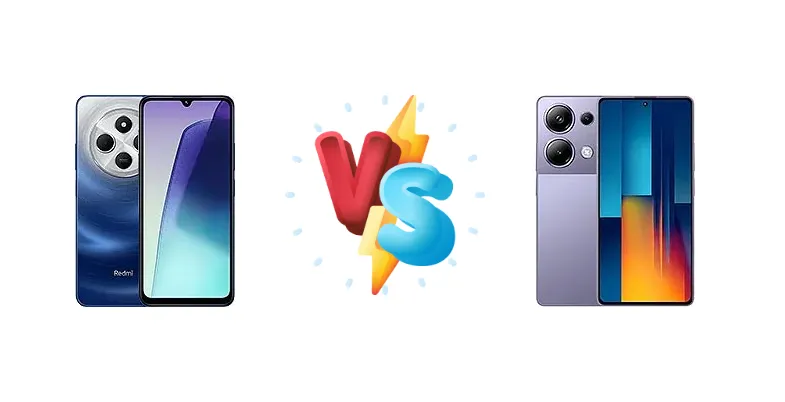
Xiaomi’s Redmi and Poco lines consistently deliver impressive value, but navigating their overlapping portfolios can be tricky. The Redmi 14C focuses on providing a solid all-around experience at an ultra-affordable price, while the Poco M6 Pro 4G aims for a more performance-oriented approach, particularly in the realm of charging speed. This comparison dissects the key differences to help you choose the right phone for your needs.
🏆 Quick Verdict
For most users, the Poco M6 Pro 4G is the better buy. Its significantly faster 67W charging (full charge in 44 minutes) and more powerful Helio G99 chipset, featuring Cortex-A76 cores, offer a noticeable improvement in daily usability and longevity, justifying the likely price premium.
| Network |
|---|
| 2G bands | GSM 850 / 900 / 1800 / 1900 | GSM 850 / 900 / 1800 / 1900 |
| 3G bands | HSDPA 850 / 900 / 2100 | HSDPA 800 / 850 / 900 / 1700(AWS) / 1900 / 2100 |
| 4G bands | 1, 3, 5, 7, 8, 20, 28, 38, 40, 41 | 1, 2, 3, 4, 5, 7, 8, 12, 13, 17, 18, 19, 20, 26, 28, 38, 40, 41, 66 |
| Speed | HSPA, LTE | HSPA, LTE |
| Technology | GSM / HSPA / LTE | GSM / HSPA / LTE |
| Launch |
|---|
| Announced | 2024, August 30 | 2024, January 11 |
| Status | Available. Released 2024, August 30 | Available. Released 2024, January 12 |
| Body |
|---|
| Build | Glass front (Gorilla Glass 3), plastic frame, glass back or silicone polymer (eco leather) back | Glass front (Gorilla Glass 5), plastic frame |
| Dimensions | 171.9 x 77.8 x 8.2 mm (6.77 x 3.06 x 0.32 in) | 161.1 x 75 x 8 mm (6.34 x 2.95 x 0.31 in) |
| SIM | Nano-SIM + Nano-SIM | Nano-SIM + Nano-SIM |
| Weight | 204 / 207 / 211 g (7.20 oz) | 179 g (6.31 oz) |
| Display |
|---|
| Protection | Corning Gorilla Glass 3 | Corning Gorilla Glass 5 |
| Resolution | 720 x 1640 pixels (~260 ppi density) | 1080 x 2400 pixels, 20:9 ratio (~395 ppi density) |
| Size | 6.88 inches, 112.4 cm2 (~84.0% screen-to-body ratio) | 6.67 inches, 107.4 cm2 (~88.9% screen-to-body ratio) |
| Type | IPS LCD, 120Hz, 450 nits (typ), 600 nits (HBM) | AMOLED, 120Hz, 1000 nits (HBM), 1300 nits (peak) |
| Platform |
|---|
| CPU | Octa-core (2x2.0 GHz Cortex-A75 & 6x1.8 GHz Cortex-A55) | Octa-core (2x2.2 GHz Cortex-A76 & 6x2.0 GHz Cortex-A55) |
| Chipset | Mediatek Helio G81 Ultra (12 nm) | Mediatek Helio G99 Ultra |
| GPU | Mali-G52 MC2 | Mali-G57 MC2 |
| OS | Android 14, HyperOS | Android 13, MIUI 14, planned upgrade to Android 14, HyperOS |
| Memory |
|---|
| Card slot | microSDXC (dedicated slot) | microSDXC (uses shared SIM slot) |
| Internal | 64GB 4GB RAM, 128GB 4GB RAM, 128GB 6GB RAM, 128GB 8GB RAM, 256GB 4GB RAM, 256GB 8GB RAM | 256GB 8GB RAM, 512GB 12GB RAM |
| Main Camera |
|---|
| Dual | 50 MP, f/1.8, 28mm (wide), 1/2.96", PDAF
or
50 MP, f/1.8, 28mm (wide), 1/2.76", 0.64µm, PDAF
Auxiliary lens | - |
| Features | LED flash, HDR | LED flash, HDR, panorama |
| Triple | - | 64 MP, f/1.8, 25mm (wide), 1/2.0", 0.7µm, PDAF, OIS
8 MP, f/2.2, (ultrawide)
2 MP (macro) |
| Video | 1080p@30fps | 1080p@30/60fps, gyro-EIS |
| Selfie camera |
|---|
| Features | HDR | - |
| Single | 13 MP, f/2.0, (wide), 1/3.06" | 16 MP, f/2.5, (wide) |
| Video | 1080p@30fps | 1080p@30/60fps |
| Sound |
|---|
| 35mm jack | Yes | Yes |
| Loudspeaker | Yes | Yes, with dual speakers |
| Comms |
|---|
| Bluetooth | 5.4, A2DP, LE | 5.2, A2DP, LE |
| Infrared port | - | Yes |
| NFC | Yes (market/region dependent) | Yes (market/region dependent) |
| Positioning | GPS, GLONASS, GALILEO, BDS | GPS, GALILEO, GLONASS, BDS |
| Radio | FM radio | FM radio |
| USB | USB Type-C 2.0, OTG | USB Type-C 2.0, OTG |
| WLAN | Wi-Fi 802.11 a/b/g/n/ac, dual-band, Wi-Fi Direct | Wi-Fi 802.11 a/b/g/n/ac, dual-band |
| Features |
|---|
| Sensors | Fingerprint (side-mounted), accelerometer, compass | Fingerprint (under display, optical), accelerometer, gyro, compass |
| Battery |
|---|
| Charging | 18W wired, PD | 67W wired, 100% in 44 min |
| Type | 5160 mAh | 5000 mAh |
| Misc |
|---|
| Colors | Midnight Black, Sage Green, Dreamy Purple, Starry Blue | Black, Blue, Purple |
| Models | 2411DRN47C, 2409BRN2CA, 2409BRN2CG, 2409BRN2CY | 2312FPCA6G |
| Price | € 104.00 / $ 107.72 / £ 139.47 | $ 170.00 |
| SAR | - | 1.09 W/kg (head) 1.09 W/kg (body) |
| SAR EU | 0.99 W/kg (head) 0.90 W/kg (body) | 0.99 W/kg (head) 0.99 W/kg (body) |
Xiaomi Redmi 14C
- Ultra-affordable price point
- Reliable Mediatek Helio G81 performance for basic tasks
- Potentially larger battery capacity (unconfirmed)
- Slow 18W charging
- Less powerful chipset compared to the Poco M6 Pro
- Likely lower display brightness
Xiaomi Poco M6 Pro 4G
- Significantly faster 67W charging (44 min to 100%)
- More powerful Mediatek Helio G99 chipset
- Brighter 1053 nit display
- Likely a higher price tag than the Redmi 14C
- Potentially smaller battery capacity (unconfirmed)
- May not include a charger in the box (depending on region)
Display Comparison
The Poco M6 Pro 4G boasts a significantly brighter display, reaching a measured peak of 1053 nits. This is a substantial advantage over what we’d expect from the Redmi 14C, making the Poco more usable outdoors under direct sunlight. While both likely utilize LCD panels (given the price point), the higher brightness of the Poco translates to a more vibrant and readable experience. We lack specific details on color accuracy for either device, but the Redmi 14C’s display is likely tuned for power efficiency rather than color fidelity.
Camera Comparison
Both phones likely feature a multi-camera setup, but detailed sensor information is limited. We can assume the Poco M6 Pro 4G will have a more capable main sensor, given its positioning as a slightly more premium device. The Redmi 14C likely relies on a more basic sensor and image processing pipeline. The presence of a 2MP macro camera on both is largely a marketing tactic; image quality from these sensors is typically underwhelming. Focus should be on the primary camera’s performance, and the Poco is expected to deliver superior results.
Performance
The core difference lies in the chipsets. The Poco M6 Pro 4G’s Mediatek Helio G99 Ultra is a clear step up from the Redmi 14C’s Helio G81 Ultra. The G99 utilizes more modern CPU cores – 2x2.2 GHz Cortex-A76 versus the Redmi’s 2x2.0 GHz Cortex-A75 – resulting in faster application loading and smoother multitasking. The G99’s improved GPU also provides a better gaming experience. While both phones likely feature similar RAM configurations, the G99’s overall architecture offers a more future-proof platform.
Battery Life
The Poco M6 Pro 4G’s 67W charging is its standout feature, achieving a full charge in just 44 minutes. This is a massive advantage over the Redmi 14C’s 18W charging, which will take considerably longer. While the Redmi 14C may have a slightly larger battery capacity (spec not provided), the Poco’s faster charging effectively mitigates any capacity difference. The Poco M6 Pro 4G also boasts an impressive 11:46h active use score, indicating excellent battery life despite the faster charging.
Buying Guide
Buy the Xiaomi Redmi 14C if you prioritize absolute affordability and a dependable, if not thrilling, experience for basic tasks like calls, messaging, and light social media. Buy the Xiaomi Poco M6 Pro 4G if you value faster performance for gaming and multitasking, and especially if you frequently find yourself needing to quickly top up your battery – the 67W charging is a game-changer in this price bracket.
Frequently Asked Questions
❓ Does the Poco M6 Pro 4G’s Helio G99 chipset get hot during extended gaming sessions?
The Helio G99 is generally efficient, but sustained gaming will inevitably generate heat. However, the G99’s architecture is designed to manage thermal throttling better than older chipsets like the G81 in the Redmi 14C. Expect some performance reduction after prolonged gaming, but it should remain playable.
❓ Is the 67W charging on the Poco M6 Pro 4G compatible with all USB-C chargers?
While the Poco M6 Pro 4G uses the USB-C standard, to achieve the full 67W charging speed, you’ll need a charger that supports Power Delivery (PD) and the appropriate charging protocol. Using a standard 18W charger will still charge the phone, but at a significantly slower rate.
❓ How does the Redmi 14C perform with multitasking and running multiple apps?
The Redmi 14C’s Helio G81 is adequate for basic multitasking, such as switching between messaging apps and browsing the web. However, it may struggle with more demanding tasks like running multiple resource-intensive apps simultaneously. The Poco M6 Pro 4G, with its Helio G99, will offer a noticeably smoother multitasking experience.
❓ What kind of video recording capabilities does the Poco M6 Pro 4G offer?
While specific details are limited, the Poco M6 Pro 4G is expected to support 1080p video recording at 30fps. Given its positioning, it may also offer a stabilization mode for smoother footage. The Redmi 14C likely supports similar video recording capabilities, but with potentially lower quality and less effective stabilization.