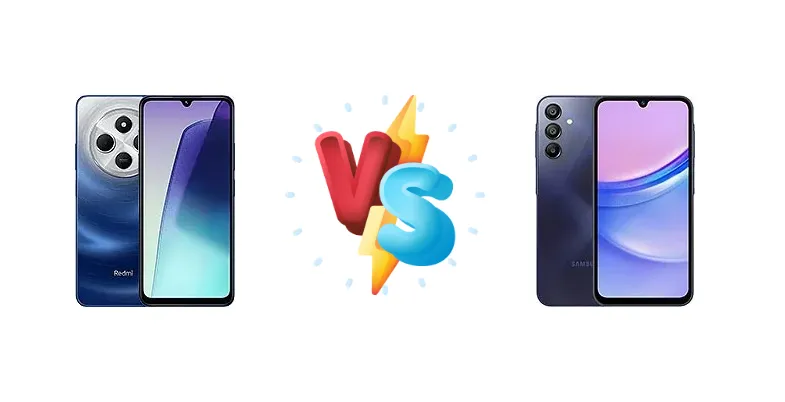
The Xiaomi Redmi 14C and Samsung Galaxy A15 represent compelling options in the ultra-budget smartphone space. While both aim to deliver essential features at an accessible price, they diverge significantly in their core hardware, particularly in their chipset and display technology. This comparison dissects these differences to determine which device offers the best value for your money.
🏆 Quick Verdict
For most users, the Samsung Galaxy A15 emerges as the superior choice. Its more efficient Helio G99 chipset, coupled with a brighter 808-nit display and significantly longer battery life (15:28h active use), provides a smoother and more enjoyable user experience despite a slightly higher price point.
| Network |
|---|
| 2G bands | GSM 850 / 900 / 1800 / 1900 | GSM 850 / 900 / 1800 / 1900 |
| 3G bands | HSDPA 850 / 900 / 2100 | HSDPA 850 / 900 / 2100 |
| 4G bands | 1, 3, 5, 7, 8, 20, 28, 38, 40, 41 | 1, 3, 5, 7, 8, 20, 28, 38, 40, 41 |
| Speed | HSPA, LTE | HSPA, LTE |
| Technology | GSM / HSPA / LTE | GSM / HSPA / LTE |
| Launch |
|---|
| Announced | 2024, August 30 | 2023, December 11 |
| Status | Available. Released 2024, August 30 | Available. Released 2023, December 16 |
| Body |
|---|
| Build | Glass front (Gorilla Glass 3), plastic frame, glass back or silicone polymer (eco leather) back | Glass front, plastic back, plastic frame |
| Dimensions | 171.9 x 77.8 x 8.2 mm (6.77 x 3.06 x 0.32 in) | 160.1 x 76.8 x 8.4 mm (6.30 x 3.02 x 0.33 in) |
| SIM | Nano-SIM + Nano-SIM | · Nano-SIM· Nano-SIM + Nano-SIM |
| Weight | 204 / 207 / 211 g (7.20 oz) | 200 g (7.05 oz) |
| Display |
|---|
| Protection | Corning Gorilla Glass 3 | - |
| Resolution | 720 x 1640 pixels (~260 ppi density) | 1080 x 2340 pixels, 19.5:9 ratio (~396 ppi density) |
| Size | 6.88 inches, 112.4 cm2 (~84.0% screen-to-body ratio) | 6.5 inches, 103.7 cm2 (~84.3% screen-to-body ratio) |
| Type | IPS LCD, 120Hz, 450 nits (typ), 600 nits (HBM) | Super AMOLED, 90Hz, 800 nits (HBM) |
| Platform |
|---|
| CPU | Octa-core (2x2.0 GHz Cortex-A75 & 6x1.8 GHz Cortex-A55) | Octa-core (2x2.2 GHz Cortex-A76 & 6x2.0 GHz Cortex-A55) |
| Chipset | Mediatek Helio G81 Ultra (12 nm) | Mediatek Helio G99 (6 nm) |
| GPU | Mali-G52 MC2 | Mali-G57 MC2 |
| OS | Android 14, HyperOS | Android 14, up to 4 major Android upgrades, One UI 7 |
| Memory |
|---|
| Card slot | microSDXC (dedicated slot) | microSDXC (uses shared SIM slot) |
| Internal | 64GB 4GB RAM, 128GB 4GB RAM, 128GB 6GB RAM, 128GB 8GB RAM, 256GB 4GB RAM, 256GB 8GB RAM | 128GB 4GB RAM, 128GB 6GB RAM, 128GB 8GB RAM, 256GB 6GB RAM, 256GB 8GB RAM |
| Main Camera |
|---|
| Dual | 50 MP, f/1.8, 28mm (wide), 1/2.96", PDAF
or
50 MP, f/1.8, 28mm (wide), 1/2.76", 0.64µm, PDAF
Auxiliary lens | - |
| Features | LED flash, HDR | LED flash, panorama, HDR |
| Triple | - | 50 MP, f/1.8, 26mm (wide), 1/2.8", 0.64µm, PDAF
5 MP, f/2.2, 17mm (ultrawide), 1/5.0", 1.12µm
2 MP (macro) |
| Video | 1080p@30fps | 1080p@30fps |
| Selfie camera |
|---|
| Features | HDR | - |
| Single | 13 MP, f/2.0, (wide), 1/3.06" | 13 MP, f/2.0, 26mm (wide), 1/3.06", 1.12µm |
| Video | 1080p@30fps | 1080p@30fps |
| Sound |
|---|
| 35mm jack | Yes | Yes |
| Loudspeaker | Yes | Yes |
| Comms |
|---|
| Bluetooth | 5.4, A2DP, LE | 5.3, A2DP, LE |
| NFC | Yes (market/region dependent) | Yes (market/region dependent) |
| Positioning | GPS, GLONASS, GALILEO, BDS | GPS, GALILEO, GLONASS, BDS, QZSS |
| Radio | FM radio | FM radio (market/region dependent) |
| USB | USB Type-C 2.0, OTG | USB Type-C 2.0 |
| WLAN | Wi-Fi 802.11 a/b/g/n/ac, dual-band, Wi-Fi Direct | Wi-Fi 802.11 a/b/g/n/ac, dual-band, Wi-Fi Direct |
| Features |
|---|
| Sensors | Fingerprint (side-mounted), accelerometer, compass | Fingerprint (side-mounted), accelerometer, compass |
| Battery |
|---|
| Charging | 18W wired, PD | 25W wired |
| Type | 5160 mAh | 5000 mAh |
| Misc |
|---|
| Colors | Midnight Black, Sage Green, Dreamy Purple, Starry Blue | Brave Black, Optimistic Blue, Magical Blue, Personality Yellow |
| Models | 2411DRN47C, 2409BRN2CA, 2409BRN2CG, 2409BRN2CY | SM-A155F, SM-A155F/DSN, SM-A155M, SM-A155M/DS, SM-A155P, SM-A155R |
| Price | € 104.00 / $ 107.72 / £ 139.47 | € 168.99 / $ 125.00 / £ 113.00 |
| SAR EU | 0.99 W/kg (head) 0.90 W/kg (body) | 0.42 W/kg (head) 1.29 W/kg (body) |
Xiaomi Redmi 14C
- Potentially lower price point
- May offer expandable storage (market dependent)
- Xiaomi’s MIUI software offers extensive customization options
- Less efficient Helio G81 chipset
- Likely lower display brightness
- Shorter battery life compared to A15
Samsung Galaxy A15
- More efficient Helio G99 chipset
- Brighter 808-nit display
- Longer battery life (15:28h active use)
- Faster 25W charging
- Potentially higher price
- Samsung’s One UI can be resource-intensive
- May lack a headphone jack (market dependent)
Display Comparison
The Samsung Galaxy A15 boasts a significant advantage in display quality, achieving a measured peak brightness of 808 nits. This is crucial for outdoor visibility, a common pain point in this price segment. While the Redmi 14C’s display specifications are not provided, it’s reasonable to assume it falls short of this brightness level given its positioning. The A15’s panel likely offers better color accuracy and viewing angles, enhancing the overall visual experience. The lack of information on the Redmi 14C’s panel type makes a direct comparison difficult, but the A15’s brightness alone is a compelling differentiator.
Camera Comparison
Without detailed camera specifications for either device, a precise comparison is challenging. However, given the market segment, it’s likely both phones rely on similar sensor configurations. The focus should be on image processing. Samsung generally excels in computational photography, offering more vibrant and detailed images, even with lower-end sensors. The Redmi 14C may lean towards a more natural, less processed look. The presence of OIS (Optical Image Stabilization) on either device is unlikely at this price point, so low-light performance will likely be similar, relying heavily on software algorithms.
Performance
The core performance difference lies in the chipsets: the Redmi 14C utilizes the Mediatek Helio G81 Ultra (12nm), while the Galaxy A15 features the Helio G99 (6nm). The G99’s 6nm process is significantly more efficient, translating to better thermal management and sustained performance. While both are octa-core CPUs, the A15’s Cortex-A76 cores (2x2.2 GHz) offer a performance edge over the Redmi 14C’s Cortex-A75 cores (2x2.0 GHz). This means faster app loading times, smoother multitasking, and a more responsive user interface on the Galaxy A15. The G99’s improved GPU will also provide a better gaming experience, even if both phones aren’t designed for demanding titles.
Battery Life
The Samsung Galaxy A15’s 15:28h active use battery score is a standout feature. While the Redmi 14C’s battery capacity is unknown, the G99’s superior power efficiency in the A15 allows it to deliver significantly longer runtimes. The A15 also supports 25W wired charging, compared to the Redmi 14C’s 18W, meaning faster top-ups. While 18W isn’t slow, the 25W charging on the A15 will reduce downtime, especially for users who frequently use their phones throughout the day. The combination of efficiency and faster charging gives the A15 a clear advantage.
Buying Guide
Buy the Xiaomi Redmi 14C if you prioritize absolute affordability and are willing to compromise on performance and display quality for the lowest possible price. Buy the Samsung Galaxy A15 if you value a brighter, more responsive display, longer battery life, and a more modern chipset for a slightly increased investment. The A15 is the better all-rounder for daily use and light gaming.
Frequently Asked Questions
❓ Does the Mediatek Helio G99 in the Galaxy A15 get noticeably warmer during extended gaming sessions compared to the G81 in the Redmi 14C?
The Helio G99’s 6nm process is inherently more thermally efficient than the G81’s 12nm process. This means the Galaxy A15 will generate less heat under load, resulting in less throttling and more sustained performance during gaming. While neither phone is a gaming powerhouse, the A15 will offer a smoother experience for longer periods.
❓ How much of a difference will the 25W charging make on the Galaxy A15 compared to the Redmi 14C’s 18W charging?
The 25W charging on the Galaxy A15 will significantly reduce charging times. While exact 0-100% times aren’t available, expect the A15 to charge considerably faster, potentially shaving off 30-60 minutes compared to the Redmi 14C. This is particularly beneficial for users who need to quickly top up their battery throughout the day.
❓ Is the difference in CPU performance between the Cortex-A76 (A15) and Cortex-A75 (14C) cores noticeable in everyday tasks like browsing and social media?
Yes, the Cortex-A76 cores in the Galaxy A15 offer a noticeable performance boost in everyday tasks. You’ll experience faster app loading times, smoother scrolling, and a more responsive user interface. While the difference might not be dramatic, it contributes to a more fluid and enjoyable overall experience.