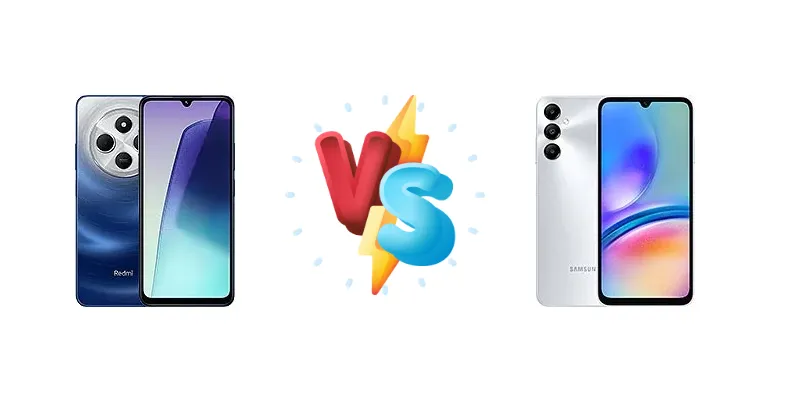
The sub-$150 smartphone market is fiercely competitive. The Xiaomi Redmi 14C and Samsung Galaxy A05s represent two compelling options, each prioritizing different strengths. The Redmi 14C leans on a more powerful CPU core configuration, while the Galaxy A05s boasts a more efficient chipset and a significantly longer battery life in active use. This comparison dissects these trade-offs to determine which device best suits your needs.
🏆 Quick Verdict
For the average user prioritizing longevity and consistent performance, the Samsung Galaxy A05s is the better choice. Its Snapdragon 680, built on a 6nm process, delivers superior efficiency, translating to over 11 hours of active use. While the Redmi 14C’s Helio G81 offers a theoretical CPU advantage, the A05s’ real-world smoothness and battery life are more impactful.
| Network |
|---|
| 2G bands | GSM 850 / 900 / 1800 / 1900 | GSM 850 / 900 / 1800 / 1900 |
| 3G bands | HSDPA 850 / 900 / 2100 | HSDPA 850 / 900 / 2100 |
| 4G bands | 1, 3, 5, 7, 8, 20, 28, 38, 40, 41 | 1, 3, 5, 7, 8, 20, 28, 38, 40, 41 |
| Speed | HSPA, LTE | HSPA, LTE |
| Technology | GSM / HSPA / LTE | GSM / HSPA / LTE |
| Launch |
|---|
| Announced | 2024, August 30 | 2023, September 25 |
| Status | Available. Released 2024, August 30 | Available. Released 2023, October 18 |
| Body |
|---|
| Build | Glass front (Gorilla Glass 3), plastic frame, glass back or silicone polymer (eco leather) back | Glass front, plastic back, plastic frame |
| Dimensions | 171.9 x 77.8 x 8.2 mm (6.77 x 3.06 x 0.32 in) | 168 x 77.8 x 8.8 mm (6.61 x 3.06 x 0.35 in) |
| SIM | Nano-SIM + Nano-SIM | · Nano-SIM· Nano-SIM + Nano-SIM |
| Weight | 204 / 207 / 211 g (7.20 oz) | 194 g (6.84 oz) |
| Display |
|---|
| Protection | Corning Gorilla Glass 3 | - |
| Resolution | 720 x 1640 pixels (~260 ppi density) | 1080 x 2400 pixels, 20:9 ratio (~393 ppi density) |
| Size | 6.88 inches, 112.4 cm2 (~84.0% screen-to-body ratio) | 6.7 inches, 108.4 cm2 (~82.9% screen-to-body ratio) |
| Type | IPS LCD, 120Hz, 450 nits (typ), 600 nits (HBM) | PLS LCD, 90Hz |
| Platform |
|---|
| CPU | Octa-core (2x2.0 GHz Cortex-A75 & 6x1.8 GHz Cortex-A55) | Octa-core (4x2.4 GHz Kryo 265 Gold & 4x1.9 GHz Kryo 265 Silver) |
| Chipset | Mediatek Helio G81 Ultra (12 nm) | Qualcomm SM6225 Snapdragon 680 4G (6 nm) |
| GPU | Mali-G52 MC2 | Adreno 610 |
| OS | Android 14, HyperOS | Android 13, up to 2 major Android upgrades, One UI 7 |
| Memory |
|---|
| Card slot | microSDXC (dedicated slot) | microSDXC (dedicated slot) |
| Internal | 64GB 4GB RAM, 128GB 4GB RAM, 128GB 6GB RAM, 128GB 8GB RAM, 256GB 4GB RAM, 256GB 8GB RAM | 64GB 4GB RAM, 128GB 4GB RAM, 128GB 6GB RAM |
| Main Camera |
|---|
| Dual | 50 MP, f/1.8, 28mm (wide), 1/2.96", PDAF
or
50 MP, f/1.8, 28mm (wide), 1/2.76", 0.64µm, PDAF
Auxiliary lens | - |
| Features | LED flash, HDR | LED flash |
| Triple | - | 50 MP, f/1.8, (wide), 1/2.8", 0.64µm, AF
2 MP (macro)
Auxiliary lens |
| Video | 1080p@30fps | 1080p@30/60fps |
| Selfie camera |
|---|
| Features | HDR | - |
| Single | 13 MP, f/2.0, (wide), 1/3.06" | 13 MP, f/2.0, (wide), 1/3.X", 1.12µm |
| Video | 1080p@30fps | 1080p@30fps |
| Sound |
|---|
| 35mm jack | Yes | Yes |
| Loudspeaker | Yes | Yes |
| Comms |
|---|
| Bluetooth | 5.4, A2DP, LE | 5.1, A2DP, LE |
| NFC | Yes (market/region dependent) | Yes (market/region dependent) |
| Positioning | GPS, GLONASS, GALILEO, BDS | GPS, GLONASS, GALILEO, BDS, QZSS |
| Radio | FM radio | Unspecified |
| USB | USB Type-C 2.0, OTG | USB Type-C 2.0 |
| WLAN | Wi-Fi 802.11 a/b/g/n/ac, dual-band, Wi-Fi Direct | Wi-Fi 802.11 a/b/g/n/ac, dual-band, Wi-Fi Direct |
| Features |
|---|
| Sensors | Fingerprint (side-mounted), accelerometer, compass | Fingerprint (side-mounted), accelerometer, proximity |
| Battery |
|---|
| Charging | 18W wired, PD | 25W wired |
| Type | 5160 mAh | Li-Po 5000 mAh |
| Misc |
|---|
| Colors | Midnight Black, Sage Green, Dreamy Purple, Starry Blue | Black, Silver, Light Green, Violet |
| Models | 2411DRN47C, 2409BRN2CA, 2409BRN2CG, 2409BRN2CY | SM-A057F, SM-A057F/DS, SM-A057M, SM-A057M/DS, SM-A057G/DSN, SM-A057G |
| Price | € 104.00 / $ 107.72 / £ 139.47 | $ 134.00 / C$ 146.99 / £ 83.94 / € 100.99 |
| SAR EU | 0.99 W/kg (head) 0.90 W/kg (body) | 0.58 W/kg (head) 1.31 W/kg (body) |
Xiaomi Redmi 14C
- Potentially higher CPU burst performance for specific tasks.
- May offer a lower initial price point.
- Xiaomi’s MIUI offers extensive customization options.
- Less efficient chipset leads to shorter battery life.
- 12nm process prone to thermal throttling.
- Display specifications are unknown, potentially inferior to the A05s.
Samsung Galaxy A05s
- Superior battery life (11:32h active use).
- More efficient Snapdragon 680 chipset (6nm).
- Faster 25W charging.
- Brighter and higher contrast display (468 nits, 1418:1).
- CPU core clock speeds are slightly lower than the Redmi 14C.
- Samsung’s One UI can be resource-intensive.
- May be slightly more expensive than the Redmi 14C.
Display Comparison
The Samsung Galaxy A05s features a display with a measured peak brightness of 468 nits and a 1418:1 contrast ratio. While the Redmi 14C’s display specifications are not provided, Samsung’s measured data indicates a brighter and more vibrant viewing experience, particularly outdoors. The contrast ratio suggests deeper blacks and more vivid colors on the A05s. Without knowing the Redmi 14C’s panel type or brightness, it’s difficult to assess its color accuracy, but Samsung’s displays generally offer better calibration in this price segment.
Camera Comparison
Both phones are expected to feature basic camera setups geared towards casual photography. The Redmi 14C’s camera specifications are not detailed, but budget phones often prioritize megapixel count over sensor size and image processing. The Galaxy A05s’ camera is described as 'Photo / Video' without further detail. Without knowing sensor sizes or apertures, it’s difficult to make a definitive judgment. However, Samsung’s image processing algorithms generally produce more pleasing results in challenging lighting conditions, even with similar hardware. It's likely both phones will struggle in low light, and the inclusion of a 2MP macro lens on either device is largely a marketing gimmick.
Performance
The core difference lies in the chipsets. The Redmi 14C utilizes the Mediatek Helio G81, a 12nm chip with a dual-cluster CPU configuration: two Cortex-A75 cores at 2.0 GHz and six Cortex-A55 cores at 1.8 GHz. This setup aims for burst performance. Conversely, the Galaxy A05s employs the Qualcomm Snapdragon 680, a 6nm chip with four Kryo 265 Gold cores at 2.4 GHz and four Kryo 265 Silver cores at 1.9 GHz. The 6nm process of the Snapdragon 680 provides significantly better power efficiency, reducing heat and improving sustained performance. While the Redmi 14C’s A75 cores have a higher clock speed, the Snapdragon 680’s architecture and process node likely result in smoother multitasking and gaming, especially during extended sessions. The A05s will likely exhibit less thermal throttling.
Battery Life
The Samsung Galaxy A05s shines in battery life, achieving 11 hours and 32 minutes of active use. The Redmi 14C’s battery capacity is not specified, but its less efficient Helio G81 chipset will likely result in shorter runtimes. The A05s also supports 25W wired charging, while the Redmi 14C is limited to 18W. This translates to faster charging speeds for the A05s, minimizing downtime. The combination of a more efficient chipset and faster charging gives the A05s a clear advantage in battery performance.
Buying Guide
Buy the Xiaomi Redmi 14C if you frequently engage in CPU-intensive tasks like light video editing or running multiple apps simultaneously and are willing to compromise on battery life. Buy the Samsung Galaxy A05s if you prioritize all-day battery life, smooth everyday performance, and a more refined software experience. The A05s is ideal for users who primarily browse, use social media, and occasionally play less demanding games.
Frequently Asked Questions
❓ Will the Snapdragon 680 in the Galaxy A05s struggle with demanding games like PUBG Mobile?
While the Snapdragon 680 isn't a gaming powerhouse, it's capable of running PUBG Mobile at medium settings with stable frame rates. The 6nm process helps prevent overheating during extended gaming sessions, providing a more consistent experience than the Redmi 14C’s Helio G81, which is more prone to throttling.
❓ Does the Redmi 14C support Power Delivery (PD) charging, and how long does a full charge take?
Yes, the Redmi 14C supports 18W wired charging with Power Delivery (PD). However, given the lack of information on battery capacity, a full charge is estimated to take between 2-3 hours, significantly longer than the Galaxy A05s’ 25W charging.
❓ Is the camera on the Samsung Galaxy A05s good enough for social media photos?
The Galaxy A05s’ camera is adequate for casual social media photography in good lighting conditions. Samsung’s image processing typically enhances colors and details, resulting in shareable photos. However, expect limited performance in low-light scenarios.
❓ How does the software experience differ between MIUI on the Redmi 14C and One UI on the Galaxy A05s?
MIUI is known for its extensive customization options and features, but can sometimes feel cluttered with pre-installed apps. One UI offers a cleaner, more streamlined experience, but may include Samsung’s own suite of apps. Both interfaces receive regular updates, but Samsung generally provides longer software support.