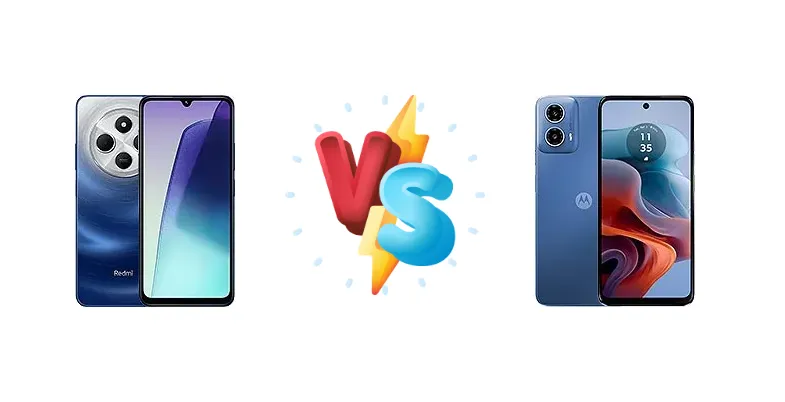
The sub-$200 smartphone market is fiercely competitive. The Xiaomi Redmi 14C and Motorola Moto G34 both aim to deliver essential features at an accessible price point, but they take different approaches. The Redmi 14C relies on MediaTek’s Helio G81, while the Moto G34 opts for Qualcomm’s Snapdragon 695 5G. This comparison dissects these key differences to determine which device offers the best value.
🏆 Quick Verdict
For the average user prioritizing efficiency and future-proofing, the Motorola Moto G34 is the better choice. Its Snapdragon 695, built on a 6nm process, offers superior performance per watt and 5G connectivity, offsetting the Redmi 14C’s slightly lower price in most scenarios.
| Network |
|---|
| 2G bands | GSM 850 / 900 / 1800 / 1900 | GSM 850 / 900 / 1800 / 1900 |
| 3G bands | HSDPA 850 / 900 / 2100 | HSDPA 850 / 900 / 1900 / 2100 |
| 4G bands | 1, 3, 5, 7, 8, 20, 28, 38, 40, 41 | 1, 2, 3, 5, 7, 8, 20, 26, 28, 32, 38, 40, 41, 42 - ЕМЕА |
| 5G bands | - | 1, 3, 5, 7, 8, 20, 26, 28, 38, 40, 41, 77, 78 SA/NSA - ЕМЕА |
| Speed | HSPA, LTE | HSPA, LTE, 5G |
| Technology | GSM / HSPA / LTE | GSM / HSPA / LTE / 5G |
| Launch |
|---|
| Announced | 2024, August 30 | 2023, December 22 |
| Status | Available. Released 2024, August 30 | Available. Released 2023, December 29 |
| Body |
|---|
| Build | Glass front (Gorilla Glass 3), plastic frame, glass back or silicone polymer (eco leather) back | Glass front, plastic back or silicone polymer (eco leather), plastic frame |
| Dimensions | 171.9 x 77.8 x 8.2 mm (6.77 x 3.06 x 0.32 in) | 162.7 x 74.6 x 8 mm (6.41 x 2.94 x 0.31 in) |
| SIM | Nano-SIM + Nano-SIM | · Nano-SIM + eSIM· Nano-SIM + Nano-SIM |
| Weight | 204 / 207 / 211 g (7.20 oz) | 179 g or 181 g (6.31 oz) |
| Display |
|---|
| Protection | Corning Gorilla Glass 3 | - |
| Resolution | 720 x 1640 pixels (~260 ppi density) | 720 x 1600 pixels, 20:9 ratio (~270 ppi density) |
| Size | 6.88 inches, 112.4 cm2 (~84.0% screen-to-body ratio) | 6.5 inches, 102.0 cm2 (~84.0% screen-to-body ratio) |
| Type | IPS LCD, 120Hz, 450 nits (typ), 600 nits (HBM) | IPS LCD, 120Hz |
| Platform |
|---|
| CPU | Octa-core (2x2.0 GHz Cortex-A75 & 6x1.8 GHz Cortex-A55) | Octa-core (2x2.2 GHz Kryo 660 Gold & 6x1.7 GHz Kryo 660 Silver) |
| Chipset | Mediatek Helio G81 Ultra (12 nm) | Qualcomm SM6375 Snapdragon 695 5G (6 nm) |
| GPU | Mali-G52 MC2 | Adreno 619 |
| OS | Android 14, HyperOS | Android 13 or Android 14 |
| Memory |
|---|
| Card slot | microSDXC (dedicated slot) | microSDXC (uses shared SIM slot) |
| Internal | 64GB 4GB RAM, 128GB 4GB RAM, 128GB 6GB RAM, 128GB 8GB RAM, 256GB 4GB RAM, 256GB 8GB RAM | 64GB 4GB RAM, 128GB 4GB RAM, 128GB 8GB RAM, 256GB 8GB RAM |
| Main Camera |
|---|
| Dual | 50 MP, f/1.8, 28mm (wide), 1/2.96", PDAF
or
50 MP, f/1.8, 28mm (wide), 1/2.76", 0.64µm, PDAF
Auxiliary lens | 50 MP, f/1.8 (wide), 0.64µm, PDAF
2 MP (macro) |
| Features | LED flash, HDR | LED flash, HDR, panorama |
| Video | 1080p@30fps | 1080p@30fps |
| Selfie camera |
|---|
| Features | HDR | - |
| Single | 13 MP, f/2.0, (wide), 1/3.06" | 16 MP, f/2.4, (wide), 1.0µm |
| Video | 1080p@30fps | 1080p@30fps |
| Sound |
|---|
| 35mm jack | Yes | Yes |
| Loudspeaker | Yes | Yes, with stereo speakers |
| Comms |
|---|
| Bluetooth | 5.4, A2DP, LE | 5.1, A2DP, LE |
| NFC | Yes (market/region dependent) | Yes (market/region dependent) |
| Positioning | GPS, GLONASS, GALILEO, BDS | GPS, GALILEO, GLONASS, BDS, QZSS |
| Radio | FM radio | FM radio |
| USB | USB Type-C 2.0, OTG | USB Type-C 2.0 |
| WLAN | Wi-Fi 802.11 a/b/g/n/ac, dual-band, Wi-Fi Direct | Wi-Fi 802.11 a/b/g/n/ac, dual-band |
| Features |
|---|
| Sensors | Fingerprint (side-mounted), accelerometer, compass | Fingerprint (side-mounted), accelerometer, gyro, proximity, compass |
| Battery |
|---|
| Charging | 18W wired, PD | 18W wired |
| Type | 5160 mAh | Li-Po 5000 mAh |
| Misc |
|---|
| Colors | Midnight Black, Sage Green, Dreamy Purple, Starry Blue | Charcoal Black, Ice Blue, Ocean Green, Vanilla Cream |
| Models | 2411DRN47C, 2409BRN2CA, 2409BRN2CG, 2409BRN2CY | XT2363-2, XT2363-3 |
| Price | € 104.00 / $ 107.72 / £ 139.47 | € 142.00 |
| SAR EU | 0.99 W/kg (head) 0.90 W/kg (body) | - |
Xiaomi Redmi 14C
- Potentially lower price point
- Acceptable performance for basic tasks
- 18W fast charging
- Less efficient Helio G81 chipset
- Likely struggles with demanding games
- No 5G connectivity
Motorola Moto G34
- More efficient Snapdragon 695 chipset
- 5G connectivity for faster data speeds
- Better performance for multitasking and gaming
- May be slightly more expensive
- 18W charging is standard, not exceptional
- Software update support may vary
Display Comparison
Neither device boasts a standout display. Both likely feature LCD panels, a common trait in this price bracket. However, the lack of detailed display specs (resolution, brightness) necessitates a focus on the chipsets’ ability to drive the UI smoothly. The Redmi 14C’s Helio G81 will likely suffice for basic tasks, but the Moto G34’s Snapdragon 695, with its more powerful GPU, should offer a slightly more fluid experience when scrolling and navigating.
Camera Comparison
Without detailed camera specifications beyond the chipsets, a direct comparison is difficult. However, the Snapdragon 695 typically supports more advanced image signal processors (ISPs) than the Helio G81. This means the Moto G34 is likely to offer better image processing, resulting in improved dynamic range and noise reduction, especially in low-light conditions. The presence of a more modern ISP also suggests better video recording capabilities. The Redmi 14C will likely deliver acceptable results in good lighting, but will fall behind in challenging scenarios.
Performance
The core difference lies in the chipsets. The Motorola Moto G34’s Qualcomm Snapdragon 695 (6nm) is a significant upgrade over the Xiaomi Redmi 14C’s MediaTek Helio G81 (12nm). The 6nm process inherently offers better power efficiency, translating to less heat generation and potentially less throttling during sustained workloads. While both CPUs feature an octa-core configuration with similar core arrangements (2x performance cores, 6x efficiency cores), the Snapdragon 695’s Kryo 660 Gold cores operate at a higher clock speed (2.2 GHz vs 2.0 GHz), providing a noticeable performance boost. This is particularly relevant for gaming and multitasking. The Redmi 14C’s Helio G81, while capable, will struggle with more demanding applications.
Battery Life
Both phones feature 18W wired charging, suggesting similar charging speeds (approximately 2-3 hours for a full charge). The actual battery life will depend on usage patterns and the efficiency of the respective chipsets. The Snapdragon 695’s 6nm process gives the Moto G34 an advantage in power efficiency, meaning it will likely deliver longer battery life on a single charge, despite potentially having a similar battery capacity to the Redmi 14C. The more efficient chipset reduces the strain on the battery during everyday tasks.
Buying Guide
Buy the Xiaomi Redmi 14C if you prioritize maximizing value and are primarily focused on basic tasks like calling, texting, and light social media use. Its lower price point makes it ideal for first-time smartphone users or those on a very tight budget. Buy the Motorola Moto G34 if you value smoother multitasking, occasional gaming, and the benefits of 5G connectivity. The Snapdragon 695 provides a more responsive experience and a longer software support lifespan.
Frequently Asked Questions
❓ Will the Moto G34’s Snapdragon 695 handle popular games like PUBG Mobile or Call of Duty Mobile?
The Snapdragon 695 is capable of running PUBG Mobile and Call of Duty Mobile at medium settings with reasonable frame rates. While it won’t deliver a flagship gaming experience, it provides a significantly smoother experience than the Helio G81 in the Redmi 14C, especially during prolonged gaming sessions due to better thermal management.
❓ Does the Redmi 14C support VoLTE and VoWiFi for improved call quality?
VoLTE and VoWiFi support depend on the carrier and region. While the Helio G81 chipset is technically capable of supporting these features, Xiaomi’s implementation varies. It’s crucial to check with your mobile carrier to confirm compatibility before purchasing the Redmi 14C.
❓ How does the 5G connectivity on the Moto G34 impact real-world usage?
5G connectivity on the Moto G34 provides significantly faster download and upload speeds when connected to a 5G network. This translates to quicker app downloads, smoother streaming, and lower latency for online gaming. However, the benefits are only realized in areas with 5G coverage.