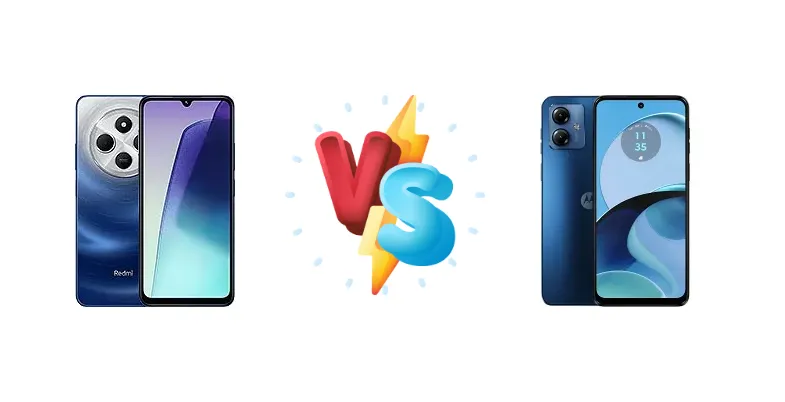
The Xiaomi Redmi 14C and Motorola Moto G14 represent the fiercely competitive sub-$150 smartphone market. Both devices aim to deliver essential features at an accessible price point, but they diverge in chipset choice and charging implementation. This comparison dissects these differences to determine which phone offers the best value for your money.
🏆 Quick Verdict
For the average user prioritizing consistent performance and faster charging, the Xiaomi Redmi 14C is the better choice. While the Moto G14 offers a clean software experience, the Redmi 14C’s Helio G81 provides a slight edge in processing power and benefits from a more consistently available 18W charging solution.
| Network |
|---|
| 2G bands | GSM 850 / 900 / 1800 / 1900 | GSM 850 / 900 / 1800 / 1900 |
| 3G bands | HSDPA 850 / 900 / 2100 | HSDPA 850 / 900 / 1900 / 2100 |
| 4G bands | 1, 3, 5, 7, 8, 20, 28, 38, 40, 41 | 1, 2, 3, 5, 7, 8, 20, 28, 38, 40, 41 |
| Speed | HSPA, LTE | HSPA, LTE |
| Technology | GSM / HSPA / LTE | GSM / HSPA / LTE |
| Launch |
|---|
| Announced | 2024, August 30 | 2023, August 01 |
| Status | Available. Released 2024, August 30 | Available. Released 2023, August 08 |
| Body |
|---|
| Build | Glass front (Gorilla Glass 3), plastic frame, glass back or silicone polymer (eco leather) back | Glass front (Panda glass), plastic frame, plastic back |
| Dimensions | 171.9 x 77.8 x 8.2 mm (6.77 x 3.06 x 0.32 in) | 161.5 x 73.8 x 8 mm (6.36 x 2.91 x 0.31 in) |
| SIM | Nano-SIM + Nano-SIM | Nano-SIM + Nano-SIM |
| Weight | 204 / 207 / 211 g (7.20 oz) | 177 g (6.24 oz) |
| Display |
|---|
| Protection | Corning Gorilla Glass 3 | Panda glass |
| Resolution | 720 x 1640 pixels (~260 ppi density) | 1080 x 2400 pixels, 20:9 ratio (~405 ppi density) |
| Size | 6.88 inches, 112.4 cm2 (~84.0% screen-to-body ratio) | 6.5 inches, 102.0 cm2 (~85.6% screen-to-body ratio) |
| Type | IPS LCD, 120Hz, 450 nits (typ), 600 nits (HBM) | IPS LCD |
| Platform |
|---|
| CPU | Octa-core (2x2.0 GHz Cortex-A75 & 6x1.8 GHz Cortex-A55) | Octa-core (2x2.0 GHz Cortex-A75 & 6x1.8 GHz Cortex-A55) |
| Chipset | Mediatek Helio G81 Ultra (12 nm) | Unisoc Tiger T616 (12 nm) |
| GPU | Mali-G52 MC2 | Mali-G57 MP1 |
| OS | Android 14, HyperOS | Android 13, planned upgrade to Android 14 |
| Memory |
|---|
| Card slot | microSDXC (dedicated slot) | microSDXC (dedicated slot) |
| Internal | 64GB 4GB RAM, 128GB 4GB RAM, 128GB 6GB RAM, 128GB 8GB RAM, 256GB 4GB RAM, 256GB 8GB RAM | 128GB 4GB RAM, 256GB 8GB RAM |
| Main Camera |
|---|
| Dual | 50 MP, f/1.8, 28mm (wide), 1/2.96", PDAF
or
50 MP, f/1.8, 28mm (wide), 1/2.76", 0.64µm, PDAF
Auxiliary lens | 50 MP, f/1.8, (wide), 0.64µm, PDAF
2 MP (macro) |
| Features | LED flash, HDR | LED flash, HDR, panorama |
| Video | 1080p@30fps | 1080p@30fps |
| Selfie camera |
|---|
| Features | HDR | - |
| Single | 13 MP, f/2.0, (wide), 1/3.06" | 8 MP, f/2.0, (wide), 1/4.0", 1.12µm |
| Video | 1080p@30fps | 1080p@30fps |
| Sound |
|---|
| 35mm jack | Yes | Yes |
| Loudspeaker | Yes | Yes, with stereo speakers |
| Comms |
|---|
| Bluetooth | 5.4, A2DP, LE | 5.0, A2DP, LE |
| NFC | Yes (market/region dependent) | Yes (market/region dependent) |
| Positioning | GPS, GLONASS, GALILEO, BDS | GPS, GLONASS, GALILEO |
| Radio | FM radio | FM radio |
| USB | USB Type-C 2.0, OTG | USB Type-C 2.0 |
| WLAN | Wi-Fi 802.11 a/b/g/n/ac, dual-band, Wi-Fi Direct | Wi-Fi 802.11 a/b/g/n/ac, dual-band |
| Features |
|---|
| Sensors | Fingerprint (side-mounted), accelerometer, compass | Fingerprint (side-mounted), accelerometer, gyro, proximity, compass (market/region dependent) |
| Battery |
|---|
| Charging | 18W wired, PD | 15W wired
20W wired (India) |
| Type | 5160 mAh | Li-Po 5000 mAh |
| Misc |
|---|
| Colors | Midnight Black, Sage Green, Dreamy Purple, Starry Blue | Steel Gray, Sky Blue, Butter Cream, Pale Lilac |
| Models | 2411DRN47C, 2409BRN2CA, 2409BRN2CG, 2409BRN2CY | PAYF0010IN |
| Price | € 104.00 / $ 107.72 / £ 139.47 | $ 190.00 / £ 89.99 / € 149.90 |
| SAR EU | 0.99 W/kg (head) 0.90 W/kg (body) | - |
Xiaomi Redmi 14C
- Slightly better GPU performance with the Helio G81.
- More consistent 18W charging with PD support.
- Potentially more responsive multitasking.
- Xiaomi’s MIUI software can be more resource-intensive.
- Camera image processing may be overly saturated for some users.
Motorola Moto G14
- Clean, near-stock Android experience.
- Potentially faster 20W charging (India only).
- Motorola’s software is generally lightweight.
- Unisoc T616 chipset offers slightly lower GPU performance.
- 15W charging is slower than the Redmi 14C’s standard 18W.
Display Comparison
Neither Xiaomi nor Motorola provide display specifications beyond size in the provided data. Assuming typical LCD panels for this price bracket, the display experience will likely be similar. Color accuracy and peak brightness are likely to be modest on both devices. The absence of high refresh rates is expected, focusing on power efficiency.
Camera Comparison
Without detailed camera specifications, a direct comparison is limited. Both phones likely feature a primary camera alongside auxiliary lenses (often 2MP macro or depth sensors). The image processing algorithms will significantly impact the final image quality. Motorola typically favors a more natural look, while Xiaomi often boosts saturation. The absence of Optical Image Stabilization (OIS) is expected in this price range, relying on software stabilization for video recording.
Performance
Both the Redmi 14C and Moto G14 utilize an octa-core CPU configuration with the same core arrangement: 2x2.0 GHz Cortex-A75 and 6x1.8 GHz Cortex-A55. However, the chipset differs – the Redmi 14C employs the Mediatek Helio G81 Ultra (12nm), while the Moto G14 uses the Unisoc Tiger T616 (also 12nm). While the CPU architecture is identical, the Helio G81 generally demonstrates slightly better GPU performance, making it marginally better suited for gaming. The 12nm fabrication process on both chips suggests similar thermal characteristics, though real-world performance will depend on the phone’s cooling solution. The G81’s slight edge in GPU performance will be noticeable in graphically intensive tasks.
Battery Life
Battery capacity isn’t specified, but both phones likely house batteries in the 5000mAh range, typical for this segment. The key difference lies in charging speed. The Redmi 14C supports 18W wired charging with Power Delivery (PD), offering broader compatibility with chargers. The Moto G14 supports 15W charging globally, but a 20W variant is available in India. While 20W is faster, the 18W PD support on the Redmi 14C provides more consistent fast charging across different regions. A full 0-100% charge on the Redmi 14C will likely take around 2-2.5 hours, while the Moto G14 (15W) could take closer to 3 hours.
Buying Guide
Buy the Xiaomi Redmi 14C if you need a phone capable of handling moderate gaming and multitasking with a slightly more responsive experience. Its 18W charging is also more reliable across all regions. Buy the Motorola Moto G14 if you prioritize a clean, near-stock Android experience and potentially faster 20W charging (available in India), and are less concerned with pushing the phone’s processing limits.
Frequently Asked Questions
❓ Will the Unisoc Tiger T616 in the Moto G14 struggle with demanding apps like PUBG Mobile?
While the Unisoc T616 is capable, it’s less powerful than the Helio G81 in the Redmi 14C. PUBG Mobile will likely be playable on medium settings, but you may experience occasional frame drops or stuttering, especially during intense firefights. The Redmi 14C will provide a smoother experience for gaming.
❓ Does the Redmi 14C’s MIUI software come with a lot of bloatware?
Xiaomi’s MIUI is known for including pre-installed apps (bloatware). While the amount has decreased in recent versions, you can expect to find several apps pre-loaded on the Redmi 14C. Fortunately, most can be uninstalled or disabled, freeing up storage space and reducing system resource usage.
❓ Is the 20W charging on the Moto G14 (India) a significant upgrade over the 15W version?
Yes, the 20W charging is a noticeable improvement. It will reduce charging times by approximately 20-30 minutes compared to the 15W version. However, this faster charging is only available in the Indian market.
❓ Which phone is better for someone who primarily uses social media and messaging apps?
Both phones are perfectly adequate for social media and messaging. The Moto G14’s cleaner software might offer a slightly smoother experience due to less background processing, but the difference will be minimal for these everyday tasks.