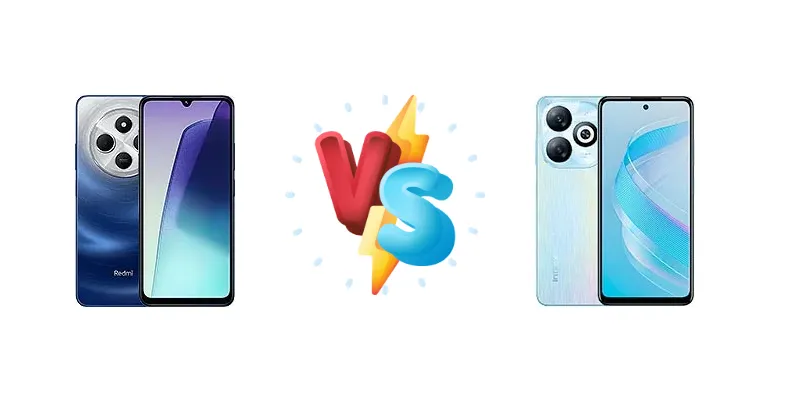
The sub-$150 smartphone market is fiercely competitive. The Xiaomi Redmi 14C and Infinix Smart 8 Pro both aim to deliver essential smartphone functionality at an accessible price point. However, they take different approaches to achieving this, particularly in chipset selection and charging capabilities. This comparison dissects these differences to determine which device offers the best overall experience.
🏆 Quick Verdict
For most users, the Xiaomi Redmi 14C emerges as the stronger choice. Its Mediatek Helio G81 Ultra chipset, featuring more powerful Cortex-A75 cores, provides a noticeable performance advantage over the Smart 8 Pro’s Helio G36. While the Smart 8 Pro offers reverse wired charging, the Redmi 14C’s faster 18W charging and superior CPU performance make it the better all-rounder.
| Network |
|---|
| 2G bands | GSM 850 / 900 / 1800 / 1900 | GSM 850 / 900 / 1800 / 1900 |
| 3G bands | HSDPA 850 / 900 / 2100 | HSDPA 850 / 900 / 1700(AWS) / 1900 / 2100 |
| 4G bands | 1, 3, 5, 7, 8, 20, 28, 38, 40, 41 | 1, 2, 3, 4, 5, 7, 8, 20, 28, 38, 41, 40 |
| Speed | HSPA, LTE | HSPA, LTE |
| Technology | GSM / HSPA / LTE | GSM / HSPA / LTE |
| Launch |
|---|
| Announced | 2024, August 30 | 2024, January 29 |
| Status | Available. Released 2024, August 30 | Available. Released 2024, February |
| Body |
|---|
| Build | Glass front (Gorilla Glass 3), plastic frame, glass back or silicone polymer (eco leather) back | Glass front, plastic back, plastic frame |
| Dimensions | 171.9 x 77.8 x 8.2 mm (6.77 x 3.06 x 0.32 in) | 163.6 x 75.6 x 8.5 mm (6.44 x 2.98 x 0.33 in) |
| SIM | Nano-SIM + Nano-SIM | Nano-SIM + Nano-SIM |
| Weight | 204 / 207 / 211 g (7.20 oz) | 189 g (6.67 oz) |
| Display |
|---|
| Protection | Corning Gorilla Glass 3 | - |
| Resolution | 720 x 1640 pixels (~260 ppi density) | 720 x 1612 pixels, 20:9 ratio (~267 ppi density) |
| Size | 6.88 inches, 112.4 cm2 (~84.0% screen-to-body ratio) | 6.6 inches, 104.6 cm2 (~84.6% screen-to-body ratio) |
| Type | IPS LCD, 120Hz, 450 nits (typ), 600 nits (HBM) | IPS LCD, 90Hz, 500 nits (peak) |
| Platform |
|---|
| CPU | Octa-core (2x2.0 GHz Cortex-A75 & 6x1.8 GHz Cortex-A55) | Octa-core (4x2.2 GHz Cortex-A53 & 4x1.6 GHz Cortex-A53) |
| Chipset | Mediatek Helio G81 Ultra (12 nm) | Mediatek Helio G36 (12 nm) |
| GPU | Mali-G52 MC2 | PowerVR GE8320 |
| OS | Android 14, HyperOS | Android 13 (Go edition), XOS 13 |
| Memory |
|---|
| Card slot | microSDXC (dedicated slot) | microSDXC (dedicated slot) |
| Internal | 64GB 4GB RAM, 128GB 4GB RAM, 128GB 6GB RAM, 128GB 8GB RAM, 256GB 4GB RAM, 256GB 8GB RAM | 64GB 4GB RAM, 128GB 8GB RAM, 256GB 4GB RAM |
| Main Camera |
|---|
| Dual | 50 MP, f/1.8, 28mm (wide), 1/2.96", PDAF
or
50 MP, f/1.8, 28mm (wide), 1/2.76", 0.64µm, PDAF
Auxiliary lens | - |
| Features | LED flash, HDR | Ring-LED flash, HDR, panorama |
| Single | - | 50 MP, f/1.9, (wide), AF
Auxiliary lens |
| Video | 1080p@30fps | 1080p@30fps |
| Selfie camera |
|---|
| Features | HDR | - |
| Single | 13 MP, f/2.0, (wide), 1/3.06" | 8 MP, f/2.0, (wide) |
| Video | 1080p@30fps | Yes |
| Sound |
|---|
| 35mm jack | Yes | Yes |
| Loudspeaker | Yes | Yes |
| Comms |
|---|
| Bluetooth | 5.4, A2DP, LE | 5.0, A2DP, LE |
| NFC | Yes (market/region dependent) | No |
| Positioning | GPS, GLONASS, GALILEO, BDS | GPS |
| Radio | FM radio | FM radio |
| USB | USB Type-C 2.0, OTG | USB Type-C 2.0, OTG |
| WLAN | Wi-Fi 802.11 a/b/g/n/ac, dual-band, Wi-Fi Direct | Wi-Fi 802.11 a/b/g/n/ac, dual-band |
| Features |
|---|
| Sensors | Fingerprint (side-mounted), accelerometer, compass | Fingerprint (side-mounted), accelerometer, gyro, proximity, compass |
| Battery |
|---|
| Charging | 18W wired, PD | 10W wired
Reverse wired |
| Type | 5160 mAh | 5000 mAh |
| Misc |
|---|
| Colors | Midnight Black, Sage Green, Dreamy Purple, Starry Blue | Rainbow Blue, Galaxy White, Shiny Gold, Timber Black |
| Models | 2411DRN47C, 2409BRN2CA, 2409BRN2CG, 2409BRN2CY | X6525B |
| Price | € 104.00 / $ 107.72 / £ 139.47 | About 100 EUR |
| SAR EU | 0.99 W/kg (head) 0.90 W/kg (body) | - |
Xiaomi Redmi 14C
- Faster CPU performance with Helio G81 Ultra
- 18W charging with PD for quicker top-ups
- Likely better software optimization
- May lack reverse wired charging
- Display specs are not publicly available
Infinix Smart 8 Pro
- Reverse wired charging for accessory top-ups
- Potentially lower price point
- Large battery capacity (likely 5000mAh)
- Slower CPU performance with Helio G36
- Slower 10W charging
- Less refined software experience
Display Comparison
Neither Xiaomi nor Infinix provide display specifications beyond resolution in their marketing materials. However, given the price point, both likely utilize IPS LCD panels. The real difference lies in processing power impacting UI smoothness. The Redmi 14C’s more capable chipset will contribute to a more responsive experience when scrolling and navigating the interface, even if the panels themselves are similar in quality.
Camera Comparison
Without detailed camera specifications, it’s difficult to make a definitive judgment. Both phones likely feature a primary camera and multiple auxiliary lenses (often 2MP macro or depth sensors). The image processing capabilities will heavily influence the final image quality. Given Xiaomi’s generally more refined software, the Redmi 14C likely offers slightly better image processing, even with similar hardware. The absence of OIS on either device means low-light performance will be limited.
Performance
The core difference between these two devices is the chipset. The Redmi 14C’s Mediatek Helio G81 Ultra utilizes a dual-cluster CPU configuration with two Cortex-A75 cores clocked at 2.0 GHz, paired with six Cortex-A55 cores at 1.8 GHz. This architecture provides a significant boost in single-core performance compared to the Infinix Smart 8 Pro’s Helio G36. The G36 features four Cortex-A53 cores at 2.2 GHz and another four at 1.6 GHz. While the G36’s higher clock speed on the A53 cores might seem appealing, the older A53 architecture and lack of A75 cores result in lower overall performance, especially in demanding tasks. This translates to slower app loading times and less fluid multitasking on the Smart 8 Pro.
Battery Life
Both devices likely feature batteries in the 5000mAh range, a common capacity for this price segment. However, the charging speeds differ significantly. The Redmi 14C supports 18W wired charging with Power Delivery (PD), allowing for faster top-ups. The Infinix Smart 8 Pro is limited to 10W charging. This means the Redmi 14C will achieve a full charge considerably faster, a crucial advantage for users who rely on their phone throughout the day. The Smart 8 Pro’s inclusion of reverse wired charging is a niche feature, allowing it to act as a power bank for other devices, but it comes at the cost of slower overall charging speeds.
Buying Guide
Buy the Xiaomi Redmi 14C if you prioritize smoother multitasking, slightly better gaming performance, and faster charging. This phone is ideal for users who frequently switch between apps or enjoy casual mobile games. Buy the Infinix Smart 8 Pro if you absolutely need reverse wired charging to top up accessories, and are willing to trade some processing power for that convenience. It’s a good fit for users who primarily use their phone for basic communication and light social media.
Frequently Asked Questions
❓ Will the Helio G36 in the Infinix Smart 8 Pro struggle with popular apps like Facebook and WhatsApp?
While the Helio G36 can handle basic apps like Facebook and WhatsApp, you may experience occasional lag or slowdowns when multitasking or using more demanding features within those apps. The Redmi 14C’s Helio G81 Ultra will provide a smoother experience overall.
❓ How long will it take to fully charge the Redmi 14C with the 18W charger?
With an 18W PD charger (sold separately), the Redmi 14C should fully charge from 0% to 100% in approximately 2-2.5 hours, depending on usage during charging. This is significantly faster than the Infinix Smart 8 Pro’s 10W charging, which will take over 4 hours.
❓ Is the reverse wired charging on the Infinix Smart 8 Pro useful for everyday use?
Reverse wired charging is a niche feature. It's useful for topping up accessories like Bluetooth headphones or smartwatches in emergencies, but it's not a primary reason to choose this phone over the Redmi 14C, especially considering the slower overall charging speed.