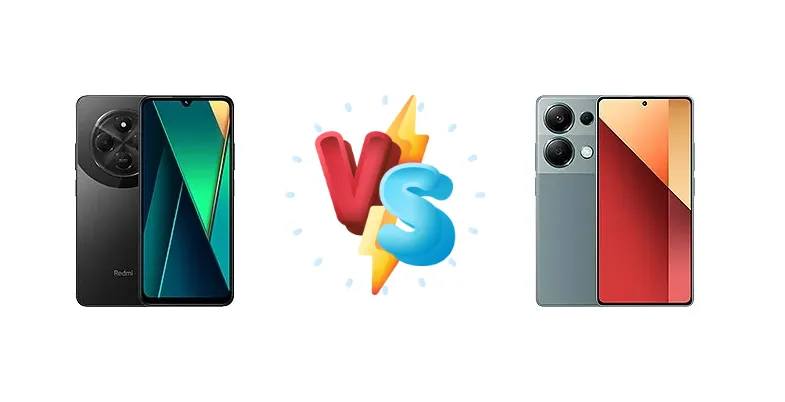
Xiaomi consistently delivers compelling options in the budget and mid-range smartphone space. The Redmi 14C, primarily for the Chinese market, represents a cost-optimized approach, while the Redmi Note 13 Pro 4G aims for a more balanced experience with faster charging and a brighter display. This comparison dissects the key differences to help you determine which device best suits your needs.
🏆 Quick Verdict
For the average user prioritizing a smoother experience and faster charging, the Redmi Note 13 Pro 4G is the clear winner. Its Helio G99 Ultra chipset and 67W charging significantly outperform the Redmi 14C’s Helio G81 Ultra and 18W charging, justifying the price difference.
| Network |
|---|
| 2G bands | GSM 850 / 900 / 1800 / 1900 | GSM 850 / 900 / 1800 / 1900 |
| 3G bands | HSDPA 850 / 900 / 2100 | HSDPA 850 / 900 / 1700(AWS) / 1900 / 2100 |
| 4G bands | 1, 3, 5, 8, 34, 38, 39, 40, 41 | 1, 2, 3, 4, 5, 7, 8, 12, 13, 17, 18, 19, 20, 26, 28, 38, 40, 41, 66 |
| Speed | HSPA, LTE | HSPA, LTE |
| Technology | GSM / HSPA / LTE | GSM / HSPA / LTE |
| Launch |
|---|
| Announced | 2024, December 30 | 2024, January 15 |
| Status | Available. Released 2025, January 29 | Available. Released 2024, January 15 |
| Body |
|---|
| Build | - | Glass front (Gorilla Glass 5), plastic frame, plastic back |
| Dimensions | 171.9 x 77.8 x 8.2 mm (6.77 x 3.06 x 0.32 in) | 161.1 x 75 x 8 mm (6.34 x 2.95 x 0.31 in) |
| SIM | Nano-SIM + Nano-SIM | Nano-SIM + Nano-SIM |
| Weight | 204 g (7.20 oz) | 188 g (6.63 oz) |
| Display |
|---|
| Protection | - | Corning Gorilla Glass 5 |
| Resolution | 720 x 1640 pixels (~260 ppi density) | 1080 x 2400 pixels, 20:9 ratio (~395 ppi density) |
| Size | 6.88 inches, 112.4 cm2 (~84.0% screen-to-body ratio) | 6.67 inches, 107.4 cm2 (~88.9% screen-to-body ratio) |
| Type | IPS LCD, 120Hz, 450 nits (typ), 600 nits (HBM) | AMOLED, 1B colors, 120Hz, 500 nits (typ), 1000 nits (HBM), 1300 nits (peak) |
| Platform |
|---|
| CPU | Octa-core (2x2.0 GHz Cortex-A75 & 6x1.8 GHz Cortex-A55) | Octa-core (2x2.2 GHz Cortex-A76 & 6x2.0 GHz Cortex-A55) |
| Chipset | Mediatek Helio G81 Ultra (12 nm) | Mediatek Helio G99 Ultra |
| GPU | Mali-G52 MC2 | Mali-G57 MC2 |
| OS | Android 14, HyperOS | Android 13, up to 3 major Android upgrades, HyperOS |
| Memory |
|---|
| Card slot | microSDXC (dedicated slot) | microSDXC (uses shared SIM slot) |
| Internal | 64GB 4GB RAM, 128GB 4GB RAM, 128GB 6GB RAM, 256GB 8GB RAM | 128GB 8GB RAM, 256GB 8GB RAM, 256GB 12GB RAM, 512GB 8GB RAM, 512GB 12GB RAM |
| Main Camera |
|---|
| Features | LED flash, HDR | LED flash, HDR, panorama |
| Single | 13 MP, (wide), PDAF
Auxiliary lens | - |
| Triple | - | 200 MP, f/1.7, 23mm (wide), 1/1.4", 0.56µm, multi-directional PDAF, OIS
8 MP, f/2.2, 15mm, 120˚ (ultrawide), 1/4.4", 1.0µm
2 MP (macro) |
| Video | 1080p@30fps | 1080p@30/60fps |
| Selfie camera |
|---|
| Single | 5 MP, (wide) | 16 MP, f/2.4, (wide), 1/3.0", 1.0µm |
| Video | 1080p@30fps | 1080p@30/60fps |
| Sound |
|---|
| 35mm jack | Yes | Yes |
| Loudspeaker | Yes | Yes, with dual speakers |
| Comms |
|---|
| Bluetooth | 5.4, A2DP, LE | 5.2, A2DP, LE |
| Infrared port | - | Yes |
| NFC | No | Yes (market/region dependent) |
| Positioning | GPS, GLONASS, GALILEO, BDS | GPS, GLONASS, GALILEO, BDS |
| Radio | FM radio | FM radio |
| USB | USB Type-C 2.0 | USB Type-C 2.0, OTG |
| WLAN | Wi-Fi 802.11 a/b/g/n/ac, dual-band | Wi-Fi 802.11 a/b/g/n/ac, dual-band |
| Features |
|---|
| Sensors | Fingerprint (side-mounted), accelerometer, compass | Fingerprint (under display, optical), accelerometer, gyro, compass |
| Battery |
|---|
| Charging | 18W wired, PD | 67W wired, 50% in 16 min, 100% in 46 min |
| Type | 5160 mAh | 5000 mAh |
| Misc |
|---|
| Colors | Black, Green, Silver | Midnight Black, Lavender Purple, Forest Green |
| Models | - | 23117RA68G, 2312FPCA6G |
| Price | About 100 EUR | € 92.00 / $ 269.99 / £ 299.99 |
| SAR | - | 1.09 W/kg (head) 1.09 W/kg (body) |
| SAR EU | - | 0.99 W/kg (head) 0.99 W/kg (body) |
Xiaomi Redmi 14C (China)
- Extremely affordable price point
- Decent performance for basic tasks
- Reliable Xiaomi software experience
- Slow charging speed (18W)
- Less powerful chipset compared to the Note 13 Pro 4G
- Likely lower display brightness
Xiaomi Redmi Note 13 Pro 4G
- Significantly faster 67W charging
- More powerful Helio G99 Ultra chipset
- Brighter display (1047 nits)
- Potentially better camera performance
- Higher price compared to the Redmi 14C
- May not be available in all markets
Display Comparison
The Redmi Note 13 Pro 4G boasts a significantly brighter display, reaching a measured 1047 nits. This is crucial for outdoor visibility, a clear advantage over the Redmi 14C, which lacks published brightness data but is expected to be considerably dimmer given its positioning. While both likely utilize LCD panels, the Note 13 Pro 4G’s higher peak brightness translates to a more enjoyable viewing experience in all lighting conditions. Bezels are expected to be slightly slimmer on the Note 13 Pro 4G, contributing to a more modern aesthetic.
Camera Comparison
While both phones likely feature multi-camera setups, the Redmi Note 13 Pro 4G is expected to offer a more refined camera experience. Details on the Note 13 Pro 4G’s camera are limited, but its positioning suggests a larger main sensor and potentially optical image stabilization (OIS). The Redmi 14C’s camera performance will likely be adequate for casual snapshots, but the Note 13 Pro 4G should excel in low-light conditions and offer more detailed images. We anticipate the Note 13 Pro 4G will also offer more versatile video recording options.
Performance
The Redmi Note 13 Pro 4G’s Mediatek Helio G99 Ultra chipset represents a notable upgrade over the Redmi 14C’s Helio G81 Ultra. The G99 Ultra features newer Cortex-A76 cores clocked at 2.2 GHz, compared to the G81 Ultra’s Cortex-A75 cores at 2.0 GHz. This architectural improvement, coupled with the higher clock speed, results in a tangible performance boost in CPU-intensive tasks and gaming. While both phones share 6x Cortex-A55 efficiency cores, the G99 Ultra’s superior CPU and GPU will deliver a smoother, more responsive user experience. The Note 13 Pro 4G is likely to handle demanding games with higher frame rates and fewer stutters.
Battery Life
The Redmi Note 13 Pro 4G shines in the battery and charging department. Its 67W wired charging capability is a game-changer, achieving a 50% charge in just 16 minutes and a full charge in 46 minutes. This is a massive improvement over the Redmi 14C’s 18W charging, which will take significantly longer to replenish the battery. While the Redmi Note 13 Pro 4G achieves an active use score of 11:36h, the faster charging mitigates any potential concerns about battery life, ensuring minimal downtime. The Redmi 14C’s battery capacity is not specified, but its slower charging speed will be a significant inconvenience for power users.
Buying Guide
Buy the Xiaomi Redmi 14C (China) if you need a highly affordable smartphone for basic tasks like calling, messaging, and light social media use, and are comfortable with slower performance and charging. Buy the Xiaomi Redmi Note 13 Pro 4G if you prefer a more responsive device with a brighter, more vibrant display, significantly faster charging, and a more capable chipset for gaming and multitasking.
Frequently Asked Questions
❓ Is the Redmi Note 13 Pro 4G’s 67W charging compatible with Power Delivery (PD) chargers?
While the Redmi 14C supports PD charging at 18W, the Redmi Note 13 Pro 4G utilizes Xiaomi’s proprietary 67W charging protocol for maximum speed. While it may charge at a slower rate with a standard PD charger, it won’t achieve the full 67W potential without a compatible charger.
❓ How does the Helio G99 Ultra in the Redmi Note 13 Pro 4G perform in graphically demanding games like PUBG Mobile?
The Helio G99 Ultra is capable of running PUBG Mobile at high settings with smooth frame rates. While it won’t match the performance of flagship chipsets, it provides a significantly better gaming experience than the Helio G81 Ultra in the Redmi 14C, allowing for more consistent performance and fewer dropped frames.
❓ Does the Redmi 14C support VoLTE and VoWiFi for improved call quality?
Given its market positioning, the Redmi 14C likely supports VoLTE (Voice over LTE) for faster call setup and higher quality voice calls. VoWiFi (Voice over Wi-Fi) support is less certain and may depend on regional carrier compatibility. Check with your carrier to confirm VoWiFi support.
❓ What type of storage does the Redmi Note 13 Pro 4G use, and is it expandable?
The Redmi Note 13 Pro 4G is expected to utilize UFS 2.2 storage for faster app loading and file transfer speeds. It also includes a dedicated microSD card slot for expandable storage, allowing you to increase the internal storage capacity as needed.