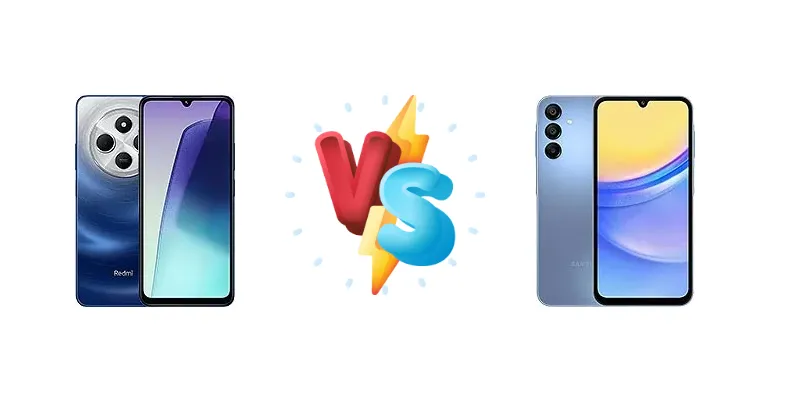
The sub-$200 5G smartphone market is fiercely competitive. Both the Xiaomi Redmi 14C 5G and the Samsung Galaxy A15 5G aim to deliver connectivity and essential features at an accessible price point. However, they take different approaches to achieving this, with Xiaomi prioritizing chipset efficiency and Samsung focusing on display quality and faster charging. This comparison dissects the key differences to determine which phone offers the best value.
🏆 Quick Verdict
For the average user, the Samsung Galaxy A15 5G emerges as the slightly better choice. Its significantly brighter 786-nit display and 25W charging offer a more polished user experience, outweighing the Redmi 14C 5G’s marginally more efficient chipset. However, the Redmi 14C 5G remains a strong contender for those prioritizing raw efficiency.
| Network |
|---|
| 2G bands | GSM 850 / 900 / 1800 / 1900 | GSM 850 / 900 / 1800 / 1900 |
| 3G bands | HSDPA 850 / 900 / 2100 | HSDPA 850 / 900 / 1700(AWS) / 1900 / 2100 |
| 4G bands | 1, 3, 5, 8, 28, 40, 41 | 1, 2, 3, 4, 5, 7, 8, 12, 17, 20, 26, 28, 38, 40, 41, 66 |
| 5G bands | 1, 3, 5, 8, 28, 40, 78 SA/NSA | 1, 3, 5, 7, 8, 26, 28, 40, 41, 66, 77, 78 SA/NSA/Sub6 |
| Speed | HSPA, LTE, 5G | HSPA, LTE, 5G |
| Technology | GSM / HSPA / LTE / 5G | GSM / HSPA / LTE / 5G |
| Launch |
|---|
| Announced | 2025, January 06 | 2023, December 11 |
| Status | Available. Released 2025, January 10 | Available. Released 2023, December 16 |
| Body |
|---|
| Build | Glass front, plastic frame | Glass front, plastic back, plastic frame |
| Dimensions | 171.9 x 77.8 x 8.2 mm (6.77 x 3.06 x 0.32 in) | 160.1 x 76.8 x 8.4 mm (6.30 x 3.02 x 0.33 in) |
| SIM | Nano-SIM + Nano-SIM | · Nano-SIM· Nano-SIM + Nano-SIM |
| Weight | 205 g or 212 g (7.23 oz) | 200 g (7.05 oz) |
| Display |
|---|
| Resolution | 720 x 1640 pixels (~260 ppi density) | 1080 x 2340 pixels, 19.5:9 ratio (~396 ppi density) |
| Size | 6.88 inches, 112.4 cm2 (~84.0% screen-to-body ratio) | 6.5 inches, 103.7 cm2 (~84.3% screen-to-body ratio) |
| Type | IPS LCD, 120Hz, 450 nits (typ), 600 nits (HBM) | Super AMOLED, 90Hz, 800 nits (HBM) |
| Platform |
|---|
| CPU | Octa-core (2x2.2 GHz Cortex-A78 & 6x1.95 GHz Cortex-A55) | Octa-core (2x2.2 GHz Cortex-A76 & 6x2.0 GHz Cortex-A55) |
| Chipset | Qualcomm SM4450 Snapdragon 4 Gen 2 (4 nm) | Mediatek Dimensity 6100+ (6 nm) |
| GPU | Adreno 613 | Mali-G57 MC2 |
| OS | Android 14, up to 2 major Android upgrades, HyperOS | Android 14, upgradable to Android 16, One UI 8, up to 4 major Android upgrades |
| Memory |
|---|
| Card slot | microSDXC (dedicated slot) | microSDXC (uses shared SIM slot) |
| Internal | 64GB 4GB RAM, 128GB 4GB RAM, 128GB 6GB RAM, 256GB 4GB RAM | 64GB 4GB RAM, 128GB 4GB RAM, 128GB 6GB RAM, 128GB 8GB RAM, 256GB 8GB RAM |
| Main Camera |
|---|
| Features | LED flash, HDR | LED flash, panorama, HDR |
| Single | 50 MP, f/1.8, 27mm (wide), PDAF | - |
| Triple | - | 50 MP, f/1.8, (wide), AF
5 MP, f/2.2, (ultrawide)
2 MP (macro) |
| Video | 1080p@30fps | 1080p@30fps, gyro-EIS |
| Selfie camera |
|---|
| Single | 8 MP | 13 MP, f/2.0, (wide) |
| Video | 1080p@30fps | 1080p@30fps |
| Sound |
|---|
| 35mm jack | Yes | Yes |
| Loudspeaker | Yes | Yes |
| Comms |
|---|
| Bluetooth | Yes | 5.3, A2DP, LE |
| NFC | No | Yes (market/region dependent) |
| Positioning | GPS, GLONASS, GALILEO, BDS | GPS, GALILEO, GLONASS, BDS, QZSS |
| Radio | FM radio, recording | No |
| USB | USB Type-C 2.0 | USB Type-C 2.0 |
| WLAN | Wi-Fi 802.11 a/b/g/n/ac, dual-band | Wi-Fi 802.11 a/b/g/n/ac, dual-band, Wi-Fi Direct |
| Features |
|---|
| Sensors | Fingerprint (side-mounted), accelerometer, compass | Fingerprint (side-mounted), accelerometer, gyro, compass |
| Battery |
|---|
| Charging | 18W wired, PD | 25W wired |
| Type | Li-Po 5160 mAh | 5000 mAh |
| Misc |
|---|
| Colors | Stardust Purple, Starlight Blue, Stargaze Black | Brave Black, Personality Yellow, Magical Blue, Optimistic Blue |
| Models | 2411DRN47I | SM-A156B, SM-A156B/DS, SM-A156P, SM-A156P/DS, SM-A156U, SM-A156U1, SM-A156U1/DS, SM-A156W, SM-A156P/N, SM-A156P/DSN, SM-S156VL, SM-A156M, SM-A156E, SM-A156E/DSN |
| Price | ₹ 8,998 | € 167.00 / $ 79.97 / ₹ 17,490 |
| SAR | 0.85 W/kg (head) 0.76 W/kg (body) | - |
| SAR EU | - | 0.80 W/kg (head) 1.46 W/kg (body) |
Xiaomi Redmi 14C 5G
- More efficient 4nm Snapdragon 4 Gen 2 chipset
- Potentially longer battery life due to chipset efficiency
- Competitive price point
- Likely dimmer display compared to the A15 5G
- Slower 18W charging
Samsung Galaxy A15 5G
- Brighter 786-nit display for better outdoor visibility
- Faster 25W wired charging
- Strong multimedia performance from Dimensity 6100+
- 6nm chipset may run slightly warmer under sustained load
- Potentially slightly lower battery life compared to the Redmi 14C 5G
Display Comparison
The Samsung Galaxy A15 5G boasts a substantial advantage in display quality, achieving a measured peak brightness of 786 nits. This is a significant leap over what we’d expect from the Redmi 14C 5G, making the A15 far more usable in direct sunlight. While the Redmi 14C 5G’s panel specifications are not provided, it’s likely to be dimmer. Both phones likely utilize LCD panels given their price point, but Samsung’s superior brightness and potentially better color calibration provide a more immersive viewing experience.
Camera Comparison
Detailed camera specifications are limited, but we can infer some differences. Both phones likely feature a primary camera and depth/macro sensors. Given the market segment, image processing will be a key differentiator. Samsung typically emphasizes vibrant, saturated colors, while Xiaomi often aims for a more natural look. Without detailed sensor size information, it’s difficult to declare a clear winner, but the presence of Optical Image Stabilization (OIS) on either device would be a significant advantage, which is unlikely at this price point. The 2MP macro cameras found on many phones in this class are generally of limited utility.
Performance
Both the Redmi 14C 5G and Galaxy A15 5G employ octa-core CPUs, but their underlying architectures differ. The Redmi 14C 5G utilizes Qualcomm’s Snapdragon 4 Gen 2, featuring two Cortex-A78 cores for performance and six Cortex-A55 cores for efficiency, built on a 4nm process. The Galaxy A15 5G, on the other hand, uses the MediaTek Dimensity 6100+ with two Cortex-A76 cores and six Cortex-A55 cores, fabricated on a 6nm node. While the clock speeds are similar (2.2GHz for the performance cores on both), the 4nm process of the Snapdragon 4 Gen 2 *should* translate to better thermal efficiency and potentially longer sustained performance under load. However, the Dimensity 6100+ is known for its strong multimedia capabilities.
Battery Life
The Samsung Galaxy A15 5G delivers a compelling battery experience with a measured active use score of 14 hours and 31 minutes. While the Redmi 14C 5G’s battery capacity isn’t specified, the Snapdragon 4 Gen 2’s 4nm efficiency could potentially offer comparable endurance. However, the A15 5G’s 25W wired charging is a clear advantage over the Redmi 14C 5G’s 18W charging. This translates to significantly faster top-up times, reducing downtime and improving overall usability.
Buying Guide
Buy the Xiaomi Redmi 14C 5G if you prioritize long-term efficiency and are comfortable with a less vibrant display. Its Qualcomm Snapdragon 4 Gen 2 (4nm) chipset offers excellent power management for extended use. Buy the Samsung Galaxy A15 5G if you value a brighter, more visible screen for outdoor use and faster charging speeds to minimize downtime. The A15 is ideal for media consumption and users who need quick power boosts.
Frequently Asked Questions
❓ Does the MediaTek Dimensity 6100+ in the Galaxy A15 5G tend to overheat during prolonged gaming sessions?
While the Dimensity 6100+ is a capable chip, it's built on a 6nm process, which can generate more heat than the Redmi 14C 5G’s 4nm Snapdragon 4 Gen 2. However, the A15 5G’s larger chassis and Samsung’s thermal management should prevent significant throttling during moderate gaming. Expect some performance reduction after extended play, but it shouldn’t be severe.
❓ Is the 18W charging on the Redmi 14C 5G slow compared to the 25W charging on the Galaxy A15 5G in real-world use?
Yes, the difference is noticeable. 18W charging will take considerably longer to fully charge the Redmi 14C 5G. Expect a 0-100% charge to take around 2.5-3 hours, while the Galaxy A15 5G can achieve a full charge in approximately 1.5-2 hours with 25W charging. This faster charging is a significant convenience factor for many users.
❓ How does the Snapdragon 4 Gen 2's efficiency impact the Redmi 14C 5G's standby battery drain?
The 4nm process of the Snapdragon 4 Gen 2 contributes to excellent standby power efficiency. This means the Redmi 14C 5G should experience minimal battery drain when not actively in use, potentially extending its overall usability for users who don't heavily utilize their phones throughout the day.