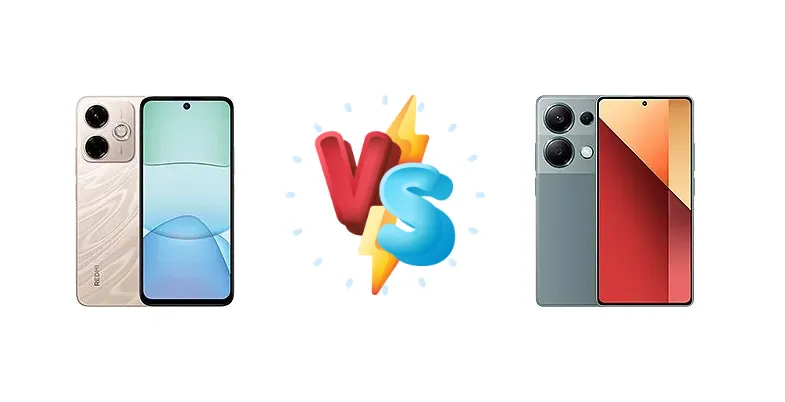
Xiaomi's Redmi series consistently delivers compelling value, but navigating the lineup can be tricky. The Redmi 13x and Note 13 Pro 4G represent two distinct approaches within the brand's mid-range strategy. The 13x focuses on delivering a solid core experience at an aggressive price point, while the Note 13 Pro 4G aims to elevate the experience with a brighter display and significantly faster charging. This comparison will dissect the key differences to help you determine which device best suits your needs.
🏆 Quick Verdict
For the average user prioritizing convenience and a more polished experience, the Xiaomi Redmi Note 13 Pro 4G is the better choice. Its 67W charging dramatically reduces downtime, and the brighter 1047 nit display offers superior visibility. However, the Redmi 13x remains a strong contender for budget-conscious buyers who can live with slower charging.
| Network |
|---|
| 2G bands | GSM 850 / 900 / 1800 / 1900 | GSM 850 / 900 / 1800 / 1900 |
| 3G bands | HSDPA 850 / 900 / 2100 | HSDPA 850 / 900 / 1700(AWS) / 1900 / 2100 |
| 4G bands | LTE | 1, 2, 3, 4, 5, 7, 8, 12, 13, 17, 18, 19, 20, 26, 28, 38, 40, 41, 66 |
| Speed | HSPA, LTE | HSPA, LTE |
| Technology | GSM / HSPA / LTE | GSM / HSPA / LTE |
| Launch |
|---|
| Announced | 2025, March 28 | 2024, January 15 |
| Status | Available. Released 2025, March 28 | Available. Released 2024, January 15 |
| Body |
|---|
| Build | Glass front, plastic frame, glass back | Glass front (Gorilla Glass 5), plastic frame, plastic back |
| Dimensions | 168.6 x 76.3 x 8.3 mm (6.64 x 3.00 x 0.33 in) | 161.1 x 75 x 8 mm (6.34 x 2.95 x 0.31 in) |
| SIM | Nano-SIM + Nano-SIM | Nano-SIM + Nano-SIM |
| Weight | 205 g (7.23 oz) | 188 g (6.63 oz) |
| Display |
|---|
| Protection | Corning Gorilla Glass | Corning Gorilla Glass 5 |
| Resolution | 1080 x 2460 pixels (~396 ppi density) | 1080 x 2400 pixels, 20:9 ratio (~395 ppi density) |
| Size | 6.79 inches, 109.5 cm2 (~85.1% screen-to-body ratio) | 6.67 inches, 107.4 cm2 (~88.9% screen-to-body ratio) |
| Type | IPS LCD, 90Hz, 550 nits (HBM) | AMOLED, 1B colors, 120Hz, 500 nits (typ), 1000 nits (HBM), 1300 nits (peak) |
| Platform |
|---|
| CPU | Octa-core (2x2.0 GHz Cortex-A75 & 6x1.8 GHz Cortex-A55) | Octa-core (2x2.2 GHz Cortex-A76 & 6x2.0 GHz Cortex-A55) |
| Chipset | Mediatek Helio G91 Ultra (12 nm) | Mediatek Helio G99 Ultra |
| GPU | Mali-G52 MC2 | Mali-G57 MC2 |
| OS | Android 14, HyperOS | Android 13, up to 3 major Android upgrades, HyperOS |
| Memory |
|---|
| Card slot | microSDXC (uses shared SIM slot) | microSDXC (uses shared SIM slot) |
| Internal | 128GB 6GB RAM, 128GB 8GB RAM, 256GB 8GB RAM | 128GB 8GB RAM, 256GB 8GB RAM, 256GB 12GB RAM, 512GB 8GB RAM, 512GB 12GB RAM |
| Main Camera |
|---|
| Dual | 108 MP, f/1.8, (wide), 1/1.67", 0.64µm, PDAF
2 MP (macro) | - |
| Features | LED flash, HDR | LED flash, HDR, panorama |
| Triple | - | 200 MP, f/1.7, 23mm (wide), 1/1.4", 0.56µm, multi-directional PDAF, OIS
8 MP, f/2.2, 15mm, 120˚ (ultrawide), 1/4.4", 1.0µm
2 MP (macro) |
| Video | 1080p@30fps | 1080p@30/60fps |
| Selfie camera |
|---|
| Features | HDR | - |
| Single | 13 MP, f/2.5, (wide) | 16 MP, f/2.4, (wide), 1/3.0", 1.0µm |
| Video | 1080p@30fps | 1080p@30/60fps |
| Sound |
|---|
| 35mm jack | Yes | Yes |
| Loudspeaker | Yes | Yes, with dual speakers |
| Comms |
|---|
| Bluetooth | 5.4, A2DP, LE | 5.2, A2DP, LE |
| Infrared port | Yes | Yes |
| NFC | Yes (market/region dependent) | Yes (market/region dependent) |
| Positioning | GPS, GLONASS, GALILEO, BDS | GPS, GLONASS, GALILEO, BDS |
| Radio | FM radio | FM radio |
| USB | USB Type-C | USB Type-C 2.0, OTG |
| WLAN | Wi-Fi 802.11 a/b/g/n/ac, dual-band | Wi-Fi 802.11 a/b/g/n/ac, dual-band |
| Features |
|---|
| Sensors | Fingerprint (side-mounted), accelerometer, compass | Fingerprint (under display, optical), accelerometer, gyro, compass |
| Battery |
|---|
| Charging | 33W wired | 67W wired, 50% in 16 min, 100% in 46 min |
| Type | 5030 mAh | 5000 mAh |
| Misc |
|---|
| Colors | Black, Blue, Gold | Midnight Black, Lavender Purple, Forest Green |
| Models | 24049RN28L | 23117RA68G, 2312FPCA6G |
| Price | About 150 EUR | € 92.00 / $ 269.99 / £ 299.99 |
| SAR | - | 1.09 W/kg (head) 1.09 W/kg (body) |
| SAR EU | - | 0.99 W/kg (head) 0.99 W/kg (body) |
Xiaomi Redmi 13x
- More affordable price point
- Decent performance for everyday tasks
- Reliable MediaTek Helio G91 Ultra chipset
- Slower 33W charging
- Likely dimmer display compared to the Note 13 Pro 4G
Xiaomi Redmi Note 13 Pro 4G
- Significantly faster 67W charging
- Brighter 1047 nit display for better outdoor visibility
- More powerful Helio G99 Ultra processor
- Higher price compared to the Redmi 13x
- May not offer a substantial camera upgrade for casual users
Display Comparison
The Redmi Note 13 Pro 4G boasts a significantly brighter display, reaching a measured peak of 1047 nits. This is a substantial advantage over what we'd expect from the Redmi 13x, making it far more usable outdoors under direct sunlight. While the 13x's display specs aren't provided, it's likely to be considerably dimmer. The Note 13 Pro 4G's higher brightness also translates to a more vivid and engaging viewing experience for videos and games. We can assume both use IPS LCD panels given the price points, but the Note 13 Pro 4G's brightness is the key differentiator.
Camera Comparison
Detailed camera specs beyond 'Photo/Video' are absent for both devices. However, given the Note 13 Pro 4G's positioning, it's reasonable to expect a more sophisticated camera system. Xiaomi typically reserves features like Optical Image Stabilization (OIS) and larger sensor sizes for its 'Pro' models. While the 13x likely offers a capable camera for everyday snapshots, the Note 13 Pro 4G is expected to deliver superior image quality, especially in low-light conditions, and more stable video recording. We can assume the Note 13 Pro 4G will have a more versatile camera setup.
Performance
Both devices utilize MediaTek Helio G-series chipsets, but the Note 13 Pro 4G's Helio G99 Ultra offers a performance edge over the 13x's Helio G91 Ultra. The G99 Ultra features a faster CPU configuration – 2x2.2 GHz Cortex-A76 cores versus the 13x’s 2x2.0 GHz Cortex-A75 cores – resulting in snappier application loading and smoother multitasking. While both are octa-core designs with similar Cortex-A55 efficiency cores, the higher clock speeds and architectural improvements in the G99 Ultra translate to a noticeable performance boost, particularly in demanding applications. The Note 13 Pro 4G will likely exhibit less stuttering during intensive tasks.
Battery Life
The Redmi Note 13 Pro 4G’s 67W wired charging is a game-changer. Xiaomi claims a 50% charge in just 16 minutes and a full charge in 46 minutes. This is a significant improvement over the Redmi 13x’s 33W charging. While the 13x will still provide a full day of use for most users, the Note 13 Pro 4G’s faster charging minimizes downtime and offers greater convenience. The Note 13 Pro 4G’s active use score of 11:36h suggests good battery optimization, and the faster charging mitigates any potential concerns about battery life.
Buying Guide
Buy the Xiaomi Redmi 13x if you need a dependable daily driver with a focus on affordability and aren't heavily reliant on fast charging or a particularly bright screen. Buy the Xiaomi Redmi Note 13 Pro 4G if you prioritize a vibrant display for media consumption, significantly faster charging speeds to minimize downtime, and a generally more refined user experience, even if it comes at a slightly higher cost.
Frequently Asked Questions
❓ Is the Helio G99 Ultra in the Note 13 Pro 4G powerful enough for demanding games like Genshin Impact?
The Helio G99 Ultra is capable of running Genshin Impact, but you'll likely need to lower the graphics settings to medium or low to maintain a stable frame rate. It's not a dedicated gaming chipset, but it provides a noticeable improvement over the G91 Ultra in the Redmi 13x, offering a smoother experience overall.
❓ How much faster is the 67W charging on the Note 13 Pro 4G compared to the 33W charging on the Redmi 13x in real-world use?
The 67W charging on the Note 13 Pro 4G is substantially faster. Xiaomi claims 0-100% in 46 minutes, while the 13x will take considerably longer. This means you can top up your Note 13 Pro 4G quickly during short breaks, whereas the 13x requires a longer charging period.
❓ Does the Redmi Note 13 Pro 4G support video recording at 4K resolution?
While official specifications aren't provided, Xiaomi's Note series typically supports 4K video recording. It's highly probable the Note 13 Pro 4G offers 4K recording capabilities, providing greater flexibility for video content creators. The Redmi 13x is less likely to support 4K recording.