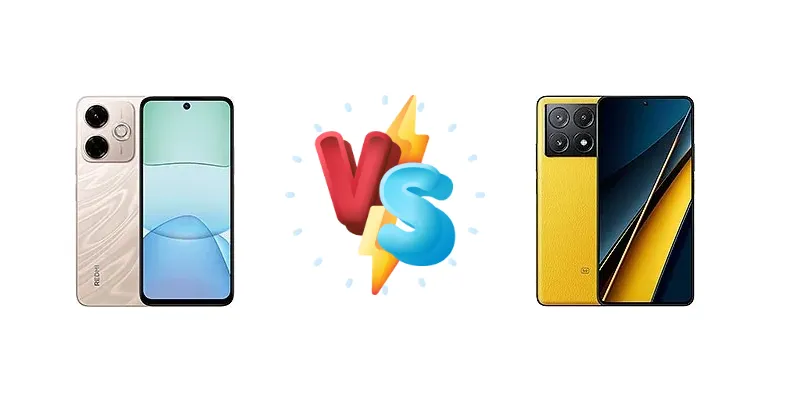
Xiaomi's mid-range offerings are increasingly competitive, but navigating the options can be tricky. The Redmi 13x focuses on providing a solid, efficient experience, while the Poco X6 Pro aims for near-flagship performance at a more accessible price. This comparison dissects the key differences between these two devices, focusing on where each excels and who will benefit most.
🏆 Quick Verdict
For most users, the Poco X6 Pro is the superior choice. Its significantly more powerful Dimensity 8300 Ultra chipset, coupled with 67W fast charging and a brighter display, delivers a noticeably smoother and more responsive experience. The Redmi 13x remains a viable option for budget-conscious users prioritizing efficiency.
| Network |
|---|
| 2G bands | GSM 850 / 900 / 1800 / 1900 | GSM 850 / 900 / 1800 / 1900 |
| 3G bands | HSDPA 850 / 900 / 2100 | HSDPA 850 / 900 / 1700(AWS) / 1900 / 2100 |
| 4G bands | LTE | 1, 2, 3, 4, 5, 7, 8, 18, 19, 20, 28, 38, 40, 41, 48, 66 |
| 5G bands | - | 1, 2, 3, 5, 7, 8, 20, 28, 38, 40, 41, 48, 77, 78 SA/NSA/Sub6 |
| Speed | HSPA, LTE | HSPA, LTE, 5G |
| Technology | GSM / HSPA / LTE | GSM / HSPA / LTE / 5G |
| Launch |
|---|
| Announced | 2025, March 28 | 2024, January 11 |
| Status | Available. Released 2025, March 28 | Available. Released 2024, January 12 |
| Body |
|---|
| Build | Glass front, plastic frame, glass back | Glass front (Gorilla Glass 5), plastic frame, plastic back or silicone polymer back (eco leather) |
| Dimensions | 168.6 x 76.3 x 8.3 mm (6.64 x 3.00 x 0.33 in) | 160.5 x 74.3 x 8.3 mm (6.32 x 2.93 x 0.33 in) |
| SIM | Nano-SIM + Nano-SIM | Nano-SIM + Nano-SIM |
| Weight | 205 g (7.23 oz) | 186 g or 190 g (6.56 oz) |
| Display |
|---|
| Protection | Corning Gorilla Glass | Corning Gorilla Glass 5 |
| Resolution | 1080 x 2460 pixels (~396 ppi density) | 1220 x 2712 pixels, 20:9 ratio (~446 ppi density) |
| Size | 6.79 inches, 109.5 cm2 (~85.1% screen-to-body ratio) | 6.67 inches, 107.4 cm2 (~90.1% screen-to-body ratio) |
| Type | IPS LCD, 90Hz, 550 nits (HBM) | AMOLED, 68B colors, 120Hz, 1920Hz PWM, HDR10+, Dolby Vision, 500 nits (typ), 1200 nits (HBM), 1800 nits (peak) |
| Platform |
|---|
| CPU | Octa-core (2x2.0 GHz Cortex-A75 & 6x1.8 GHz Cortex-A55) | Octa-core (1x3.35 GHz Cortex-A715 & 3x3.20 GHz Cortex-A715 & 4x2.20 GHz Cortex-A510) |
| Chipset | Mediatek Helio G91 Ultra (12 nm) | Mediatek Dimensity 8300 Ultra (4 nm) |
| GPU | Mali-G52 MC2 | Mali G615-MC6 |
| OS | Android 14, HyperOS | Android 14, up to 3 major Android upgrades, HyperOS |
| Memory |
|---|
| Card slot | microSDXC (uses shared SIM slot) | No |
| Internal | 128GB 6GB RAM, 128GB 8GB RAM, 256GB 8GB RAM | 256GB 8GB RAM, 256GB 12GB RAM, 512GB 12GB RAM |
| Main Camera |
|---|
| Dual | 108 MP, f/1.8, (wide), 1/1.67", 0.64µm, PDAF
2 MP (macro) | - |
| Features | LED flash, HDR | LED flash, HDR, panorama |
| Triple | - | 64 MP, f/1.7, 25mm (wide), 1/2.0", 0.7µm, PDAF, OIS
8 MP, f/2.2, 120˚ (ultrawide), 1/4.0", 1.12µm
2 MP (macro) |
| Video | 1080p@30fps | 4K@24/30fps, 1080p@30/60fps, gyro-EIS |
| Selfie camera |
|---|
| Features | HDR | HDR, panorama |
| Single | 13 MP, f/2.5, (wide) | 16 MP, f/2.4, (wide), 1/3.06", 1.0µm |
| Video | 1080p@30fps | 1080p@30/60fps |
| Sound |
|---|
| 35mm jack | Yes | No |
| Loudspeaker | Yes | Yes, with dual speakers |
| Comms |
|---|
| Bluetooth | 5.4, A2DP, LE | 5.4, A2DP, LE, aptX HD |
| Infrared port | Yes | Yes |
| NFC | Yes (market/region dependent) | Yes (market/region dependent) |
| Positioning | GPS, GLONASS, GALILEO, BDS | GPS, GALILEO, GLONASS, QZSS, BDS (B1I+B1c) |
| Radio | FM radio | No |
| USB | USB Type-C | USB Type-C 2.0, OTG |
| WLAN | Wi-Fi 802.11 a/b/g/n/ac, dual-band | Wi-Fi 802.11 a/b/g/n/ac/6, dual-band, Wi-Fi Direct |
| Features |
|---|
| Sensors | Fingerprint (side-mounted), accelerometer, compass | Fingerprint (under display, optical), accelerometer, gyro, compass |
| Battery |
|---|
| Charging | 33W wired | 67W wired, QC2.0, PD3.0, 100% in 45 min |
| Type | 5030 mAh | 5000 mAh |
| Misc |
|---|
| Colors | Black, Blue, Gold | Black, Yellow, Gray |
| Models | 24049RN28L | 2311DRK48G, 2311DRK48I |
| Price | About 150 EUR | € 195.30 / $ 209.79 / £ 274.99 / ₹ 21,999 |
| SAR EU | - | 0.99 W/kg (head) 1.00 W/kg (body) |
Xiaomi Redmi 13x
- Potentially better battery efficiency due to the Helio G91 Ultra.
- More affordable price point.
- Reliable performance for basic tasks.
- Significantly weaker performance compared to the Poco X6 Pro.
- Slower charging speed (33W).
- Likely a less capable camera system.
Xiaomi Poco X6 Pro
- Exceptional performance with the Dimensity 8300 Ultra.
- Fast 67W charging with QC2.0 and PD3.0 support.
- Brighter display for better outdoor visibility.
- Potentially shorter battery life compared to the Redmi 13x.
- Higher price tag.
- May run slightly warmer under sustained load.
Display Comparison
The Poco X6 Pro boasts a significantly brighter display, reaching a measured 1148 nits, compared to an unspecified brightness for the Redmi 13x. This higher peak brightness translates to better visibility outdoors under direct sunlight. While panel technology isn't specified for either, the X6 Pro's brightness suggests a higher-quality panel. Bezels are likely comparable given both phones target similar price brackets, but the X6 Pro's superior brightness is a clear advantage for media consumption and outdoor use.
Camera Comparison
While both phones feature cameras, the context data is limited. We can assume the Poco X6 Pro, positioned as a higher-tier device, likely has a more capable main sensor and image processing pipeline. The Redmi 13x likely focuses on providing adequate image quality for social media sharing. Without specific sensor size or aperture information, it’s difficult to make a definitive judgment, but the X6 Pro’s positioning suggests a more robust camera experience, potentially including features like OIS (Optical Image Stabilization) not found on the 13x.
Performance
The performance gap between these phones is substantial. The Poco X6 Pro’s Mediatek Dimensity 8300 Ultra (4nm) is a powerhouse, featuring an octa-core configuration with a 3.35 GHz Cortex-A715 prime core and three additional Cortex-A715 cores. This contrasts sharply with the Redmi 13x’s Mediatek Helio G91 Ultra (12nm) and its less efficient Cortex-A75 cores. The 4nm process of the Dimensity chip offers superior thermal efficiency, meaning the X6 Pro will sustain peak performance for longer periods without throttling. The X6 Pro’s CPU architecture is also more modern, leading to improved single-core and multi-core performance. This difference will be most noticeable in demanding games and applications.
Battery Life
The Poco X6 Pro’s 67W wired charging is a significant advantage, promising a full charge in just 45 minutes with support for QC2.0 and PD3.0 standards. The Redmi 13x’s 33W charging is considerably slower. While the Redmi 13x’s battery capacity isn’t specified, the X6 Pro’s active use score of 11:46h suggests a well-optimized battery system. The faster charging of the X6 Pro mitigates any potential battery life disadvantage, allowing for quicker top-ups throughout the day.
Buying Guide
Buy the Xiaomi Redmi 13x if you need a dependable daily driver with a focus on battery life and are comfortable with moderate performance for everyday tasks. Buy the Xiaomi Poco X6 Pro if you prioritize gaming, demanding applications, and faster charging speeds, and are willing to trade some potential battery longevity for a substantial performance boost.
Frequently Asked Questions
❓ Will the Poco X6 Pro's Dimensity 8300 Ultra get hot during extended gaming sessions?
The Dimensity 8300 Ultra is built on a 4nm process, which is significantly more efficient than the Redmi 13x's Helio G91 Ultra. While some heat is inevitable during prolonged gaming, the X6 Pro's thermal design and efficient chipset should prevent significant throttling and maintain consistent performance.
❓ Is the 33W charging on the Redmi 13x slow enough to be a major inconvenience?
Compared to the Poco X6 Pro's 67W charging, 33W is considerably slower. A full charge will take significantly longer. However, if you typically charge your phone overnight, the slower charging speed may not be a major issue. It's more of a concern if you frequently need quick top-ups during the day.
❓ How does the Helio G91 Ultra perform in popular games like PUBG Mobile and Call of Duty Mobile?
The Helio G91 Ultra can run PUBG Mobile and Call of Duty Mobile, but you'll likely need to lower graphics settings to achieve a smooth frame rate. Expect some frame drops during intense action sequences. The Poco X6 Pro, with its Dimensity 8300 Ultra, will provide a much smoother and more consistent gaming experience at higher settings.
❓ Does the Poco X6 Pro support high refresh rate gaming?
While not explicitly stated in the provided data, phones with the Dimensity 8300 Ultra typically support high refresh rate gaming. It's highly likely the Poco X6 Pro can run games at 120Hz, providing a smoother and more responsive gaming experience, assuming the game supports it.