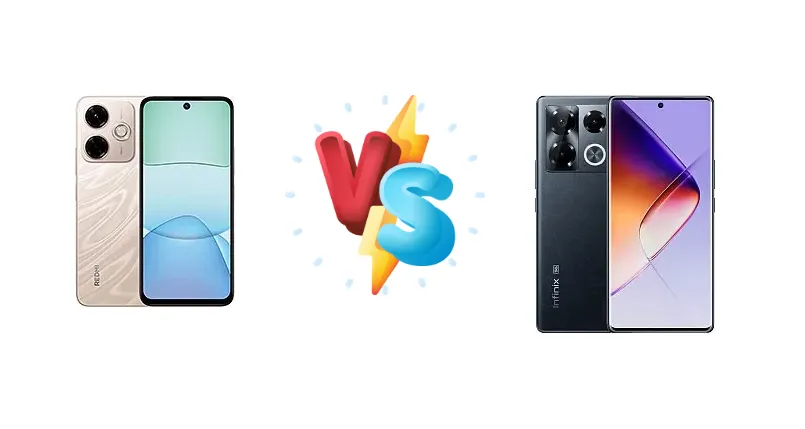
The mid-range smartphone market is fiercely competitive, and the Xiaomi Redmi 13x and Infinix Note 40 Pro+ represent compelling options for budget-conscious buyers. While both aim to deliver a solid experience, they take distinctly different approaches – the Redmi 13x prioritizing affordability, and the Note 40 Pro+ focusing on rapid charging and a brighter display. This comparison dissects their key differences to help you choose the right device.
🏆 Quick Verdict
For the average user prioritizing battery life and charging speed, the Infinix Note 40 Pro+ is the clear winner. Its 100W charging and impressive 12:23h active use battery score significantly outperform the Redmi 13x’s 33W charging. However, the Redmi 13x remains a viable option for those on a tighter budget.
| Network |
|---|
| 2G bands | GSM 850 / 900 / 1800 / 1900 | GSM 850 / 900 / 1800 / 1900 |
| 3G bands | HSDPA 850 / 900 / 2100 | HSDPA 850 / 900 / 1700(AWS) / 1900 / 2100 |
| 4G bands | LTE | 1, 2, 3, 4, 5, 7, 8, 12, 17, 20, 28, 38, 40, 41, 42, 66 |
| 5G bands | - | 1, 3, 5, 7, 8, 12, 20, 28, 38, 40, 41, 66, 77, 78 SA/NSA |
| Speed | HSPA, LTE | HSPA, LTE, 5G |
| Technology | GSM / HSPA / LTE | GSM / HSPA / LTE / 5G |
| Launch |
|---|
| Announced | 2025, March 28 | 2024, March 18 |
| Status | Available. Released 2025, March 28 | Available. Released 2024, March 19 |
| Body |
|---|
| Build | Glass front, plastic frame, glass back | Glass front, plastic frame, silicone polymer (eco leather) back |
| Dimensions | 168.6 x 76.3 x 8.3 mm (6.64 x 3.00 x 0.33 in) | 164.3 x 74.5 x 8.1 mm (6.47 x 2.93 x 0.32 in) |
| SIM | Nano-SIM + Nano-SIM | Nano-SIM + Nano-SIM |
| Weight | 205 g (7.23 oz) | 190 g or 196 g (6.70 oz) |
| Display |
|---|
| Protection | Corning Gorilla Glass | Corning Gorilla Glass |
| Resolution | 1080 x 2460 pixels (~396 ppi density) | 1080 x 2436 pixels (~393 ppi density) |
| Size | 6.79 inches, 109.5 cm2 (~85.1% screen-to-body ratio) | 6.78 inches, 109.9 cm2 (~89.8% screen-to-body ratio) |
| Type | IPS LCD, 90Hz, 550 nits (HBM) | AMOLED, 1B colors, 120Hz, 1300 nits (peak) |
| Platform |
|---|
| CPU | Octa-core (2x2.0 GHz Cortex-A75 & 6x1.8 GHz Cortex-A55) | Octa-core (2x2.2 GHz Cortex-A78 & 6x2.0 GHz Cortex-A55) |
| Chipset | Mediatek Helio G91 Ultra (12 nm) | Mediatek Dimensity 7020 (6 nm) |
| GPU | Mali-G52 MC2 | IMG BXM-8-256 |
| OS | Android 14, HyperOS | Android 14, up to 2 major Android upgrades, XOS 14 |
| Memory |
|---|
| Card slot | microSDXC (uses shared SIM slot) | No |
| Internal | 128GB 6GB RAM, 128GB 8GB RAM, 256GB 8GB RAM | 256GB 12GB RAM, 512GB 12GB RAM |
| Main Camera |
|---|
| Dual | 108 MP, f/1.8, (wide), 1/1.67", 0.64µm, PDAF
2 MP (macro) | - |
| Features | LED flash, HDR | Dual-LED flash, HDR, panorama |
| Triple | - | 108 MP, f/1.8, 24mm (wide), 1/1.67", 0.64µm, PDAF, OIS
2 MP, f/2.4
2 MP, f/2.4 |
| Video | 1080p@30fps | 1440p@30fps, 1080p@30/60fps |
| Selfie camera |
|---|
| Features | HDR | Dual-LED flash |
| Single | 13 MP, f/2.5, (wide) | 32 MP, f/2.2, (wide), 1/3.1", 0.7µm |
| Video | 1080p@30fps | 1440p@30fps, 1080p@30/60fps |
| Sound |
|---|
| 35mm jack | Yes | No |
| Loudspeaker | Yes | Yes, with stereo speakers |
| Comms |
|---|
| Bluetooth | 5.4, A2DP, LE | Yes |
| Infrared port | Yes | Yes |
| NFC | Yes (market/region dependent) | Yes (market/region dependent) |
| Positioning | GPS, GLONASS, GALILEO, BDS | GPS |
| Radio | FM radio | FM radio |
| USB | USB Type-C | USB Type-C 2.0, OTG |
| WLAN | Wi-Fi 802.11 a/b/g/n/ac, dual-band | Wi-Fi 802.11 a/b/g/n/ac, dual-band |
| Features |
|---|
| Sensors | Fingerprint (side-mounted), accelerometer, compass | Fingerprint (under display, optical), accelerometer, gyro, proximity, compass |
| Battery |
|---|
| Charging | 33W wired | 100W wired, 50% in 12 min
20W wireless MagCharge
Reverse wired
Reverse wireless |
| Type | 5030 mAh | 4600 mAh |
| Misc |
|---|
| Colors | Black, Blue, Gold | Obsidian Black, Vintage Green, Racing Edition |
| Models | 24049RN28L | X6851B |
| Price | About 150 EUR | About 290 EUR |
Xiaomi Redmi 13x
- More affordable price point
- Reliable performance for basic tasks
- Potentially longer software support (Xiaomi's track record)
- Significantly slower charging speed
- Less powerful processor
- Likely dimmer display
Infinix Note 40 Pro+
- Ultra-fast 100W charging
- Brighter and more vibrant display
- More powerful and efficient Dimensity 7020 chipset
- Higher price tag
- Potential for more bloatware (Infinix's history)
- Software update frequency may be less consistent
Display Comparison
The Infinix Note 40 Pro+ boasts a significantly brighter display, reaching a measured peak of 1130 nits. This is a substantial advantage over what we’d expect from the Redmi 13x, making the Note 40 Pro+ far more usable outdoors under direct sunlight. While the Redmi 13x’s panel specifications aren’t available, it’s likely to be a standard LCD or lower-tier AMOLED, lacking the brightness and color vibrancy of the Note 40 Pro+. The Note 40 Pro+’s brightness also suggests a more advanced panel technology, potentially with higher PWM dimming rates, benefiting users sensitive to screen flicker.
Camera Comparison
Without detailed camera specifications for the Redmi 13x, a direct comparison is limited. However, the market positioning suggests the Note 40 Pro+ likely features a more sophisticated camera system. The focus should be on the main sensor resolution and aperture. While megapixel count isn’t everything, a larger sensor generally captures more light, resulting in better low-light performance. The Note 40 Pro+’s potential for OIS (Optical Image Stabilization) would also be a significant advantage, reducing blur in photos and videos. We can safely assume the Redmi 13x will include standard camera features, but the Note 40 Pro+ is positioned to offer a more refined photographic experience.
Performance
The core difference lies in the chipsets. The Infinix Note 40 Pro+ utilizes the Mediatek Dimensity 7020, fabricated on a 6nm process. This smaller node allows for greater transistor density and improved power efficiency compared to the Redmi 13x’s Mediatek Helio G91 Ultra (12nm). The Dimensity 7020’s CPU configuration – 2x2.2 GHz Cortex-A78 cores and 6x2.0 GHz Cortex-A55 cores – provides a performance edge over the Redmi 13x’s 2x2.0 GHz Cortex-A75 and 6x1.8 GHz Cortex-A55 setup. The A78 cores in the Dimensity 7020 are architecturally superior, resulting in faster single-core performance. This translates to snappier app launches and smoother multitasking. While both phones feature octa-core CPUs, the Dimensity 7020’s more efficient architecture will likely result in better sustained performance and less thermal throttling during demanding tasks.
Battery Life
The Infinix Note 40 Pro+ truly shines in the battery and charging department. Its active use score of 12:23h demonstrates excellent battery life, likely due to the efficient Dimensity 7020 chipset. However, the real standout feature is the 100W wired charging, capable of reaching 50% charge in just 12 minutes. This is a game-changer for users who frequently need to top up their battery quickly. The Redmi 13x’s 33W charging is considerably slower, requiring significantly more time to reach a full charge. Furthermore, the Note 40 Pro+ adds 20W wireless MagCharge, reverse wired charging, and reverse wireless charging, offering unparalleled versatility. The Redmi 13x lacks these advanced charging options.
Buying Guide
Buy the Xiaomi Redmi 13x if you need a functional, reliable smartphone for everyday tasks and prioritize cost-effectiveness above all else. It’s ideal for users who don’t heavily game or rely on fast charging. Buy the Infinix Note 40 Pro+ if you prefer a brighter display, significantly faster charging speeds (including wireless MagCharge), and a more powerful processor for smoother multitasking and gaming, even if it comes at a slightly higher price.
Frequently Asked Questions
❓ Does the Mediatek Dimensity 7020 in the Infinix Note 40 Pro+ get hot during prolonged gaming sessions?
The Dimensity 7020’s 6nm process and efficient architecture are designed to minimize heat generation. While some warmth is expected during intensive gaming, it’s unlikely to experience significant throttling compared to the Redmi 13x’s Helio G91 Ultra, which is built on a less efficient 12nm node. The Note 40 Pro+’s thermal management system should handle moderate gaming loads effectively.
❓ Is the 20W MagCharge wireless charging on the Infinix Note 40 Pro+ compatible with all magnetic wireless chargers?
The Infinix Note 40 Pro+ utilizes the MagCharge standard, which is based on the MagSafe technology popularized by Apple. While it’s designed to work seamlessly with Infinix’s own MagCharge accessories, compatibility with third-party MagSafe chargers may vary. Some chargers may work flawlessly, while others might offer reduced charging speeds or require adjustments for proper alignment.
❓ How does the Redmi 13x perform with graphically demanding games like Genshin Impact or Call of Duty Mobile?
The Redmi 13x’s Helio G91 Ultra can run these games, but you’ll likely need to lower the graphics settings to medium or low to maintain a stable frame rate. The Dimensity 7020 in the Note 40 Pro+ offers a significantly smoother gaming experience, allowing for higher graphics settings and more consistent performance.