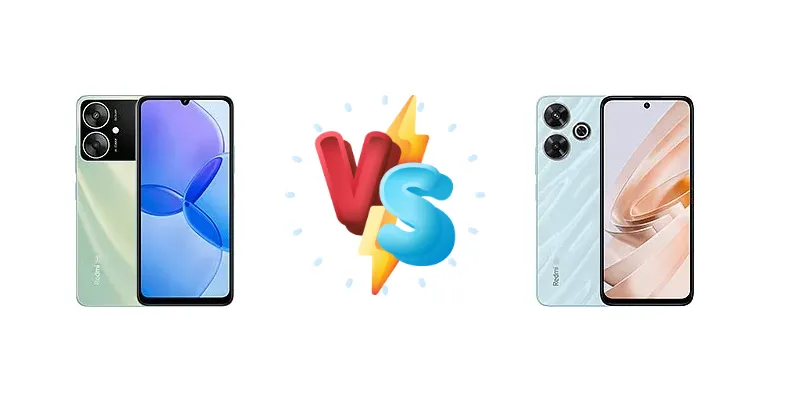
Xiaomi's Redmi series consistently delivers impressive value, but the Redmi 13R and Redmi Note 13R present a compelling internal competition. While both aim for the budget-conscious consumer, they diverge significantly in their core processing power and charging capabilities, making the choice less straightforward than it appears. This comparison dissects these differences to determine which device offers the best experience.
🏆 Quick Verdict
For most users, the Xiaomi Redmi Note 13R emerges as the stronger choice. Its Snapdragon 4+ Gen 2 chipset, built on a more efficient 4nm process, provides a noticeable performance edge and improved thermal management. The faster 33W charging is a significant convenience, offsetting the slightly smaller potential battery capacity.
| Network |
|---|
| 2G bands | GSM 850 / 900 / 1800 / 1900 | GSM 850 / 900 / 1800 / 1900 |
| 3G bands | HSDPA 850 / 900 / 2100 | HSDPA 850 / 900 / 2100 |
| 4G bands | 1, 3, 5, 8, 34, 38, 39, 40, 41 | 1, 3, 5, 8, 34, 38, 39, 40, 41 |
| 5G bands | 1, 3, 5, 8, 28, 41, 78 SA/NSA | 1, 5, 8, 28, 41, 78 SA/NSA |
| Speed | HSPA, LTE, 5G | HSPA, LTE, 5G |
| Technology | GSM / CDMA / HSPA / CDMA2000 / LTE / 5G | GSM / CDMA / HSPA / EVDO / LTE / 5G |
| Launch |
|---|
| Announced | 2023, December 08 | 2024, May 17 |
| Status | Available. Released 2023, December 08 | Available. Released 2024, May 17 |
| Body |
|---|
| Build | - | Glass front, plastic frame, glass back |
| Dimensions | 168.1 x 77.9 x 8.2 mm (6.62 x 3.07 x 0.32 in) | 168.6 x 76.3 x 8.2 mm (6.64 x 3.00 x 0.32 in) |
| SIM | Nano-SIM + Nano-SIM | Nano-SIM + Nano-SIM |
| Weight | 195 g (6.88 oz) | 205 g (7.23 oz) |
| Display |
|---|
| Protection | Corning Gorilla Glass | - |
| Resolution | 720 x 1600 pixels, 20:9 ratio (~260 ppi density) | 1080 x 2460 pixels (~396 ppi density) |
| Size | 6.74 inches, 109.7 cm2 (~83.8% screen-to-body ratio) | 6.79 inches, 109.5 cm2 (~85.1% screen-to-body ratio) |
| Type | IPS LCD, 90Hz, 450 nits (typ), 600 nits (HBM) | IPS LCD, 120Hz, 550 nits |
| Platform |
|---|
| CPU | Octa-core (2x2.2 GHz Cortex-A76 & 6x2.0 GHz Cortex-A55) | Octa-core (2x2.3 GHz Cortex-A78 & 6x1.95 GHz Cortex-A55) |
| Chipset | Mediatek Dimensity 6100+ (6 nm) | Qualcomm SM4450 Snapdragon 4+ Gen 2 (4 nm) |
| GPU | Mali-G57 MC2 | Adreno 613 |
| OS | Android 13, MIUI 14 | Android 14, HyperOS |
| Memory |
|---|
| Card slot | microSDXC (dedicated slot) | No |
| Internal | 128GB 4GB RAM | 128GB 6GB RAM, 128GB 8GB RAM, 256GB 8GB RAM, 256GB 12GB RAM, 512GB 12GB RAM |
| Main Camera |
|---|
| Dual | - | 50 MP, f/1.8, (wide), 1/2.76", 0.64µm, PDAF
2 MP (macro) |
| Features | LED flash, HDR | LED flash, HDR |
| Single | 50 MP, f/1.8, 28mm (wide), PDAF
Auxiliary lens | - |
| Video | 1080p@30fps | 1080p@30fps |
| Selfie camera |
|---|
| Features | HDR | - |
| Single | 5 MP | 8 MP, (wide), 1/4.0", 1.12µm |
| Video | 1080p@30fps | 1080p@30fps |
| Sound |
|---|
| 35mm jack | Yes | Yes |
| Loudspeaker | Yes | Yes |
| Comms |
|---|
| Bluetooth | 5.3, A2DP, LE | 5.3, A2DP, LE |
| Infrared port | - | Yes |
| NFC | No | Yes |
| Positioning | GPS, GLONASS, GALILEO, BDS | GPS, GLONASS, GALILEO, BDS |
| Radio | FM radio | No |
| USB | USB Type-C 2.0 | USB Type-C |
| WLAN | Wi-Fi 802.11 a/b/g/n/ac, dual-band | Wi-Fi 802.11 a/b/g/n/ac, dual-band |
| Features |
|---|
| Sensors | Fingerprint (side-mounted), accelerometer, compass | Fingerprint (side-mounted), accelerometer, compass |
| Battery |
|---|
| Charging | 18W wired, PD | 33W wired |
| Type | 5000 mAh | 5030 mAh |
| Misc |
|---|
| Colors | Black, Green, Purple | Black, Blue, Silver |
| Models | - | 2406ERN9CC |
| Price | About 130 EUR | About 180 EUR |
Xiaomi Redmi 13R
- Potentially longer battery life due to chipset efficiency.
- May be slightly more affordable.
- Reliable MediaTek chipset for basic tasks.
- Slower charging speed (18W).
- Less powerful chipset for demanding applications.
- Likely more thermal throttling under sustained load.
Xiaomi Redmi Note 13R
- Faster 33W charging for quicker top-ups.
- More powerful Snapdragon 4+ Gen 2 chipset.
- Improved power efficiency and thermal management.
- Potentially slightly shorter battery life.
- May be marginally more expensive.
- No significant camera advantages without further specs.
Display Comparison
Neither Xiaomi provides display specs beyond resolution, so a direct comparison is limited. However, given the price points, both likely utilize IPS LCD panels. The absence of high refresh rates is expected. The key differentiator will be color calibration and peak brightness, which will require independent testing. Bezels are likely comparable, reflecting the budget nature of both devices.
Camera Comparison
Without detailed camera sensor information, a precise comparison is difficult. However, Xiaomi typically employs similar camera setups across its budget range. The primary sensor quality will be the most significant factor. We can assume both phones will feature a multi-camera system, but the image processing algorithms and sensor size will dictate the final image quality. The absence of Optical Image Stabilization (OIS) is expected on both models. Focusing on the main sensor's megapixel count and aperture size (when available) will be crucial for assessing camera performance.
Performance
The core battleground is the chipset. The Redmi Note 13R’s Qualcomm Snapdragon 4+ Gen 2 (4nm) boasts a more modern architecture and fabrication process than the Redmi 13R’s MediaTek Dimensity 6100+ (6nm). While the Dimensity 6100+ features Cortex-A76 cores clocked at 2.2 GHz, the Snapdragon 4+ Gen 2 counters with Cortex-A78 cores at 2.3 GHz. The 4nm process of the Snapdragon translates to better power efficiency, meaning less heat generation under load and potentially sustained performance. This benefits gamers and users running demanding applications. The Note 13R is likely to exhibit less throttling during extended use.
Battery Life
The Redmi Note 13R’s 33W wired charging is a clear advantage over the Redmi 13R’s 18W charging. This translates to significantly faster top-up times, a crucial benefit for users who frequently find themselves needing a quick power boost. While battery capacity isn't specified, the Snapdragon 4+ Gen 2’s improved efficiency could offset a potentially smaller battery in the Note 13R, resulting in comparable real-world battery life. Expect the Note 13R to go from 0-100% in under an hour, while the 13R will likely take over 2 hours.
Buying Guide
Buy the Xiaomi Redmi 13R if you prioritize a potentially longer battery life and are comfortable with slightly slower performance for everyday tasks. It's ideal for users who primarily browse, use social media, and make calls. Buy the Xiaomi Redmi Note 13R if you value responsiveness, smoother multitasking, and faster charging, making it a better fit for casual gamers and those who demand a more fluid user experience.
Frequently Asked Questions
❓ Will the Snapdragon 4+ Gen 2 in the Redmi Note 13R handle demanding games like PUBG Mobile?
The Snapdragon 4+ Gen 2 is capable of running PUBG Mobile, but expect to play at medium settings for a smooth experience. The 4nm process helps mitigate throttling, but sustained high frame rates may not be achievable. The Dimensity 6100+ in the Redmi 13R will struggle more with consistent performance in demanding titles.
❓ How much faster is the 33W charging on the Redmi Note 13R compared to the 18W charging on the Redmi 13R?
The 33W charging on the Redmi Note 13R will significantly reduce charging times. Expect a full charge in approximately 60-75 minutes, while the Redmi 13R's 18W charging will likely take over 2 hours. This difference is particularly noticeable for quick top-ups when you're short on time.
❓ Does either phone support NFC for contactless payments?
NFC support is not specified in the provided data. However, given the Redmi series' history, it's likely that the Redmi Note 13R has a higher probability of including NFC, especially in certain regional variants. Check the specific model specifications before purchasing if NFC is a critical feature for you.
❓ Which phone is better for watching videos and streaming content?
Both phones will provide a satisfactory viewing experience for casual video consumption. However, the Snapdragon 4+ Gen 2 in the Redmi Note 13R may offer slightly smoother playback and less buffering, particularly with higher-resolution content. The difference will be subtle, but noticeable for demanding users.