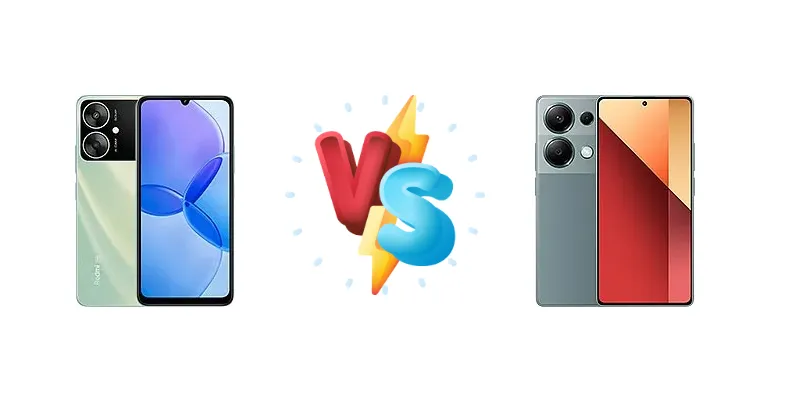
Xiaomi’s Redmi series consistently delivers compelling value, but navigating the lineup can be tricky. The Redmi 13R and Note 13 Pro 4G represent two distinct approaches: the 13R prioritizes recent chipset technology, while the Note 13 Pro 4G focuses on a more refined user experience with faster charging and a brighter display. This comparison dissects the key differences to help you choose the best Redmi for your needs.
🏆 Quick Verdict
For most users, the Xiaomi Redmi Note 13 Pro 4G is the better buy. Its significantly faster 67W charging, coupled with a brighter 1047 nit display and solid battery life (11:36h active use), outweighs the 13R’s slightly newer chipset. The 13R is a viable option for those prioritizing the latest processor on a tight budget.
| Network |
|---|
| 2G bands | GSM 850 / 900 / 1800 / 1900 | GSM 850 / 900 / 1800 / 1900 |
| 3G bands | HSDPA 850 / 900 / 2100 | HSDPA 850 / 900 / 1700(AWS) / 1900 / 2100 |
| 4G bands | 1, 3, 5, 8, 34, 38, 39, 40, 41 | 1, 2, 3, 4, 5, 7, 8, 12, 13, 17, 18, 19, 20, 26, 28, 38, 40, 41, 66 |
| 5G bands | 1, 3, 5, 8, 28, 41, 78 SA/NSA | - |
| Speed | HSPA, LTE, 5G | HSPA, LTE |
| Technology | GSM / CDMA / HSPA / CDMA2000 / LTE / 5G | GSM / HSPA / LTE |
| Launch |
|---|
| Announced | 2023, December 08 | 2024, January 15 |
| Status | Available. Released 2023, December 08 | Available. Released 2024, January 15 |
| Body |
|---|
| Build | - | Glass front (Gorilla Glass 5), plastic frame, plastic back |
| Dimensions | 168.1 x 77.9 x 8.2 mm (6.62 x 3.07 x 0.32 in) | 161.1 x 75 x 8 mm (6.34 x 2.95 x 0.31 in) |
| SIM | Nano-SIM + Nano-SIM | Nano-SIM + Nano-SIM |
| Weight | 195 g (6.88 oz) | 188 g (6.63 oz) |
| Display |
|---|
| Protection | Corning Gorilla Glass | Corning Gorilla Glass 5 |
| Resolution | 720 x 1600 pixels, 20:9 ratio (~260 ppi density) | 1080 x 2400 pixels, 20:9 ratio (~395 ppi density) |
| Size | 6.74 inches, 109.7 cm2 (~83.8% screen-to-body ratio) | 6.67 inches, 107.4 cm2 (~88.9% screen-to-body ratio) |
| Type | IPS LCD, 90Hz, 450 nits (typ), 600 nits (HBM) | AMOLED, 1B colors, 120Hz, 500 nits (typ), 1000 nits (HBM), 1300 nits (peak) |
| Platform |
|---|
| CPU | Octa-core (2x2.2 GHz Cortex-A76 & 6x2.0 GHz Cortex-A55) | Octa-core (2x2.2 GHz Cortex-A76 & 6x2.0 GHz Cortex-A55) |
| Chipset | Mediatek Dimensity 6100+ (6 nm) | Mediatek Helio G99 Ultra |
| GPU | Mali-G57 MC2 | Mali-G57 MC2 |
| OS | Android 13, MIUI 14 | Android 13, up to 3 major Android upgrades, HyperOS |
| Memory |
|---|
| Card slot | microSDXC (dedicated slot) | microSDXC (uses shared SIM slot) |
| Internal | 128GB 4GB RAM | 128GB 8GB RAM, 256GB 8GB RAM, 256GB 12GB RAM, 512GB 8GB RAM, 512GB 12GB RAM |
| Main Camera |
|---|
| Features | LED flash, HDR | LED flash, HDR, panorama |
| Single | 50 MP, f/1.8, 28mm (wide), PDAF
Auxiliary lens | - |
| Triple | - | 200 MP, f/1.7, 23mm (wide), 1/1.4", 0.56µm, multi-directional PDAF, OIS
8 MP, f/2.2, 15mm, 120˚ (ultrawide), 1/4.4", 1.0µm
2 MP (macro) |
| Video | 1080p@30fps | 1080p@30/60fps |
| Selfie camera |
|---|
| Features | HDR | - |
| Single | 5 MP | 16 MP, f/2.4, (wide), 1/3.0", 1.0µm |
| Video | 1080p@30fps | 1080p@30/60fps |
| Sound |
|---|
| 35mm jack | Yes | Yes |
| Loudspeaker | Yes | Yes, with dual speakers |
| Comms |
|---|
| Bluetooth | 5.3, A2DP, LE | 5.2, A2DP, LE |
| Infrared port | - | Yes |
| NFC | No | Yes (market/region dependent) |
| Positioning | GPS, GLONASS, GALILEO, BDS | GPS, GLONASS, GALILEO, BDS |
| Radio | FM radio | FM radio |
| USB | USB Type-C 2.0 | USB Type-C 2.0, OTG |
| WLAN | Wi-Fi 802.11 a/b/g/n/ac, dual-band | Wi-Fi 802.11 a/b/g/n/ac, dual-band |
| Features |
|---|
| Sensors | Fingerprint (side-mounted), accelerometer, compass | Fingerprint (under display, optical), accelerometer, gyro, compass |
| Battery |
|---|
| Charging | 18W wired, PD | 67W wired, 50% in 16 min, 100% in 46 min |
| Type | 5000 mAh | 5000 mAh |
| Misc |
|---|
| Colors | Black, Green, Purple | Midnight Black, Lavender Purple, Forest Green |
| Models | - | 23117RA68G, 2312FPCA6G |
| Price | About 130 EUR | € 92.00 / $ 269.99 / £ 299.99 |
| SAR | - | 1.09 W/kg (head) 1.09 W/kg (body) |
| SAR EU | - | 0.99 W/kg (head) 0.99 W/kg (body) |
Xiaomi Redmi 13R
- More modern 6nm Dimensity 6100+ chipset
- Potentially better thermal management
- Slightly more future-proof processor
- Significantly slower 18W charging
- Likely dimmer display
- Less refined overall experience
Xiaomi Redmi Note 13 Pro 4G
- 67W fast charging (50% in 16 min)
- Brighter 1047 nit display
- Excellent 11:36h active use battery life
- Older Helio G99 Ultra chipset
- Potentially less efficient manufacturing process
- May not feel as 'new' as the 13R
Display Comparison
The Redmi Note 13 Pro 4G boasts a substantial advantage in display quality, achieving a measured peak brightness of 1047 nits. This is crucial for outdoor legibility, a common pain point for budget phones. While the Redmi 13R’s display specifications are not provided, it’s reasonable to assume it falls significantly short of this brightness level. The Note 13 Pro 4G’s panel likely offers a more vibrant and comfortable viewing experience, especially in direct sunlight. We expect the Note 13 Pro 4G to have a higher contrast ratio as well.
Camera Comparison
Detailed camera specifications are limited, but the Note 13 Pro 4G is expected to have a more sophisticated camera system. While both phones likely feature a primary camera, the Note 13 Pro 4G’s sensor size and lens aperture are likely larger, resulting in better low-light performance and dynamic range. The inclusion of Optical Image Stabilization (OIS) on the Note 13 Pro 4G (a common feature in this price range) would further enhance image quality, particularly in videos. We advise ignoring the presence of 2MP macro cameras on either device, as their image quality is typically underwhelming.
Performance
Both the Redmi 13R and Note 13 Pro 4G utilize an octa-core CPU configuration with 2x2.2 GHz Cortex-A76 cores and 6x2.0 GHz Cortex-A55 cores. However, the chipset differs: the 13R features the Mediatek Dimensity 6100+ (6nm), while the Note 13 Pro 4G uses the Helio G99 Ultra. The Dimensity 6100+ benefits from a more modern 6nm manufacturing process, potentially offering slightly better power efficiency and thermal management. However, the G99 Ultra is a well-established performer, and the real-world performance difference will likely be minimal for everyday tasks. Gaming performance will be similar, but the 6nm process of the Dimensity 6100+ may allow for slightly sustained performance under heavy load.
Battery Life
The Redmi Note 13 Pro 4G shines in the battery department. Its active use score of 11 hours and 36 minutes demonstrates excellent endurance. Crucially, it supports 67W wired charging, achieving a 50% charge in just 16 minutes and a full charge in 46 minutes. The Redmi 13R, with its 18W charging, is significantly slower. While the 13R’s battery capacity isn’t specified, the Note 13 Pro 4G’s faster charging effectively mitigates any potential capacity disadvantage, offering a more convenient and less disruptive charging experience.
Buying Guide
Buy the Xiaomi Redmi 13R if you need a phone with a more modern processor for future-proofing and are willing to sacrifice charging speed and display brightness. Buy the Xiaomi Redmi Note 13 Pro 4G if you prefer a smoother, more convenient experience with significantly faster charging, a brighter screen for outdoor visibility, and proven battery endurance.
Frequently Asked Questions
❓ Does the Helio G99 Ultra in the Note 13 Pro 4G throttle under sustained gaming loads?
The Helio G99 Ultra is a capable chipset, but it's not a flagship performer. While it can handle most mobile games at medium to high settings, prolonged gaming sessions may result in some thermal throttling. However, the Note 13 Pro 4G’s thermal design is likely adequate to mitigate this to a reasonable extent.
❓ Is the 18W charging on the Redmi 13R slow enough to be a major inconvenience?
Yes, 18W charging is considerably slower than the 67W charging on the Note 13 Pro 4G. Expect a full charge to take well over two hours, which can be frustrating for users accustomed to faster charging speeds. This is a significant trade-off for the 13R.
❓ How does the 6nm process of the Dimensity 6100+ impact real-world battery life on the Redmi 13R?
The 6nm process generally leads to improved power efficiency compared to older manufacturing nodes. This *could* translate to slightly longer battery life on the Redmi 13R, but the difference will likely be marginal and overshadowed by the Note 13 Pro 4G’s larger battery and optimized power management.