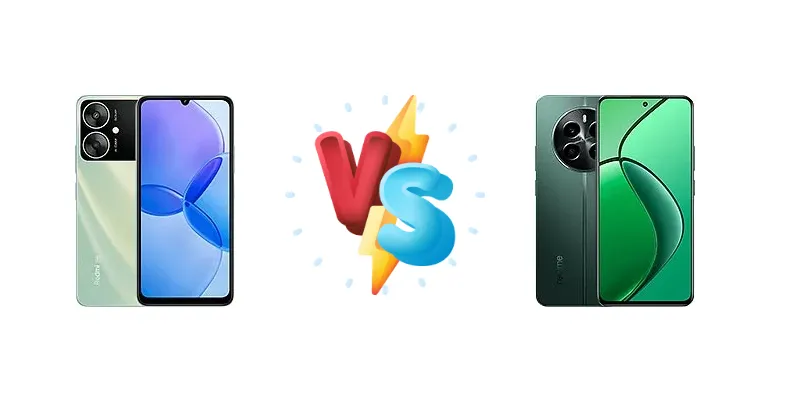
The sub-$200 smartphone market is fiercely competitive. The Xiaomi Redmi 13R and Realme 12 4G both aim to deliver a compelling experience without breaking the bank, but they take different approaches. The Redmi 13R leverages MediaTek’s Dimensity 6100+ for processing power, while the Realme 12 4G opts for Qualcomm’s Snapdragon 685. This comparison dissects their key differences to help you choose the right device.
🏆 Quick Verdict
For most users, the Realme 12 4G emerges as the better choice. Its significantly faster 67W charging – capable of reaching 50% in just 19 minutes – provides a tangible usability advantage over the Redmi 13R’s 18W charging. While the Redmi 13R’s chipset offers a slight edge in raw CPU performance, the Realme’s charging speed and overall refinement make it the more practical option.
| Network |
|---|
| 2G bands | GSM 850 / 900 / 1800 / 1900 | GSM 850 / 900 / 1800 / 1900 |
| 3G bands | HSDPA 850 / 900 / 2100 | HSDPA 850 / 900 / 2100 |
| 4G bands | 1, 3, 5, 8, 34, 38, 39, 40, 41 | 1, 3, 5, 7, 8, 20, 28, 38, 40, 41 |
| 5G bands | 1, 3, 5, 8, 28, 41, 78 SA/NSA | - |
| Speed | HSPA, LTE, 5G | HSPA, LTE |
| Technology | GSM / CDMA / HSPA / CDMA2000 / LTE / 5G | GSM / HSPA / LTE |
| Launch |
|---|
| Announced | 2023, December 08 | 2024, June 26 |
| Status | Available. Released 2023, December 08 | Available. Released 2024, July 01 |
| Body |
|---|
| Dimensions | 168.1 x 77.9 x 8.2 mm (6.62 x 3.07 x 0.32 in) | 163 x 75.5 x 7.9 mm (6.42 x 2.97 x 0.31 in) |
| SIM | Nano-SIM + Nano-SIM | Nano-SIM + Nano-SIM |
| Weight | 195 g (6.88 oz) | 187 g (6.60 oz) |
| Display |
|---|
| Protection | Corning Gorilla Glass | - |
| Resolution | 720 x 1600 pixels, 20:9 ratio (~260 ppi density) | 1080 x 2400 pixels, 20:9 ratio (~395 ppi density) |
| Size | 6.74 inches, 109.7 cm2 (~83.8% screen-to-body ratio) | 6.67 inches, 107.4 cm2 (~87.3% screen-to-body ratio) |
| Type | IPS LCD, 90Hz, 450 nits (typ), 600 nits (HBM) | AMOLED, 120Hz, 600 nits (typ), 2000 nits (peak) |
| Platform |
|---|
| CPU | Octa-core (2x2.2 GHz Cortex-A76 & 6x2.0 GHz Cortex-A55) | Octa-core (4x2.8 GHz Cortex-A73 & 4x1.9 GHz Cortex-A53) |
| Chipset | Mediatek Dimensity 6100+ (6 nm) | Qualcomm SM6225 Snapdragon 685 (6 nm) |
| GPU | Mali-G57 MC2 | Adreno 610 |
| OS | Android 13, MIUI 14 | Android 14, Realme UI 5.0 |
| Memory |
|---|
| Card slot | microSDXC (dedicated slot) | microSDXC (uses shared SIM slot) |
| Internal | 128GB 4GB RAM | 128GB 8GB RAM, 256GB 8GB RAM, 512GB 8GB RAM |
| Main Camera |
|---|
| Dual | - | 50 MP, f/1.9, 26mm (wide), 1/1.95", PDAF, OIS
Auxiliary lens |
| Features | LED flash, HDR | LED flash, HDR, panorama |
| Single | 50 MP, f/1.8, 28mm (wide), PDAF
Auxiliary lens | - |
| Video | 1080p@30fps | 1080p@30fps, gyro-EIS |
| Selfie camera |
|---|
| Features | HDR | - |
| Single | 5 MP | 16 MP, f/2.5, (wide) |
| Video | 1080p@30fps | 1080p@30fps |
| Sound |
|---|
| 35mm jack | Yes | Yes |
| Loudspeaker | Yes | Yes, with dual speakers |
| Comms |
|---|
| Bluetooth | 5.3, A2DP, LE | 5.0, A2DP, LE |
| NFC | No | Yes, 360˚ |
| Positioning | GPS, GLONASS, GALILEO, BDS | GPS, GALILEO, GLONASS, QZSS, BDS |
| Radio | FM radio | Unspecified |
| USB | USB Type-C 2.0 | USB Type-C 2.0 |
| WLAN | Wi-Fi 802.11 a/b/g/n/ac, dual-band | Wi-Fi 802.11 a/b/g/n/ac, dual-band |
| Features |
|---|
| Sensors | Fingerprint (side-mounted), accelerometer, compass | Fingerprint (under display, optical), accelerometer, gyro, proximity, compass |
| Battery |
|---|
| Charging | 18W wired, PD | 67W wired, 50% in 19 min |
| Type | 5000 mAh | 5000 mAh |
| Misc |
|---|
| Colors | Black, Green, Purple | Skyline Silver, Pioneer Green |
| Models | - | RMX3871 |
| Price | About 130 EUR | About 180 EUR |
Xiaomi Redmi 13R
- Potentially stronger CPU performance for multi-tasking
- More efficient chipset could lead to better thermal management
- Likely a more natural image processing style
- Significantly slower 18W charging
- Older display technology compared to potential Realme options
- Less refined software experience (typically)
Realme 12 4G
- Ultra-fast 67W charging (50% in 19 minutes)
- Potentially more refined software experience
- Higher clock speeds for bursty workloads
- Older CPU architecture (Cortex-A73)
- May rely heavily on software processing for camera quality
- Potentially less efficient chipset
Display Comparison
Neither device boasts a standout display. Both are likely utilizing LCD panels, a common cost-saving measure in this segment. While specific details like peak brightness and color gamut coverage are unavailable, the Realme 12 4G’s potential for a slightly higher peak brightness (based on Realme’s typical display calibration) could offer marginally better outdoor visibility. Bezels are expected to be comparable, and color accuracy will likely be standard for the price point.
Camera Comparison
Without detailed camera specs, a direct comparison is difficult. However, both phones likely feature a primary camera sensor in the 50MP range. The Realme 12 4G, based on Realme’s marketing, may prioritize software-based image enhancements and potentially offer more refined portrait modes. The Redmi 13R might lean towards a more natural image processing style. The presence of low-resolution auxiliary cameras (often 2MP) on both devices is largely for marketing purposes and offers minimal practical benefit.
Performance
The core difference lies in the chipsets. The Redmi 13R’s MediaTek Dimensity 6100+ (6nm) features a more modern CPU architecture – Cortex-A76 cores – compared to the Realme 12 4G’s Snapdragon 685 (6nm) which uses older Cortex-A73 cores. This translates to a theoretical advantage in single-core performance for the Redmi 13R. However, the Snapdragon 685’s higher clock speeds (2.8 GHz vs 2.2 GHz) on its primary cores might offer a competitive edge in bursty workloads. Both devices likely feature similar RAM configurations, but the Redmi 13R’s more efficient chipset could lead to slightly better thermal management under sustained load.
Battery Life
The Realme 12 4G’s 67W charging is a game-changer. Reaching 50% charge in 19 minutes is a significant advantage over the Redmi 13R’s 18W charging, which will likely take well over an hour to achieve the same. While battery capacity isn’t specified, the faster charging speed effectively mitigates any potential capacity difference. The Redmi 13R’s Dimensity 6100+’s efficiency could contribute to slightly longer battery life during moderate usage, but the convenience of the Realme’s rapid charging is a more impactful benefit for most users.
Buying Guide
Buy the Xiaomi Redmi 13R if you prioritize sustained CPU performance for tasks like light video editing or running multiple apps simultaneously, and are willing to sacrifice charging speed. Buy the Realme 12 4G if you value rapid charging, a more polished user experience, and don't heavily rely on demanding, prolonged CPU-intensive tasks. The Realme is ideal for everyday users and those who frequently find themselves needing a quick power boost.
Frequently Asked Questions
❓ Will the Snapdragon 685 in the Realme 12 4G struggle with demanding games like PUBG Mobile?
The Snapdragon 685 is capable of running PUBG Mobile, but you’ll likely need to stick to medium graphics settings and moderate frame rates for a smooth experience. The Dimensity 6100+ in the Redmi 13R might offer slightly better performance in gaming, but neither phone is a dedicated gaming device.
❓ Is the 18W charging on the Redmi 13R slow enough to be a dealbreaker?
For many users, yes. 18W charging is significantly slower than the 67W charging on the Realme 12 4G. Expect a full charge to take well over two hours, which can be inconvenient if you frequently need to top up your battery quickly.
❓ Does the Realme 12 4G support VoLTE/VoWiFi on all carriers?
Carrier compatibility can vary. It's crucial to check with your specific carrier to ensure the Realme 12 4G supports VoLTE and VoWiFi in your region before purchasing. This ensures you can make and receive calls over 4G/Wi-Fi networks.
❓ How does the software experience differ between Xiaomi's MIUI and Realme UI?
MIUI (Xiaomi) is known for its extensive customization options but can also be perceived as bloated with pre-installed apps. Realme UI is generally considered cleaner and more streamlined, offering a closer-to-stock Android experience with a focus on speed and efficiency.