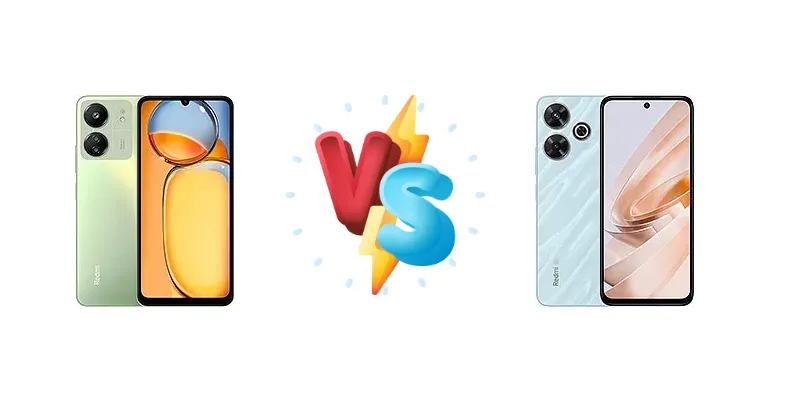
Xiaomi's Redmi series consistently delivers value, but navigating the options can be tricky. The Redmi 13C and Redmi Note 13R represent two distinct approaches to the budget segment: the 13C focuses on affordability, while the 13R introduces a newer chipset and faster charging. This comparison dissects their key differences to determine which phone best suits your needs.
🏆 Quick Verdict
For most users, the Xiaomi Redmi Note 13R is the superior choice. Its Snapdragon 4+ Gen 2 chipset, built on a 4nm process, provides a noticeable performance uplift and improved efficiency compared to the Redmi 13C’s Helio G85. The faster 33W charging is also a significant advantage, making it the better all-rounder.
| Network |
|---|
| 2G bands | GSM 850 / 900 / 1800 / 1900 | GSM 850 / 900 / 1800 / 1900 |
| 3G bands | HSDPA 850 / 900 / 2100 | HSDPA 850 / 900 / 2100 |
| 4G bands | 1, 3, 5, 7, 8, 20, 28, 38, 40, 41 | 1, 3, 5, 8, 34, 38, 39, 40, 41 |
| 5G bands | - | 1, 5, 8, 28, 41, 78 SA/NSA |
| Speed | HSPA, LTE | HSPA, LTE, 5G |
| Technology | GSM / HSPA / LTE | GSM / CDMA / HSPA / EVDO / LTE / 5G |
| Launch |
|---|
| Announced | 2023, November 10 | 2024, May 17 |
| Status | Available. Released 2023, November 10 | Available. Released 2024, May 17 |
| Body |
|---|
| Build | - | Glass front, plastic frame, glass back |
| Dimensions | 168 x 78 x 8.1 mm (6.61 x 3.07 x 0.32 in) | 168.6 x 76.3 x 8.2 mm (6.64 x 3.00 x 0.32 in) |
| SIM | Nano-SIM + Nano-SIM | Nano-SIM + Nano-SIM |
| Weight | 192 g (6.77 oz) | 205 g (7.23 oz) |
| Display |
|---|
| Protection | Corning Gorilla Glass | - |
| Resolution | 720 x 1600 pixels, 20:9 ratio (~260 ppi density) | 1080 x 2460 pixels (~396 ppi density) |
| Size | 6.74 inches, 109.7 cm2 (~83.7% screen-to-body ratio) | 6.79 inches, 109.5 cm2 (~85.1% screen-to-body ratio) |
| Type | IPS LCD, 90Hz, 450 nits (typ), 600 nits (HBM) | IPS LCD, 120Hz, 550 nits |
| Platform |
|---|
| CPU | Octa-core (2x2.0 GHz Cortex-A75 & 6x1.8 GHz Cortex-A55) | Octa-core (2x2.3 GHz Cortex-A78 & 6x1.95 GHz Cortex-A55) |
| Chipset | Mediatek MT6769Z Helio G85 (12 nm) | Qualcomm SM4450 Snapdragon 4+ Gen 2 (4 nm) |
| GPU | Mali-G52 MC2 | Adreno 613 |
| OS | Android 13, MIUI 14 | Android 14, HyperOS |
| Memory |
|---|
| Card slot | microSDXC (dedicated slot) | No |
| Internal | 128GB 4GB RAM, 128GB 6GB RAM, 128GB 8GB RAM, 256GB 4GB RAM, 256GB 8GB RAM | 128GB 6GB RAM, 128GB 8GB RAM, 256GB 8GB RAM, 256GB 12GB RAM, 512GB 12GB RAM |
| Main Camera |
|---|
| Dual | 50 MP, f/1.8, 28mm (wide), PDAF
2 MP (macro)
Auxiliary lens | 50 MP, f/1.8, (wide), 1/2.76", 0.64µm, PDAF
2 MP (macro) |
| Features | LED flash, HDR | LED flash, HDR |
| Video | 1080p@30fps | 1080p@30fps |
| Selfie camera |
|---|
| Features | HDR | - |
| Single | 8 MP, f/2.0 | 8 MP, (wide), 1/4.0", 1.12µm |
| Video | 1080p@30fps | 1080p@30fps |
| Sound |
|---|
| 35mm jack | Yes | Yes |
| Loudspeaker | Yes | Yes |
| Comms |
|---|
| Bluetooth | 5.3, A2DP, LE | 5.3, A2DP, LE |
| Infrared port | - | Yes |
| NFC | Yes (market/region dependent) | Yes |
| Positioning | GPS, GLONASS, GALILEO, BDS | GPS, GLONASS, GALILEO, BDS |
| Radio | FM radio | No |
| USB | USB Type-C 2.0 | USB Type-C |
| WLAN | Wi-Fi 802.11 a/b/g/n/ac, dual-band | Wi-Fi 802.11 a/b/g/n/ac, dual-band |
| Features |
|---|
| Sensors | Fingerprint (side-mounted), accelerometer, compass | Fingerprint (side-mounted), accelerometer, compass |
| Battery |
|---|
| Charging | 18W wired, PD | 33W wired |
| Type | Li-Po 5000 mAh | 5030 mAh |
| Misc |
|---|
| Colors | Midnight Black, Navy Blue, Glacier White, Clover Green | Black, Blue, Silver |
| Models | 23100RN82L, 23106RN0DA, 23108RN04Y, 2311DRN14I | 2406ERN9CC |
| Price | € 99.00 / $ 129.99 / £ 93.29 | About 180 EUR |
| SAR EU | 0.98 W/kg (head) 0.99 W/kg (body) | - |
Xiaomi Redmi 13C
- Most affordable option
- Decent performance for basic tasks
- Reliable Xiaomi software experience
- Older, less efficient chipset
- Slower charging speed
- Potentially lower camera quality
Xiaomi Redmi Note 13R
- More powerful Snapdragon 4+ Gen 2 chipset
- Faster 33W charging
- Improved power efficiency
- Higher price point
- May not offer significant camera improvements over the 13C
- Still a budget device with inherent limitations
Display Comparison
Both devices likely feature LCD panels, typical for this price bracket. However, detailed display specs (resolution, brightness, color gamut) are missing. The Redmi 13C’s value proposition suggests a more basic display, while the Note 13R might offer slightly better color accuracy or peak brightness due to its positioning as a more premium option. Bezels are likely comparable, focusing on maximizing screen real estate within the budget constraints.
Camera Comparison
Without detailed camera specs, it’s difficult to make a definitive judgment. However, the Redmi Note 13R, being the higher-tier device, likely benefits from a more capable main sensor and potentially better image processing algorithms. The Helio G85’s ISP (Image Signal Processor) is less advanced than the Snapdragon’s, potentially resulting in less detailed photos and poorer low-light performance on the 13C. It's reasonable to assume both phones include standard features like HDR, but the Note 13R is expected to deliver more consistent results.
Performance
The core difference lies in the chipsets. The Redmi Note 13R’s Qualcomm Snapdragon 4+ Gen 2 (4nm) is a significant upgrade over the Redmi 13C’s MediaTek Helio G85 (12nm). The 4nm process translates to better power efficiency and reduced thermal throttling, meaning sustained performance during demanding tasks. The Snapdragon’s CPU, with 2x2.3 GHz Cortex-A78 cores, also outperforms the Helio G85’s 2x2.0 GHz Cortex-A75 cores in single-core and multi-core benchmarks. This will be most noticeable in app loading times and smoother multitasking. While both phones likely feature similar RAM configurations, the Snapdragon’s superior architecture will maximize its effectiveness.
Battery Life
The Redmi 13C features 18W wired charging, while the Redmi Note 13R steps up to 33W. This difference is substantial. While battery capacity isn’t specified, the faster charging on the Note 13R will significantly reduce charging times, offering a more convenient user experience. A full charge on the 13C will likely take well over two hours, while the Note 13R could achieve a full charge in under an hour. The Snapdragon 4+ Gen 2’s improved efficiency also contributes to potentially better battery life on the Note 13R, despite potentially having a similar capacity battery.
Buying Guide
Buy the Xiaomi Redmi 13C if you prioritize absolute affordability and are primarily focused on basic smartphone tasks like calling, texting, and light social media use. Buy the Xiaomi Redmi Note 13R if you want a smoother, more responsive experience for gaming, multitasking, and appreciate the convenience of faster charging, even if it means spending a bit more.
Frequently Asked Questions
❓ Will the Snapdragon 4+ Gen 2 in the Redmi Note 13R handle demanding games like PUBG Mobile?
The Snapdragon 4+ Gen 2 is a capable chipset for casual gaming. PUBG Mobile should be playable at medium settings with reasonable frame rates. However, don't expect flagship-level performance; you may need to lower graphics settings for a smoother experience.
❓ Is the 18W charging on the Redmi 13C slow compared to other phones?
Yes, 18W charging is relatively slow by today's standards. Expect a full charge to take over two hours. This is a trade-off for the lower price point, but the Redmi Note 13R’s 33W charging offers a significantly faster experience.
❓ Does the Redmi Note 13R support any form of fast charging protocols beyond standard PD?
While the context data only specifies PD, Xiaomi often includes proprietary fast charging protocols alongside PD. Checking official specifications or user reviews will confirm if the Redmi Note 13R supports additional fast charging standards for even faster charging with compatible chargers.
❓ How much of a real-world performance difference will I notice between the Helio G85 and Snapdragon 4+ Gen 2?
The difference will be most noticeable in app loading times, multitasking, and demanding applications. The Snapdragon 4+ Gen 2’s more efficient architecture and faster cores will result in a smoother, more responsive experience overall. Basic tasks like calling and texting will feel similar on both devices.