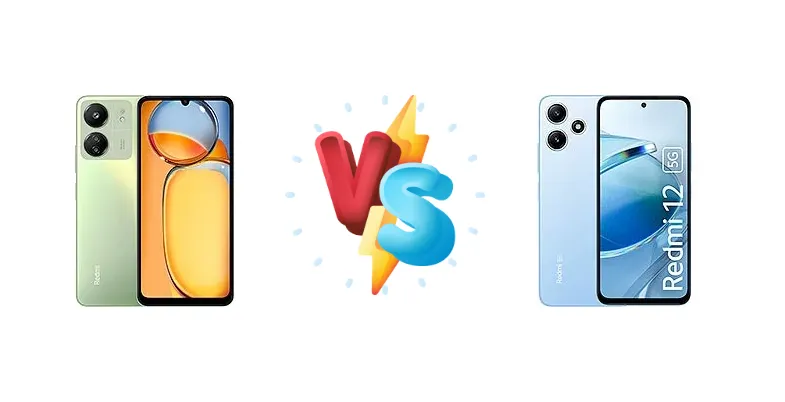
Xiaomi's Redmi series consistently delivers value, but choosing between the Redmi 13C and the Redmi 12 5G requires a closer look. The 13C focuses on incremental improvements to the core experience, while the 12 5G introduces 5G connectivity and a more modern chipset. This comparison dissects the key differences to determine which phone offers the best bang for your buck.
🏆 Quick Verdict
For the average user prioritizing future-proofing and efficiency, the Xiaomi Redmi 12 5G is the better choice. Its Snapdragon 4 Gen 2, built on a 4nm process, offers superior power efficiency and a slight performance edge over the Redmi 13C’s Helio G85, despite the latter’s higher clock speeds.
| Network |
|---|
| 2G bands | GSM 850 / 900 / 1800 / 1900 | GSM 850 / 900 / 1800 / 1900 |
| 3G bands | HSDPA 850 / 900 / 2100 | HSDPA 850 / 900 / 2100 |
| 4G bands | 1, 3, 5, 7, 8, 20, 28, 38, 40, 41 | 1, 3, 5, 8, 40, 41 |
| 5G bands | - | 1, 3, 5, 8, 28, 40, 78 SA/NSA |
| Speed | HSPA, LTE | HSPA, LTE, 5G |
| Technology | GSM / HSPA / LTE | GSM / HSPA / LTE / 5G |
| Launch |
|---|
| Announced | 2023, November 10 | 2023, August 01 |
| Status | Available. Released 2023, November 10 | Available. Released 2023, August 04 |
| Body |
|---|
| Build | - | Glass front (Gorilla Glass), plastic frame, glass back (Gorilla Glass) |
| Dimensions | 168 x 78 x 8.1 mm (6.61 x 3.07 x 0.32 in) | 168.6 x 76.3 x 8.2 mm (6.64 x 3.00 x 0.32 in) |
| SIM | Nano-SIM + Nano-SIM | Nano-SIM + Nano-SIM |
| Weight | 192 g (6.77 oz) | 199 g (7.02 oz) |
| Display |
|---|
| Protection | Corning Gorilla Glass | Corning Gorilla Glass |
| Resolution | 720 x 1600 pixels, 20:9 ratio (~260 ppi density) | 1080 x 2460 pixels (~396 ppi density) |
| Size | 6.74 inches, 109.7 cm2 (~83.7% screen-to-body ratio) | 6.79 inches, 109.5 cm2 (~85.1% screen-to-body ratio) |
| Type | IPS LCD, 90Hz, 450 nits (typ), 600 nits (HBM) | IPS LCD, 90Hz, 550 nits |
| Platform |
|---|
| CPU | Octa-core (2x2.0 GHz Cortex-A75 & 6x1.8 GHz Cortex-A55) | Octa-core (2x2.2 GHz Cortex-A78 & 6x1.95 GHz Cortex-A55) |
| Chipset | Mediatek MT6769Z Helio G85 (12 nm) | Qualcomm SM4450 Snapdragon 4 Gen 2 (4 nm) |
| GPU | Mali-G52 MC2 | Adreno 613 |
| OS | Android 13, MIUI 14 | Android 13, upgradable to Android 15, HyperOS 2 |
| Memory |
|---|
| Card slot | microSDXC (dedicated slot) | microSDXC (uses shared SIM slot) |
| Internal | 128GB 4GB RAM, 128GB 6GB RAM, 128GB 8GB RAM, 256GB 4GB RAM, 256GB 8GB RAM | 128GB 4GB RAM, 128GB 6GB RAM, 128GB 8GB RAM, 256GB 8GB RAM |
| Main Camera |
|---|
| Dual | 50 MP, f/1.8, 28mm (wide), PDAF
2 MP (macro)
Auxiliary lens | 50 MP, f/1.8, (wide), PDAF
Auxiliary lens |
| Features | LED flash, HDR | LED flash, HDR |
| Video | 1080p@30fps | 1080p@30fps |
| Selfie camera |
|---|
| Features | HDR | HDR |
| Single | 8 MP, f/2.0 | 8 MP, f/2.0, (wide), 1.12µm |
| Video | 1080p@30fps | 1080p@30fps |
| Sound |
|---|
| 35mm jack | Yes | Yes |
| Loudspeaker | Yes | Yes |
| Comms |
|---|
| Bluetooth | 5.3, A2DP, LE | 5.3, A2DP, LE |
| Infrared port | - | Yes |
| NFC | Yes (market/region dependent) | Unspecified |
| Positioning | GPS, GLONASS, GALILEO, BDS | GPS, GLONASS, GALILEO, BDS |
| Radio | FM radio | No |
| USB | USB Type-C 2.0 | USB Type-C |
| WLAN | Wi-Fi 802.11 a/b/g/n/ac, dual-band | Wi-Fi 802.11 a/b/g/n/ac, dual-band |
| Features |
|---|
| Sensors | Fingerprint (side-mounted), accelerometer, compass | Fingerprint (side-mounted), accelerometer, compass |
| Battery |
|---|
| Charging | 18W wired, PD | 18W wired, PD |
| Type | Li-Po 5000 mAh | Li-Po 5000 mAh |
| Misc |
|---|
| Colors | Midnight Black, Navy Blue, Glacier White, Clover Green | Jade Black, Pastel Blue, Moonstone Silver |
| Models | 23100RN82L, 23106RN0DA, 23108RN04Y, 2311DRN14I | 23076RN4BI, 23076RN8DY, 2AFZZRN8DY |
| Price | € 99.00 / $ 129.99 / £ 93.29 | € 104.09 / ₹ 15,999 |
| SAR | - | 1.09 W/kg (head) 0.88 W/kg (body) |
| SAR EU | 0.98 W/kg (head) 0.99 W/kg (body) | 0.98 W/kg (head) 1.00 W/kg (body) |
Xiaomi Redmi 13C
- Potentially slightly higher CPU clock speeds for basic tasks.
- May be more readily available in certain markets.
- Competitive pricing for the features offered.
- Less power-efficient chipset (12nm vs 4nm).
- Likely shorter software support lifespan.
- No 5G connectivity.
Xiaomi Redmi 12 5G
- More efficient Snapdragon 4 Gen 2 (4nm) chipset.
- 5G connectivity for faster data speeds.
- Potentially longer software support.
- Better sustained performance due to thermal efficiency.
- Slightly lower CPU clock speeds compared to the 13C.
- May be slightly more expensive than the 13C.
Display Comparison
Both devices likely feature similar LCD panels, typical for this price bracket. However, detailed display specs (resolution, brightness, color gamut) are missing. The focus here isn't on display quality, but on the underlying processing power to drive it. The 12 5G’s more efficient chipset could translate to slightly better battery life when viewing content.
Camera Comparison
Without detailed camera specs beyond the presence of sensors, a direct comparison is difficult. Both phones likely feature a primary camera and depth/macro sensors. The image signal processor (ISP) within the Snapdragon 4 Gen 2 is likely more advanced, potentially leading to better image processing, especially in low-light conditions. However, the actual image quality will depend heavily on the primary sensor used in each device, which is currently unknown.
Performance
The core difference lies in the chipsets. The Redmi 13C’s MediaTek Helio G85 (12nm) utilizes a 2x2.0 GHz Cortex-A75 and 6x1.8 GHz Cortex-A55 configuration. The Redmi 12 5G, however, boasts the Qualcomm Snapdragon 4 Gen 2 (4nm) with a 2x2.2 GHz Cortex-A78 and 6x1.95 GHz Cortex-A55 setup. While the 13C has higher clocked A75 cores, the Snapdragon 4 Gen 2’s newer architecture and significantly smaller 4nm fabrication process provide a substantial advantage in power efficiency and sustained performance. This means less throttling during extended gaming sessions and better overall responsiveness. The Snapdragon’s Cortex-A78 cores are also more efficient than the A75 cores in the Helio G85.
Battery Life
Both phones feature 18W wired charging with PD support. The actual battery capacity is not specified, but the Snapdragon 4 Gen 2’s superior power efficiency in the Redmi 12 5G will likely result in longer real-world battery life, even if the 13C has a slightly larger battery. The 4nm process allows the 12 5G to accomplish more per watt, translating to more hours of usage between charges.
Buying Guide
Buy the Xiaomi Redmi 13C if you need a slightly more powerful CPU for basic multitasking and light gaming, and 5G connectivity isn't a priority. It's a solid option for users on a very tight budget. Buy the Xiaomi Redmi 12 5G if you prioritize 5G access, longer battery life thanks to the more efficient chipset, and a phone that will likely receive software updates for a longer period.
Frequently Asked Questions
❓ Will the Redmi 12 5G's Snapdragon 4 Gen 2 handle demanding games like PUBG Mobile?
While not a gaming powerhouse, the Snapdragon 4 Gen 2 in the Redmi 12 5G is capable of running PUBG Mobile at medium settings with reasonable frame rates. The 4nm process helps mitigate throttling, allowing for more sustained gameplay compared to the Redmi 13C’s Helio G85.
❓ How much faster is 5G on the Redmi 12 5G compared to 4G on the Redmi 13C?
5G speeds on the Redmi 12 5G can be significantly faster than 4G on the Redmi 13C, potentially offering download speeds several times higher, depending on network availability and coverage. This translates to quicker app downloads, smoother streaming, and faster web browsing.
❓ Does the Redmi 13C get noticeably hotter than the Redmi 12 5G during prolonged use?
Yes, the Redmi 13C is likely to get hotter during extended use due to the less efficient 12nm Helio G85 chipset. The Snapdragon 4 Gen 2 in the Redmi 12 5G’s 4nm process generates less heat, resulting in better thermal management and reduced throttling.