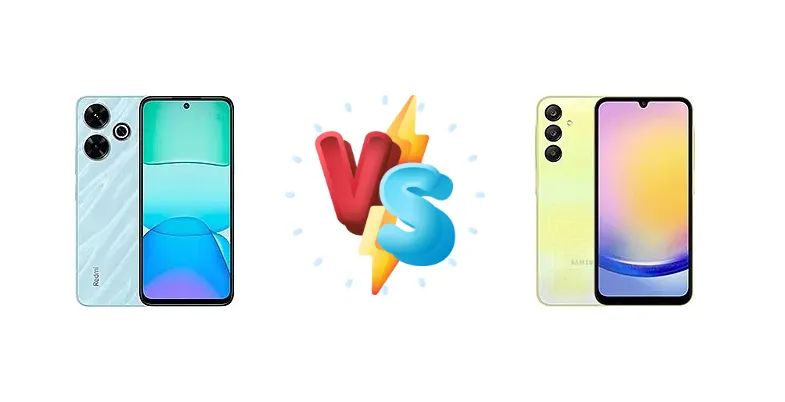
The Xiaomi Redmi 13 and Samsung Galaxy A25 represent compelling options in the increasingly competitive sub-$200 smartphone market. The Redmi 13 focuses on maximizing battery life and offering a solid all-around experience, while the Galaxy A25 prioritizes display brightness and a more modern chipset. This comparison dives deep into the specifics to determine which device delivers the best value.
🏆 Quick Verdict
For the average user prioritizing a vibrant display and future-proofing, the Samsung Galaxy A25 is the better choice. Its Exynos 1280 chipset and significantly brighter screen offer a smoother experience and better visibility outdoors. However, the Redmi 13’s exceptional battery life makes it ideal for heavy users who prioritize longevity.
| Network |
|---|
| 2G bands | GSM 850 / 900 / 1800 / 1900 | GSM 850 / 900 / 1800 / 1900 |
| 3G bands | HSDPA 850 / 900 / 2100 | HSDPA 850 / 900 / 1700(AWS) / 1900 / 2100 |
| 4G bands | 1, 3, 5, 7, 8, 20, 28, 38, 40, 41 | 1, 2, 3, 4, 5, 7, 8, 12, 13, 17, 20, 26, 28, 38, 40, 41, 66 |
| 5G bands | - | 1, 3, 5, 7, 8, 26, 28, 40, 41, 66, 77, 78 SA/NSA/Sub6 |
| Speed | HSPA, LTE | HSPA, LTE, 5G |
| Technology | GSM / HSPA / LTE | GSM / HSPA / LTE / 5G |
| Launch |
|---|
| Announced | 2024, June 03 | 2023, December 11 |
| Status | Available. Released 2024, June 03 | Available. Released 2023, December 16 |
| Body |
|---|
| Build | Glass front, plastic frame, glass back | Glass front, plastic frame, plastic back |
| Dimensions | 168.6 x 76.3 x 8.3 mm (6.64 x 3.00 x 0.33 in) | 161 x 76.5 x 8.3 mm (6.34 x 3.01 x 0.33 in) |
| SIM | Nano-SIM + Nano-SIM | · Nano-SIM· Nano-SIM + Nano-SIM |
| Weight | 205 g (7.23 oz) | 197 g (6.95 oz) |
| Display |
|---|
| Protection | Corning Gorilla Glass | - |
| Resolution | 1080 x 2460 pixels (~396 ppi density) | 1080 x 2340 pixels, 19.5:9 ratio (~396 ppi density) |
| Size | 6.79 inches, 109.5 cm2 (~85.1% screen-to-body ratio) | 6.5 inches, 103.7 cm2 (~84.2% screen-to-body ratio) |
| Type | IPS LCD, 90Hz, 550 nits (HBM) | Super AMOLED, 120Hz, 1000 nits (HBM) |
| Platform |
|---|
| CPU | Octa-core (2x2.0 GHz Cortex-A75 & 6x1.8 GHz Cortex-A55) | Octa-core (2x2.4 GHz Cortex-A78 & 6x2.0 GHz Cortex-A55) |
| Chipset | Mediatek Helio G91 Ultra (12 nm) | Exynos 1280 (5 nm) |
| GPU | Mali-G52 MC2 | Mali-G68 |
| OS | Android 14, HyperOS | Android 14, up to 4 major Android upgrades, One UI 7 |
| Memory |
|---|
| Card slot | microSDXC (uses shared SIM slot) | microSDXC (uses shared SIM slot) |
| Internal | 128GB 6GB RAM, 128GB 8GB RAM, 256GB 6GB RAM, 256GB 8GB RAM | 128GB 4GB RAM, 128GB 6GB RAM, 128GB 8GB RAM, 256GB 6GB RAM, 256GB 8GB RAM |
| Main Camera |
|---|
| Dual | 108 MP, f/1.8, (wide), 1/1.67", 0.64µm, PDAF
2 MP (macro) | - |
| Features | LED flash, HDR | LED flash, panorama, HDR |
| Triple | - | 50 MP, f/1.8, 27mm (wide), 1/2.76", 0.64µm, PDAF, OIS
8 MP, f/2.2, 120˚ (ultrawide), 1/4", 1.12µm
2 MP (macro) |
| Video | 1080p@30fps | 4K@30fps, 1080p@30/60fps, gyro-EIS |
| Selfie camera |
|---|
| Features | HDR | - |
| Single | 13 MP, f/2.5, (wide) | 13 MP, f/2.2, (wide), 1/3.06", 1.12µm |
| Video | 1080p@30fps | 1080p@30fps |
| Sound |
|---|
| 35mm jack | Yes | Yes |
| Loudspeaker | Yes | Yes, with stereo speakers |
| Comms |
|---|
| Bluetooth | 5.4, A2DP, LE | 5.3, A2DP, LE |
| Infrared port | Yes | - |
| NFC | Yes (market/region dependent) | Yes (market/region dependent) |
| Positioning | GPS, GLONASS, GALILEO, BDS | GPS, GLONASS, GALILEO, BDS, QZSS |
| Radio | FM radio | Market/region dependent |
| USB | USB Type-C | USB Type-C 2.0 |
| WLAN | Wi-Fi 802.11 a/b/g/n/ac, dual-band | Wi-Fi 802.11 a/b/g/n/ac, dual-band, Wi-Fi Direct |
| Features |
|---|
| Sensors | Fingerprint (side-mounted), accelerometer, compass | Fingerprint (side-mounted), accelerometer, gyro, compass |
| Battery |
|---|
| Charging | 33W wired | 25W wired |
| Type | 5030 mAh | 5000 mAh |
| Misc |
|---|
| Colors | Midnight Black, Sandy Gold, Ocean Blue, Pink | Brave Black, Personality Yellow, Fantasy Blue, Optimistic Blue |
| Models | 2404ARN45A, 24040RN64Y | SM-A256E, SM-A256E/DS, SM-A256E/DSN, SM-A256B, SM-A256B/DS, SM-A256B/DSN, SM-A256U, SM-A256U1 |
| Price | $ 119.79 / £ 126.47 / € 114.99 | € 175.99 / $ 120.32 / ₹ 18,399 |
| SAR EU | 0.99 W/kg (head) 0.98 W/kg (body) | 0.46 W/kg (head) 1.19 W/kg (body) |
Xiaomi Redmi 13
- Exceptional battery life (10:28h active use)
- Faster 33W charging
- More affordable price point (likely)
- Dimmer display (448 nits)
- Less powerful chipset (Helio G91 Ultra)
Samsung Galaxy A25
- Brighter display (1030 nits)
- More efficient chipset (Exynos 1280)
- Potentially better camera image processing
- Slightly shorter battery life (10:19h active use)
- Slower 25W charging
Display Comparison
The Samsung Galaxy A25 immediately pulls ahead in display technology, boasting a peak brightness of 1030 nits compared to the Redmi 13’s 448 nits. This difference is substantial, making the A25 far more usable in direct sunlight. While both devices likely utilize LCD panels (given the price point), the A25’s higher brightness translates to a more vivid and engaging viewing experience. The Redmi 13’s 1300:1 contrast ratio is respectable, but the brightness deficit is a significant drawback for outdoor use. We expect both to have 60Hz refresh rates, a common omission in this segment.
Camera Comparison
Context data is limited regarding camera performance. However, given Samsung’s image processing expertise, the Galaxy A25 is likely to deliver more consistently pleasing photos, particularly in challenging lighting conditions. While sensor size and aperture are unknown, Samsung typically optimizes its software to extract the most detail and dynamic range from its sensors. The Redmi 13’s camera is likely competent for basic photography, but may struggle with low-light performance and dynamic range. The presence of a 2MP macro camera on either device is largely irrelevant; image quality from these sensors is typically poor.
Performance
The chipset is where the A25 demonstrates a clear advantage. The Exynos 1280, fabricated on a 5nm process, offers superior efficiency and performance compared to the Redmi 13’s 12nm Mediatek Helio G91 Ultra. The A25’s CPU features 2x2.4 GHz Cortex-A78 cores, a step up from the Redmi 13’s 2x2.0 GHz Cortex-A75 cores. This translates to faster app loading times, smoother multitasking, and improved gaming performance. While both phones feature octa-core CPUs, the architectural improvements and smaller process node of the Exynos 1280 provide a tangible benefit. The A25 is likely to handle demanding applications and games with greater ease and less thermal throttling.
Battery Life
Despite having a slightly smaller battery capacity (details not provided in context), the Redmi 13 achieves an impressive 10:28h of active use, outperforming the Galaxy A25’s 10:19h. This suggests superior power efficiency from the Mediatek Helio G91 Ultra and potentially more aggressive software optimization. The A25 compensates with 25W charging, while the Redmi 13 supports 33W charging. This means the Redmi 13 will likely charge faster, offsetting some of the A25’s efficiency gains. For users prioritizing all-day battery life, the Redmi 13 is the clear winner.
Buying Guide
Buy the Xiaomi Redmi 13 if you need exceptional battery life and prioritize maximizing screen-on time above all else. It’s the perfect phone for travelers, commuters, or anyone who frequently finds themselves away from a charger. Buy the Samsung Galaxy A25 if you prefer a brighter, more responsive display and a chipset built on a more efficient process node, offering better long-term performance and potentially smoother multitasking.
Frequently Asked Questions
❓ Does the Exynos 1280 in the Galaxy A25 tend to overheat during prolonged gaming sessions?
The Exynos 1280, built on a 5nm process, is generally efficient and well-managed. While some heat generation is inevitable during gaming, it's unlikely to experience significant throttling under normal usage conditions. Samsung's thermal management is typically effective in preventing overheating.
❓ Is the 33W charging on the Redmi 13 significantly faster than the 25W charging on the Galaxy A25 in real-world use?
Yes, the 33W charging on the Redmi 13 will likely result in noticeably faster charging times. While the difference may not be dramatic, it will shave off some time when topping up the battery, offering a convenience advantage.
❓ How does the display quality of the Redmi 13 compare to other phones in its price range?
The Redmi 13's 448 nits of brightness is below average for modern smartphones, even within the budget segment. It will struggle in direct sunlight, and colors may appear washed out. Users prioritizing display quality should consider the Galaxy A25 or explore alternatives with brighter panels.
❓ Is the Mediatek Helio G91 Ultra chipset capable of running popular games like PUBG Mobile at high settings?
The Helio G91 Ultra can run PUBG Mobile, but you may need to compromise on graphics settings to maintain a smooth frame rate. Expect to play at medium settings for a balanced experience. The Exynos 1280 in the Galaxy A25 will offer a significantly smoother and more consistent gaming experience at higher settings.