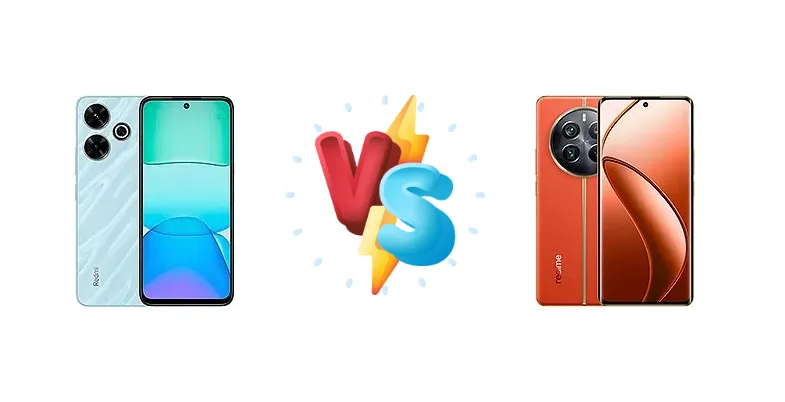
The Xiaomi Redmi 13 and Realme 12 Pro+ represent compelling options in the competitive mid-range smartphone market. While both aim to deliver a solid experience, they take different approaches. The Redmi 13 focuses on providing a balanced feature set at an accessible price, while the Realme 12 Pro+ prioritizes faster charging and a more powerful chipset, aiming for a smoother overall experience.
🏆 Quick Verdict
For the average user prioritizing battery life and faster charging, the Realme 12 Pro+ is the clear winner. Its Snapdragon 7s Gen 2 chipset and 67W charging significantly outperform the Redmi 13’s Helio G91 Ultra and 33W charging, despite the Redmi 13’s respectable active use battery score.
| Network |
|---|
| 2G bands | GSM 850 / 900 / 1800 / 1900 | GSM 850 / 900 / 1800 / 1900 |
| 3G bands | HSDPA 850 / 900 / 2100 | HSDPA 850 / 900 / 2100 |
| 4G bands | 1, 3, 5, 7, 8, 20, 28, 38, 40, 41 | 1, 3, 5, 8, 28, 40, 41 |
| 5G bands | - | 1, 3, 5, 8, 28, 40, 41, 77, 78 SA/NSA |
| Speed | HSPA, LTE | HSPA, LTE, 5G |
| Technology | GSM / HSPA / LTE | GSM / HSPA / LTE / 5G |
| Launch |
|---|
| Announced | 2024, June 03 | 2024, January 29 |
| Status | Available. Released 2024, June 03 | Available. Released 2024, January 29 |
| Body |
|---|
| Build | Glass front, plastic frame, glass back | - |
| Dimensions | 168.6 x 76.3 x 8.3 mm (6.64 x 3.00 x 0.33 in) | 161.5 x 74 x 8.8 mm (6.36 x 2.91 x 0.35 in) |
| SIM | Nano-SIM + Nano-SIM | Nano-SIM + Nano-SIM |
| Weight | 205 g (7.23 oz) | 196 g (6.91 oz) |
| Display |
|---|
| Protection | Corning Gorilla Glass | - |
| Resolution | 1080 x 2460 pixels (~396 ppi density) | 1080 x 2412 pixels, 20:9 ratio (~394 ppi density) |
| Size | 6.79 inches, 109.5 cm2 (~85.1% screen-to-body ratio) | 6.7 inches, 108.0 cm2 (~90.4% screen-to-body ratio) |
| Type | IPS LCD, 90Hz, 550 nits (HBM) | AMOLED, 1B colors, 120Hz, 800 nits (HBM), 950 nits (peak) |
| Platform |
|---|
| CPU | Octa-core (2x2.0 GHz Cortex-A75 & 6x1.8 GHz Cortex-A55) | Octa-core (4x2.40 GHz Cortex-A78 & 4x1.95 GHz Cortex-A55) |
| Chipset | Mediatek Helio G91 Ultra (12 nm) | Qualcomm SM7435-AB Snapdragon 7s Gen 2 (4 nm) |
| GPU | Mali-G52 MC2 | Adreno 710 |
| OS | Android 14, HyperOS | Android 14, Realme UI 5.0 |
| Memory |
|---|
| Card slot | microSDXC (uses shared SIM slot) | No |
| Internal | 128GB 6GB RAM, 128GB 8GB RAM, 256GB 6GB RAM, 256GB 8GB RAM | 128GB 8GB RAM, 256GB 8GB RAM, 256GB 12GB RAM, 512GB 12GB RAM |
| Main Camera |
|---|
| Dual | 108 MP, f/1.8, (wide), 1/1.67", 0.64µm, PDAF
2 MP (macro) | - |
| Features | LED flash, HDR | LED flash, HDR, panorama |
| Triple | - | 50 MP, f/1.8, 24mm (wide), 1/1.56", 1.0µm, multi-directional PDAF, OIS
64 MP, f/2.8, 71mm, (periscope telephoto), 1/2.0", 0.7µm, PDAF, OIS, 3x optical zoom
8 MP, f/2.2, 16mm, 112˚ (ultrawide), 1/4.0", 1.12µm |
| Video | 1080p@30fps | 4K@30fps, 1080p@30/60/120fps, gyro-EIS |
| Selfie camera |
|---|
| Features | HDR | - |
| Single | 13 MP, f/2.5, (wide) | 32 MP, f/2.4, 22mm (wide) |
| Video | 1080p@30fps | 1080p@30fps |
| Sound |
|---|
| 35mm jack | Yes | No |
| Loudspeaker | Yes | Yes, with stereo speakers |
| Comms |
|---|
| Bluetooth | 5.4, A2DP, LE | 5.2, A2DP, LE |
| Infrared port | Yes | - |
| NFC | Yes (market/region dependent) | Yes (market/region dependent) |
| Positioning | GPS, GLONASS, GALILEO, BDS | GPS, GLONASS, GALILEO, BDS, QZSS |
| Radio | FM radio | No |
| USB | USB Type-C | USB Type-C 2.0 |
| WLAN | Wi-Fi 802.11 a/b/g/n/ac, dual-band | Wi-Fi 802.11 a/b/g/n/ac/6, dual-band |
| Features |
|---|
| Sensors | Fingerprint (side-mounted), accelerometer, compass | Fingerprint (under display, optical), accelerometer, gyro, proximity, compass |
| Battery |
|---|
| Charging | 33W wired | 67W wired, 50% in 19 min |
| Type | 5030 mAh | 5000 mAh |
| Misc |
|---|
| Colors | Midnight Black, Sandy Gold, Ocean Blue, Pink | Submarine Blue, Navigator Beige, Explorer Red |
| Models | 2404ARN45A, 24040RN64Y | RMX3840, RMX3841 |
| Price | $ 119.79 / £ 126.47 / € 114.99 | $ 465.00 / £ 299.00 / € 344.26 / ₹ 28,400 |
| SAR EU | 0.99 W/kg (head) 0.98 W/kg (body) | - |
Xiaomi Redmi 13
- Longer active use battery life than some competitors in its price range.
- Good contrast ratio for a vibrant display.
- More affordable price point.
- Slower charging speed compared to the Realme 12 Pro+.
- Less powerful chipset resulting in lower performance.
Realme 12 Pro+
- Significantly faster 67W charging.
- More powerful Snapdragon 7s Gen 2 chipset for smoother performance.
- Brighter display for better outdoor visibility.
- Higher price compared to the Redmi 13.
- Slightly shorter active use battery life than the Redmi 13.
Display Comparison
The Realme 12 Pro+ boasts a brighter display, reaching 802 nits compared to the Redmi 13’s 448 nits. This translates to better visibility outdoors under direct sunlight. While both displays offer adequate viewing angles, the higher peak brightness of the Realme 12 Pro+ provides a more vibrant and comfortable viewing experience. Contrast ratios are strong on both devices, with the Redmi 13 achieving 1300:1, but the brightness difference is the key differentiator for users who frequently consume content outdoors.
Camera Comparison
While detailed camera specs are missing, the chipset difference suggests the Realme 12 Pro+ will have a more capable image signal processor (ISP). This translates to faster image processing, better noise reduction, and improved dynamic range. The Realme 12 Pro+ is likely to offer superior video recording capabilities as well. Without specific sensor details, it’s difficult to make a definitive statement, but the processing power advantage of the Snapdragon 7s Gen 2 is a strong indicator of better overall camera performance.
Performance
The Realme 12 Pro+’s Qualcomm Snapdragon 7s Gen 2 (4nm) represents a significant leap in performance and efficiency over the Redmi 13’s MediaTek Helio G91 Ultra (12nm). The Snapdragon 7s Gen 2 features newer Cortex-A78 cores clocked at 2.40 GHz, compared to the Redmi 13’s Cortex-A75 cores at 2.0 GHz. This architectural advantage, combined with the smaller 4nm process node, results in improved CPU and GPU performance, and better thermal management, reducing the likelihood of throttling during extended gaming sessions. The Realme 12 Pro+ will handle demanding applications and games with greater ease.
Battery Life
The Realme 12 Pro+ delivers a substantial advantage in battery performance, achieving 13:24 hours of active use compared to the Redmi 13’s 10:28 hours. This difference, coupled with the Realme 12 Pro+’s 67W wired charging (50% in 19 minutes), makes it the clear winner for users who prioritize long-lasting battery life and quick top-ups. The Redmi 13’s 33W charging is respectable, but significantly slower, requiring more downtime to reach a full charge.
Buying Guide
Buy the Xiaomi Redmi 13 if you need a reliable daily driver with a decent display and long-lasting battery for basic tasks and moderate usage, and are on a tight budget. Buy the Realme 12 Pro+ if you prefer a smoother, more responsive experience for gaming and multitasking, and value the convenience of significantly faster charging speeds, even if it comes at a higher price point.
Frequently Asked Questions
❓ Does the Snapdragon 7s Gen 2 in the Realme 12 Pro+ get hot during prolonged gaming sessions?
The Snapdragon 7s Gen 2’s 4nm process is more efficient than the Helio G91 Ultra’s 12nm process, resulting in lower heat generation. While some warmth is expected during intensive gaming, the Realme 12 Pro+ is less prone to significant throttling compared to devices with less efficient chipsets.
❓ How much faster is the 67W charging on the Realme 12 Pro+ compared to the 33W charging on the Redmi 13 in real-world use?
The Realme 12 Pro+ can reach 50% charge in just 19 minutes, while the Redmi 13 will take considerably longer. A full charge on the Realme 12 Pro+ will be significantly faster, reducing downtime and offering greater convenience for users who need to quickly top up their battery.
❓ Is the difference in active use battery life between the two phones noticeable in everyday use?
Yes, the 2.5+ hour difference in active use battery life is noticeable. Users who heavily rely on their phones throughout the day will likely appreciate the longer battery life offered by the Realme 12 Pro+.
❓ Will the Redmi 13 struggle with demanding games like Genshin Impact or Call of Duty Mobile?
The Redmi 13’s Helio G91 Ultra can run these games, but you’ll likely need to lower graphics settings to achieve a smooth frame rate. The Realme 12 Pro+’s Snapdragon 7s Gen 2 will provide a significantly better gaming experience with higher frame rates and more detailed graphics.