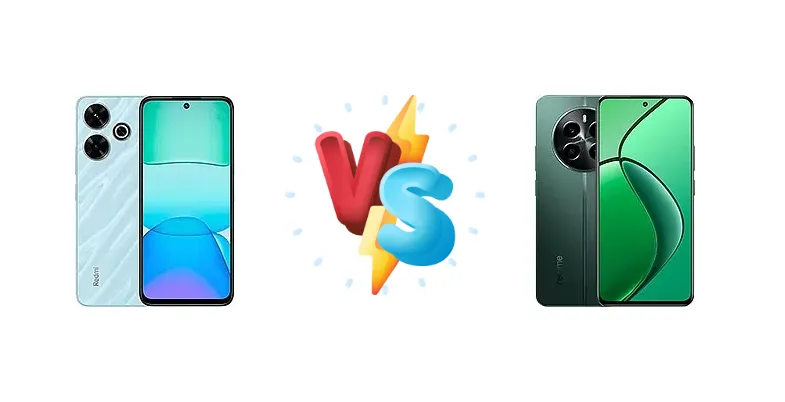
The Xiaomi Redmi 13 and Realme 12 4G represent compelling options in the crowded budget smartphone market. While both aim to deliver a solid experience without breaking the bank, they take different approaches. The Redmi 13 prioritizes sustained battery life, while the Realme 12 4G focuses on significantly faster charging speeds, creating a clear trade-off for potential buyers.
🏆 Quick Verdict
For the average user prioritizing convenience, the Realme 12 4G emerges as the winner. Its 67W charging, capable of reaching 50% in just 19 minutes, drastically reduces downtime. However, users who value maximum screen-on time and aren't concerned about quick top-ups will find the Redmi 13's 10:28h active use battery life more appealing.
| Network |
|---|
| 2G bands | GSM 850 / 900 / 1800 / 1900 | GSM 850 / 900 / 1800 / 1900 |
| 3G bands | HSDPA 850 / 900 / 2100 | HSDPA 850 / 900 / 2100 |
| 4G bands | 1, 3, 5, 7, 8, 20, 28, 38, 40, 41 | 1, 3, 5, 7, 8, 20, 28, 38, 40, 41 |
| Speed | HSPA, LTE | HSPA, LTE |
| Technology | GSM / HSPA / LTE | GSM / HSPA / LTE |
| Launch |
|---|
| Announced | 2024, June 03 | 2024, June 26 |
| Status | Available. Released 2024, June 03 | Available. Released 2024, July 01 |
| Body |
|---|
| Build | Glass front, plastic frame, glass back | - |
| Dimensions | 168.6 x 76.3 x 8.3 mm (6.64 x 3.00 x 0.33 in) | 163 x 75.5 x 7.9 mm (6.42 x 2.97 x 0.31 in) |
| SIM | Nano-SIM + Nano-SIM | Nano-SIM + Nano-SIM |
| Weight | 205 g (7.23 oz) | 187 g (6.60 oz) |
| Display |
|---|
| Protection | Corning Gorilla Glass | - |
| Resolution | 1080 x 2460 pixels (~396 ppi density) | 1080 x 2400 pixels, 20:9 ratio (~395 ppi density) |
| Size | 6.79 inches, 109.5 cm2 (~85.1% screen-to-body ratio) | 6.67 inches, 107.4 cm2 (~87.3% screen-to-body ratio) |
| Type | IPS LCD, 90Hz, 550 nits (HBM) | AMOLED, 120Hz, 600 nits (typ), 2000 nits (peak) |
| Platform |
|---|
| CPU | Octa-core (2x2.0 GHz Cortex-A75 & 6x1.8 GHz Cortex-A55) | Octa-core (4x2.8 GHz Cortex-A73 & 4x1.9 GHz Cortex-A53) |
| Chipset | Mediatek Helio G91 Ultra (12 nm) | Qualcomm SM6225 Snapdragon 685 (6 nm) |
| GPU | Mali-G52 MC2 | Adreno 610 |
| OS | Android 14, HyperOS | Android 14, Realme UI 5.0 |
| Memory |
|---|
| Card slot | microSDXC (uses shared SIM slot) | microSDXC (uses shared SIM slot) |
| Internal | 128GB 6GB RAM, 128GB 8GB RAM, 256GB 6GB RAM, 256GB 8GB RAM | 128GB 8GB RAM, 256GB 8GB RAM, 512GB 8GB RAM |
| Main Camera |
|---|
| Dual | 108 MP, f/1.8, (wide), 1/1.67", 0.64µm, PDAF
2 MP (macro) | 50 MP, f/1.9, 26mm (wide), 1/1.95", PDAF, OIS
Auxiliary lens |
| Features | LED flash, HDR | LED flash, HDR, panorama |
| Video | 1080p@30fps | 1080p@30fps, gyro-EIS |
| Selfie camera |
|---|
| Features | HDR | - |
| Single | 13 MP, f/2.5, (wide) | 16 MP, f/2.5, (wide) |
| Video | 1080p@30fps | 1080p@30fps |
| Sound |
|---|
| 35mm jack | Yes | Yes |
| Loudspeaker | Yes | Yes, with dual speakers |
| Comms |
|---|
| Bluetooth | 5.4, A2DP, LE | 5.0, A2DP, LE |
| Infrared port | Yes | - |
| NFC | Yes (market/region dependent) | Yes, 360˚ |
| Positioning | GPS, GLONASS, GALILEO, BDS | GPS, GALILEO, GLONASS, QZSS, BDS |
| Radio | FM radio | Unspecified |
| USB | USB Type-C | USB Type-C 2.0 |
| WLAN | Wi-Fi 802.11 a/b/g/n/ac, dual-band | Wi-Fi 802.11 a/b/g/n/ac, dual-band |
| Features |
|---|
| Sensors | Fingerprint (side-mounted), accelerometer, compass | Fingerprint (under display, optical), accelerometer, gyro, proximity, compass |
| Battery |
|---|
| Charging | 33W wired | 67W wired, 50% in 19 min |
| Type | 5030 mAh | 5000 mAh |
| Misc |
|---|
| Colors | Midnight Black, Sandy Gold, Ocean Blue, Pink | Skyline Silver, Pioneer Green |
| Models | 2404ARN45A, 24040RN64Y | RMX3871 |
| Price | $ 119.79 / £ 126.47 / € 114.99 | About 180 EUR |
| SAR EU | 0.99 W/kg (head) 0.98 W/kg (body) | - |
Xiaomi Redmi 13
- Exceptional battery life (10:28h active use)
- Decent display contrast ratio (1300:1)
- Potentially lower price point
- Slower charging speed (33W)
- Less efficient chipset (12nm process)
Realme 12 4G
- Ultra-fast charging (67W, 50% in 19 min)
- More efficient chipset (6nm process)
- Potentially better ISP for image processing
- Battery life likely shorter than Redmi 13
- May be slightly more expensive
Display Comparison
The Redmi 13 boasts a display with a 1300:1 contrast ratio and a measured peak brightness of 448 nits. While adequate for indoor use, this brightness level may struggle in direct sunlight. The Realme 12’s display specifications are not provided, but Realme typically focuses on vibrant color profiles. The Redmi 13’s contrast ratio suggests a decent viewing experience for media consumption, but without knowing the Realme 12’s panel technology (IPS vs AMOLED) or color accuracy, a definitive judgment is difficult. The Redmi 13's brightness is a potential limitation for outdoor visibility.
Camera Comparison
Camera details beyond the main sensors are absent for both devices. However, the chipset differences suggest the Snapdragon 685 in the Realme 12 4G will likely offer superior image signal processing (ISP) capabilities, resulting in better dynamic range and noise reduction. Without sensor size or aperture information, it’s difficult to assess low-light performance. The Realme 12’s ISP advantage is a key factor, even with potentially similar sensor resolutions.
Performance
The Realme 12 4G utilizes the Qualcomm Snapdragon 685, fabricated on a 6nm process, offering improved power efficiency compared to the Redmi 13’s Mediatek Helio G91 Ultra (12nm). While the Redmi 13’s CPU features slightly higher clocked Cortex-A75 cores (2.0 GHz vs 2.8 GHz on the Realme), the Snapdragon 685’s more efficient architecture and newer Cortex-A73 cores likely translate to better sustained performance and thermal management. The 6nm process is a significant advantage for the Realme 12, potentially reducing throttling during extended gaming or demanding tasks. The Redmi 13's CPU clock speed doesn't necessarily equate to real-world performance gains.
Battery Life
The Redmi 13 shines with an impressive 10:28h active use battery score, indicating excellent endurance. The Realme 12 4G doesn’t have a reported battery life score, but its 67W wired charging is a game-changer. Reaching 50% charge in just 19 minutes significantly reduces downtime compared to the Redmi 13’s 33W charging. While the Redmi 13 offers longer runtimes, the Realme 12’s charging speed provides a more convenient user experience, especially for those who frequently need to top up their battery.
Buying Guide
Buy the Xiaomi Redmi 13 if you need exceptional battery endurance for all-day use, frequently travel, or dislike being tethered to a charger. Buy the Realme 12 4G if you prefer the convenience of incredibly fast charging, often find yourself needing a quick power boost, and value a more modern chipset fabrication process for potential efficiency gains.
Frequently Asked Questions
❓ Does the Mediatek Helio G91 Ultra in the Redmi 13 struggle with demanding games like PUBG?
While the Helio G91 Ultra can run PUBG, the 12nm process and less efficient architecture compared to the Snapdragon 685 may lead to noticeable frame drops and throttling during extended gaming sessions. Lowering graphics settings is recommended for a smoother experience.
❓ How much faster is the 67W charging on the Realme 12 4G compared to the 33W charging on the Redmi 13 in real-world use?
The Realme 12 4G’s 67W charging can take the phone from 0% to 50% in approximately 19 minutes. The Redmi 13’s 33W charging will take significantly longer – likely over an hour to reach 50% from a depleted battery. This difference is substantial for users who need a quick power boost.
❓ Is the Snapdragon 685 in the Realme 12 4G a significant upgrade over previous Snapdragon 600 series chips?
Yes, the Snapdragon 685 represents a notable improvement over older 600 series chips. The 6nm process and newer Cortex-A73 cores deliver better performance and power efficiency, resulting in a smoother user experience and improved battery life.