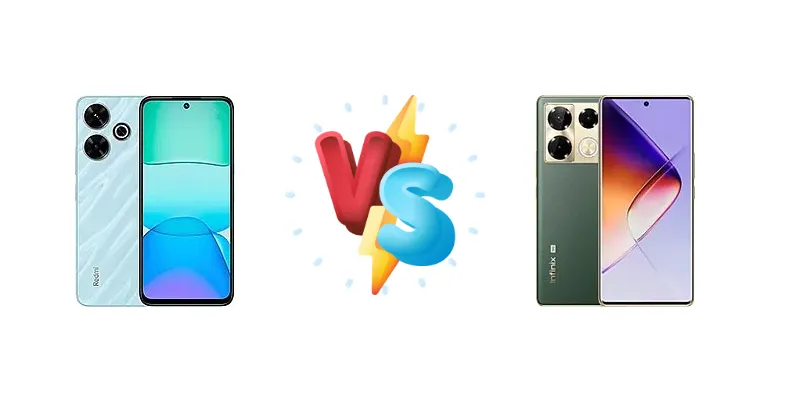
The Xiaomi Redmi 13 and Infinix Note 40 Pro represent compelling options in the crowded budget and mid-range smartphone market. While both aim to deliver value, they take different approaches: the Redmi 13 prioritizes all-day battery life and a familiar user experience, while the Note 40 Pro focuses on faster charging and a more capable processor for demanding tasks. This comparison dissects their key differences to help you choose the right device.
🏆 Quick Verdict
For the average user prioritizing performance and convenience, the Infinix Note 40 Pro emerges as the stronger contender. Its Dimensity 7020 chipset offers a noticeable performance uplift over the Redmi 13’s Helio G91 Ultra, and the inclusion of 45W wired and 20W MagCharge wireless charging provides significantly faster refueling options.
| Network |
|---|
| 2G bands | GSM 850 / 900 / 1800 / 1900 | GSM 850 / 900 / 1800 / 1900 |
| 3G bands | HSDPA 850 / 900 / 2100 | HSDPA 850 / 900 / 1700(AWS) / 1900 / 2100 |
| 4G bands | 1, 3, 5, 7, 8, 20, 28, 38, 40, 41 | 1, 2, 3, 4, 5, 7, 8, 12, 17, 20, 28, 38, 40, 41, 42, 66 |
| 5G bands | - | 1, 3, 5, 7, 8, 12, 20, 28, 38, 40, 41, 66, 77, 78 SA/NSA |
| Speed | HSPA, LTE | HSPA, LTE, 5G |
| Technology | GSM / HSPA / LTE | GSM / HSPA / LTE / 5G |
| Launch |
|---|
| Announced | 2024, June 03 | 2024, March 18 |
| Status | Available. Released 2024, June 03 | Available. Released 2024, March 19 |
| Body |
|---|
| Build | Glass front, plastic frame, glass back | - |
| Dimensions | 168.6 x 76.3 x 8.3 mm (6.64 x 3.00 x 0.33 in) | 164.3 x 74.5 x 8.1 mm (6.47 x 2.93 x 0.32 in) |
| SIM | Nano-SIM + Nano-SIM | Nano-SIM + Nano-SIM |
| Weight | 205 g (7.23 oz) | 190 g or 196 g (6.70 oz) |
| Display |
|---|
| Protection | Corning Gorilla Glass | Corning Gorilla Glass |
| Resolution | 1080 x 2460 pixels (~396 ppi density) | 1080 x 2436 pixels (~393 ppi density) |
| Size | 6.79 inches, 109.5 cm2 (~85.1% screen-to-body ratio) | 6.78 inches, 109.9 cm2 (~89.8% screen-to-body ratio) |
| Type | IPS LCD, 90Hz, 550 nits (HBM) | AMOLED, 1B colors, 120Hz, 2160Hz PWM, 1300 nits (peak) |
| Platform |
|---|
| CPU | Octa-core (2x2.0 GHz Cortex-A75 & 6x1.8 GHz Cortex-A55) | Octa-core (2x2.2 GHz Cortex-A78 & 6x2.0 GHz Cortex-A55) |
| Chipset | Mediatek Helio G91 Ultra (12 nm) | Mediatek Dimensity 7020 (6 nm) |
| GPU | Mali-G52 MC2 | IMG BXM-8-256 |
| OS | Android 14, HyperOS | Android 14, XOS 14 |
| Memory |
|---|
| Card slot | microSDXC (uses shared SIM slot) | Unspecified |
| Internal | 128GB 6GB RAM, 128GB 8GB RAM, 256GB 6GB RAM, 256GB 8GB RAM | 256GB 8GB RAM |
| Main Camera |
|---|
| Dual | 108 MP, f/1.8, (wide), 1/1.67", 0.64µm, PDAF
2 MP (macro) | - |
| Features | LED flash, HDR | Dual-LED flash, HDR, panorama |
| Triple | - | 108 MP, f/1.8, (wide), PDAF, OIS
2 MP, f/2.4
2 MP, f/2.4 |
| Video | 1080p@30fps | 1440p@30fps, 1080p@30/60fps |
| Selfie camera |
|---|
| Features | HDR | Dual-LED flash |
| Single | 13 MP, f/2.5, (wide) | 32 MP, f/2.2, (wide), 1/3.1" |
| Video | 1080p@30fps | 1080p@30fps |
| Sound |
|---|
| 35mm jack | Yes | No |
| Loudspeaker | Yes | Yes, with stereo speakers |
| Comms |
|---|
| Bluetooth | 5.4, A2DP, LE | Yes |
| Infrared port | Yes | Yes |
| NFC | Yes (market/region dependent) | Yes (market/region dependent) |
| Positioning | GPS, GLONASS, GALILEO, BDS | GPS |
| Radio | FM radio | FM radio |
| USB | USB Type-C | USB Type-C 2.0, OTG |
| WLAN | Wi-Fi 802.11 a/b/g/n/ac, dual-band | Wi-Fi 802.11 a/b/g/n/ac, dual-band |
| Features |
|---|
| Sensors | Fingerprint (side-mounted), accelerometer, compass | Fingerprint (under display, optical), accelerometer, gyro, proximity, compass |
| Battery |
|---|
| Charging | 33W wired | 45W wired, 50% in 26 min
20W wireless MagCharge
Reverse wired
Reverse wireless |
| Type | 5030 mAh | 5000 mAh |
| Misc |
|---|
| Colors | Midnight Black, Sandy Gold, Ocean Blue, Pink | Vintage Green, Titan Gold, Racing Edition |
| Models | 2404ARN45A, 24040RN64Y | X6851 |
| Price | $ 119.79 / £ 126.47 / € 114.99 | About 280 EUR |
| SAR EU | 0.99 W/kg (head) 0.98 W/kg (body) | - |
Xiaomi Redmi 13
- Exceptional battery life (10:28h active use)
- More affordable price point (likely)
- Reliable and familiar MIUI software
- Less powerful processor (Helio G91 Ultra)
- Slower charging speeds (33W wired)
- Lower peak display brightness
Infinix Note 40 Pro
- Faster and more efficient processor (Dimensity 7020)
- Significantly faster charging (45W wired, 20W wireless)
- Reverse charging capabilities
- Battery life may be shorter than Redmi 13
- Potentially higher price
- Software experience may vary
Display Comparison
The Redmi 13 features a display with a 1300:1 contrast ratio and a measured peak brightness of 448 nits. While adequate for indoor use, this falls short of the brightness levels often found in competing devices. The Note 40 Pro’s display specifications are not provided, but given its positioning, we can expect a similar or slightly improved brightness. The Redmi 13’s contrast ratio suggests a standard IPS LCD panel, while the Note 40 Pro may incorporate features like higher refresh rates (not specified) to enhance visual fluidity. The lack of detailed display specs for the Note 40 Pro makes a direct comparison challenging, but the Redmi 13’s brightness is a clear limitation.
Camera Comparison
Without detailed camera specifications for either device, a direct comparison is difficult. However, the market segment suggests both will rely on primary sensors in the 50MP-108MP range. The Redmi 13 likely features a more basic camera setup, while the Note 40 Pro may include features like Optical Image Stabilization (OIS) to improve image quality in low-light conditions. The presence of a 2MP macro camera on either device is unlikely to significantly impact overall camera performance; these sensors are often included for marketing purposes but deliver limited real-world benefits. Image processing algorithms will also play a crucial role, and Infinix often emphasizes AI-powered scene detection.
Performance
The core difference lies in the chipsets. The Infinix Note 40 Pro boasts the Mediatek Dimensity 7020 (6nm), featuring a more modern architecture with 2x2.2 GHz Cortex-A78 cores and 6x2.0 GHz Cortex-A55 cores. This contrasts with the Redmi 13’s Mediatek Helio G91 Ultra (12nm) which utilizes 2x2.0 GHz Cortex-A75 cores and 6x1.8 GHz Cortex-A55 cores. The Dimensity 7020’s 6nm process node is more efficient, leading to better thermal management and sustained performance under load. The Cortex-A78 cores in the Note 40 Pro also offer a performance advantage over the A75 cores in the Redmi 13. This translates to faster app loading times, smoother multitasking, and improved gaming performance on the Infinix device.
Battery Life
The Redmi 13 shines with a remarkable 10:28h active use battery score, indicating excellent endurance. The Infinix Note 40 Pro’s battery capacity is not specified, but its 45W wired charging capability significantly surpasses the Redmi 13’s 33W charging. The Note 40 Pro can reach 50% charge in just 26 minutes, a substantial time saving. Furthermore, the Note 40 Pro introduces 20W MagCharge wireless charging and reverse wired/wireless charging, offering unparalleled convenience. While the Redmi 13’s battery life is impressive, the Note 40 Pro’s faster charging and wireless capabilities provide a more versatile and user-friendly experience.
Buying Guide
Buy the Xiaomi Redmi 13 if you need a reliable, long-lasting phone for everyday tasks and prioritize maximizing battery life above all else. Its 10:28h active use score is impressive. Buy the Infinix Note 40 Pro if you prefer a smoother experience with more demanding apps, enjoy faster charging speeds, and appreciate the convenience of wireless charging and reverse charging capabilities.
Frequently Asked Questions
❓ Does the Mediatek Dimensity 7020 in the Infinix Note 40 Pro get hot during extended gaming sessions?
The Dimensity 7020’s 6nm process node is designed for improved thermal efficiency compared to the Redmi 13’s Helio G91 Ultra (12nm). While some heat generation is inevitable during gaming, the Note 40 Pro is likely to maintain stable performance for longer periods due to its more efficient chipset and potentially better thermal management design.
❓ How practical is the 20W MagCharge wireless charging on the Infinix Note 40 Pro?
The 20W MagCharge offers a convenient alternative to wired charging, especially for topping up the battery throughout the day. While not as fast as the 45W wired charging, it provides a significant speed boost over standard wireless charging and is particularly useful for users who frequently use wireless charging pads.
❓ Is the 33W charging on the Redmi 13 slow compared to the competition?
33W charging is becoming increasingly common in the budget segment, but it is noticeably slower than the 45W charging offered by the Infinix Note 40 Pro. Expect a longer time to fully charge the Redmi 13, potentially exceeding 2 hours from 0 to 100%.
❓ Can the Infinix Note 40 Pro charge other devices wirelessly?
Yes, the Infinix Note 40 Pro supports reverse wireless charging, allowing you to use it as a wireless power bank for other Qi-compatible devices like earbuds or smartphones. This is a convenient feature for users who frequently travel or need to share power with friends.