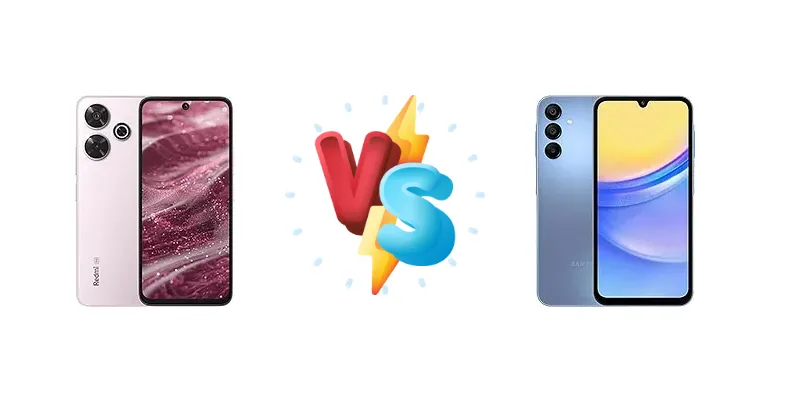
The sub-$200 5G smartphone market is fiercely competitive. The Xiaomi Redmi 13 5G and Samsung Galaxy A15 5G represent compelling options, but cater to slightly different priorities. The Redmi 13 5G focuses on efficient performance with its newer Snapdragon chipset, while the Galaxy A15 5G prioritizes display brightness and extended battery life. This comparison will dissect their key differences to determine which device delivers the best value.
🏆 Quick Verdict
For the average user prioritizing all-around performance and efficiency, the Xiaomi Redmi 13 5G is the better choice. Its Snapdragon 4 Gen 2 (4nm) chipset offers a slight edge in processing power and thermal management, despite the Galaxy A15 5G’s impressive battery endurance. However, those who heavily value display brightness will find the A15 more appealing.
| Network |
|---|
| 2G bands | GSM 850 / 900 / 1800 / 1900 | GSM 850 / 900 / 1800 / 1900 |
| 3G bands | HSDPA 850 / 900 / 2100 | HSDPA 850 / 900 / 1700(AWS) / 1900 / 2100 |
| 4G bands | 1, 3, 5, 8, 40, 41 | 1, 2, 3, 4, 5, 7, 8, 12, 17, 20, 26, 28, 38, 40, 41, 66 |
| 5G bands | 1, 3, 5, 8, 28, 40, 78 SA/NSA | 1, 3, 5, 7, 8, 26, 28, 40, 41, 66, 77, 78 SA/NSA/Sub6 |
| Speed | HSPA, LTE, 5G | HSPA, LTE, 5G |
| Technology | GSM / HSPA / LTE / 5G | GSM / HSPA / LTE / 5G |
| Launch |
|---|
| Announced | 2024, July 09 | 2023, December 11 |
| Status | Available. Released 2024, July 12 | Available. Released 2023, December 16 |
| Body |
|---|
| Build | Glass front (Gorilla Glass 3), glass back, plastic frame | Glass front, plastic back, plastic frame |
| Dimensions | 168.6 x 76.3 x 8.3 mm (6.64 x 3.00 x 0.33 in) | 160.1 x 76.8 x 8.4 mm (6.30 x 3.02 x 0.33 in) |
| SIM | Nano-SIM + Nano-SIM | · Nano-SIM· Nano-SIM + Nano-SIM |
| Weight | 205 g (7.23 oz) | 200 g (7.05 oz) |
| Display |
|---|
| Protection | Corning Gorilla Glass 3 | - |
| Resolution | 1080 x 2460 pixels (~396 ppi density) | 1080 x 2340 pixels, 19.5:9 ratio (~396 ppi density) |
| Size | 6.79 inches, 109.5 cm2 (~85.1% screen-to-body ratio) | 6.5 inches, 103.7 cm2 (~84.3% screen-to-body ratio) |
| Type | IPS LCD, 120Hz, 550 nits (HBM) | Super AMOLED, 90Hz, 800 nits (HBM) |
| Platform |
|---|
| CPU | Octa-core (2x2.3 GHz Cortex-A78 & 6x2.0 GHz Cortex-A55) | Octa-core (2x2.2 GHz Cortex-A76 & 6x2.0 GHz Cortex-A55) |
| Chipset | Qualcomm SM4450 Snapdragon 4 Gen 2 AE (4 nm) | Mediatek Dimensity 6100+ (6 nm) |
| GPU | Adreno 613 | Mali-G57 MC2 |
| OS | Android 14, HyperOS, up to 2 major Android upgrades | Android 14, upgradable to Android 16, One UI 8, up to 4 major Android upgrades |
| Memory |
|---|
| Card slot | microSDXC (uses shared SIM slot) | microSDXC (uses shared SIM slot) |
| Internal | 128GB 6GB RAM, 128GB 8GB RAM, 256GB 8GB RAM | 64GB 4GB RAM, 128GB 4GB RAM, 128GB 6GB RAM, 128GB 8GB RAM, 256GB 8GB RAM |
| Main Camera |
|---|
| Dual | 108 MP, f/1.8, (wide), 0.64µm, PDAF
2 MP (macro) | - |
| Features | LED flash, HDR | LED flash, panorama, HDR |
| Triple | - | 50 MP, f/1.8, (wide), AF
5 MP, f/2.2, (ultrawide)
2 MP (macro) |
| Video | 1080p@30fps | 1080p@30fps, gyro-EIS |
| Selfie camera |
|---|
| Features | HDR | - |
| Single | 13 MP, f/2.5, (wide) | 13 MP, f/2.0, (wide) |
| Video | 1080p@30fps | 1080p@30fps |
| Sound |
|---|
| 35mm jack | Yes | Yes |
| Loudspeaker | Yes | Yes |
| Comms |
|---|
| Bluetooth | 5.0, A2DP, LE | 5.3, A2DP, LE |
| Infrared port | Yes | - |
| NFC | Yes (market/region dependent) | Yes (market/region dependent) |
| Positioning | GPS, GLONASS, GALILEO, BDS | GPS, GALILEO, GLONASS, BDS, QZSS |
| Radio | FM radio | No |
| USB | USB Type-C | USB Type-C 2.0 |
| WLAN | Wi-Fi 802.11 a/b/g/n/ac, dual-band | Wi-Fi 802.11 a/b/g/n/ac, dual-band, Wi-Fi Direct |
| Features |
|---|
| Sensors | Fingerprint (side-mounted), accelerometer, compass | Fingerprint (side-mounted), accelerometer, gyro, compass |
| Battery |
|---|
| Charging | 33W wired, 50% in 30 min | 25W wired |
| Type | Li-Po 5030 mAh | 5000 mAh |
| Misc |
|---|
| Colors | Black Diamond, Hawaiian Blue, Orchid Pink | Brave Black, Personality Yellow, Magical Blue, Optimistic Blue |
| Models | 2406ERN9CI | SM-A156B, SM-A156B/DS, SM-A156P, SM-A156P/DS, SM-A156U, SM-A156U1, SM-A156U1/DS, SM-A156W, SM-A156P/N, SM-A156P/DSN, SM-S156VL, SM-A156M, SM-A156E, SM-A156E/DSN |
| Price | ₹ 11,199 | € 167.00 / $ 79.97 / ₹ 17,490 |
| SAR EU | - | 0.80 W/kg (head) 1.46 W/kg (body) |
Xiaomi Redmi 13 5G
- More efficient Snapdragon 4 Gen 2 chipset
- Faster 33W charging
- Potentially better sustained performance
- Likely lower peak display brightness
- Battery life may be shorter than the A15 5G
Samsung Galaxy A15 5G
- Brighter 786 nit display
- Excellent battery life (14:31h active use)
- Samsung’s established brand reputation
- Less efficient Dimensity 6100+ chipset
- Slower 25W charging
Display Comparison
The Samsung Galaxy A15 5G boasts a significantly brighter display, reaching a measured 786 nits. This is a substantial advantage for outdoor use, where the Redmi 13 5G’s display brightness is not specified but likely falls below this figure. While both likely utilize LCD panels given the price point, the A15’s higher peak brightness is a clear win for visibility. Bezels are expected to be similar on both devices, and color accuracy is likely standard for this segment – adequate but not professional-grade.
Camera Comparison
Camera performance is difficult to assess without detailed sample comparisons. However, the focus should be on the main sensors. While both phones likely include multiple rear cameras, the 2MP macro lenses common in this price range offer limited utility. The aperture and sensor size of the primary cameras will be the key differentiators. Without this data, it’s difficult to declare a winner, but Samsung’s image processing generally leans towards more saturated colors, while Xiaomi often aims for a more natural look.
Performance
The chipset is where the Redmi 13 5G gains a notable advantage. The Qualcomm Snapdragon 4 Gen 2, built on a 4nm process, is more efficient than the MediaTek Dimensity 6100+ (6nm) found in the Galaxy A15 5G. While both CPUs feature a similar core configuration (2x high-performance Cortex-A78/A76 and 6x efficiency cores), the 4nm node of the Snapdragon translates to better thermal efficiency and potentially less throttling under sustained load. The Redmi 13 5G is likely to maintain higher sustained performance during gaming or demanding applications. RAM configurations are not specified, but LPDDR4X is probable on both.
Battery Life
The Samsung Galaxy A15 5G shines in battery life, achieving an active use score of 14 hours and 31 minutes. While the Redmi 13 5G’s battery capacity is not specified, the more efficient Snapdragon 4 Gen 2 chipset could partially offset the A15’s larger battery. Charging speeds differ significantly: the Redmi 13 5G supports 33W wired charging (50% in 30 minutes), while the A15 5G is limited to 25W. This means the Redmi 13 5G will likely charge faster, despite potentially having a smaller battery.
Buying Guide
Buy the Xiaomi Redmi 13 5G if you need a phone that handles everyday tasks and light gaming smoothly, and appreciate a more modern, efficient processor. Buy the Samsung Galaxy A15 5G if you prefer a brighter display for outdoor visibility and prioritize maximizing battery life above all else, even if it means a slight performance trade-off.
Frequently Asked Questions
❓ Does the MediaTek Dimensity 6100+ in the Galaxy A15 5G tend to overheat during prolonged gaming sessions?
While the Dimensity 6100+ is a capable chip, its 6nm process is less efficient than the Snapdragon 4 Gen 2’s 4nm process. This means the Galaxy A15 5G is more likely to experience thermal throttling during extended gaming, potentially leading to reduced performance over time. The Redmi 13 5G should maintain higher sustained performance.
❓ Is the 25W charging on the Galaxy A15 5G slow compared to other phones in this price range?
Yes, 25W charging is relatively slow compared to the 33W charging offered by the Redmi 13 5G. While it won’t be drastically slow, you’ll spend more time tethered to a charger to reach a full charge. The Redmi 13 5G’s 33W charging can reach 50% in just 30 minutes.
❓ How does the display quality of the Galaxy A15 5G compare to more expensive Samsung phones?
The Galaxy A15 5G’s display, while bright at 786 nits, is likely an LCD panel and won’t match the color accuracy or vibrancy of Samsung’s AMOLED displays found in their higher-end devices. It’s a good display for the price, but don’t expect flagship-level quality.