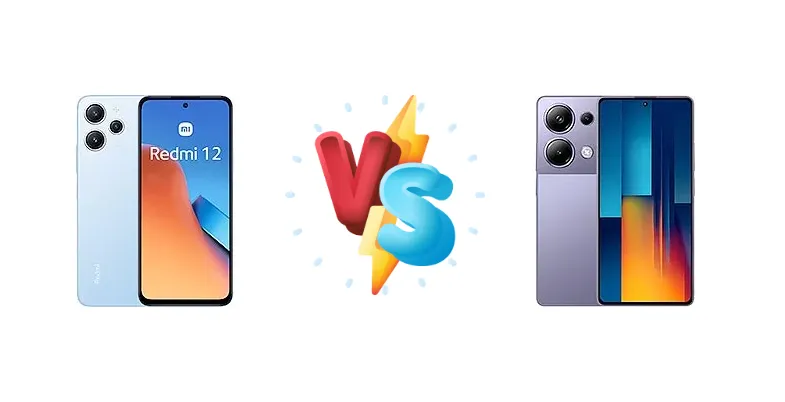
Xiaomi consistently delivers compelling options in the budget smartphone space, and the Redmi 12 and Poco M6 Pro 4G are prime examples. While both aim for affordability, they take different approaches. The Redmi 12 prioritizes endurance and a balanced experience, while the Poco M6 Pro 4G aggressively targets performance and charging speed. This comparison dissects their key differences to determine which device offers the best value.
🏆 Quick Verdict
For most users, the Poco M6 Pro 4G emerges as the stronger choice. Its significantly faster 67W charging (full charge in 44 minutes) and more powerful Helio G99 Ultra chipset provide a noticeable performance boost, justifying the slight price premium. However, the Redmi 12 remains a viable option for those prioritizing maximum battery endurance.
| Network |
|---|
| 2G bands | GSM 850 / 900 / 1800 / 1900 | GSM 850 / 900 / 1800 / 1900 |
| 3G bands | HSDPA 850 / 900 / 2100 | HSDPA 800 / 850 / 900 / 1700(AWS) / 1900 / 2100 |
| 4G bands | 1, 3, 5, 7, 8, 20, 28, 38, 40, 41 | 1, 2, 3, 4, 5, 7, 8, 12, 13, 17, 18, 19, 20, 26, 28, 38, 40, 41, 66 |
| Speed | HSPA, LTE | HSPA, LTE |
| Technology | GSM / HSPA / LTE | GSM / HSPA / LTE |
| Launch |
|---|
| Announced | 2023, June 15 | 2024, January 11 |
| Status | Available. Released 2023, June 15 | Available. Released 2024, January 12 |
| Body |
|---|
| Build | Glass front, plastic frame, glass back | Glass front (Gorilla Glass 5), plastic frame |
| Dimensions | 168.6 x 76.3 x 8.2 mm (6.64 x 3.00 x 0.32 in) | 161.1 x 75 x 8 mm (6.34 x 2.95 x 0.31 in) |
| SIM | Nano-SIM + Nano-SIM | Nano-SIM + Nano-SIM |
| Weight | 198.5 g (7.02 oz) | 179 g (6.31 oz) |
| Display |
|---|
| Protection | - | Corning Gorilla Glass 5 |
| Resolution | 1080 x 2460 pixels (~396 ppi density) | 1080 x 2400 pixels, 20:9 ratio (~395 ppi density) |
| Size | 6.79 inches, 109.5 cm2 (~85.1% screen-to-body ratio) | 6.67 inches, 107.4 cm2 (~88.9% screen-to-body ratio) |
| Type | IPS LCD, 90Hz, 550 nits (peak) | AMOLED, 120Hz, 1000 nits (HBM), 1300 nits (peak) |
| Platform |
|---|
| CPU | Octa-core (2x2.0 GHz Cortex-A75 & 6x1.8 GHz Cortex-A55) | Octa-core (2x2.2 GHz Cortex-A76 & 6x2.0 GHz Cortex-A55) |
| Chipset | Mediatek MT6769H Helio G88 (12 nm) | Mediatek Helio G99 Ultra |
| GPU | Mali-G52 MC2 | Mali-G57 MC2 |
| OS | Android 13, upgradable to Android 14, HyperOS | Android 13, MIUI 14, planned upgrade to Android 14, HyperOS |
| Memory |
|---|
| Card slot | microSDXC (uses shared SIM slot) | microSDXC (uses shared SIM slot) |
| Internal | 128GB 2GB RAM, 128GB 4GB RAM, 128GB 6GB RAM, 128GB 8GB RAM, 256GB 4GB RAM, 256GB 8GB RAM | 256GB 8GB RAM, 512GB 12GB RAM |
| Main Camera |
|---|
| Features | LED flash, HDR | LED flash, HDR, panorama |
| Triple | 50 MP, f/1.8, (wide), PDAF
8 MP, f/2.2, 120˚ (ultrawide)
2 MP (macro) | 64 MP, f/1.8, 25mm (wide), 1/2.0", 0.7µm, PDAF, OIS
8 MP, f/2.2, (ultrawide)
2 MP (macro) |
| Video | 1080p@30fps | 1080p@30/60fps, gyro-EIS |
| Selfie camera |
|---|
| Single | 8 MP, f/2.1, (wide) | 16 MP, f/2.5, (wide) |
| Video | 1080p@30fps | 1080p@30/60fps |
| Sound |
|---|
| 35mm jack | Yes | Yes |
| Loudspeaker | Yes | Yes, with dual speakers |
| Comms |
|---|
| Bluetooth | 5.3, A2DP, LE | 5.2, A2DP, LE |
| Infrared port | Yes | Yes |
| NFC | Yes (market/region dependent) | Yes (market/region dependent) |
| Positioning | GPS, GLONASS, BDS, GALILEO | GPS, GALILEO, GLONASS, BDS |
| Radio | FM radio | FM radio |
| USB | USB Type-C | USB Type-C 2.0, OTG |
| WLAN | Wi-Fi 802.11 a/b/g/n/ac, dual-band | Wi-Fi 802.11 a/b/g/n/ac, dual-band |
| Features |
|---|
| Sensors | Fingerprint (side-mounted), accelerometer, compass | Fingerprint (under display, optical), accelerometer, gyro, compass |
| Battery |
|---|
| Charging | 18W wired, PD | 67W wired, 100% in 44 min |
| Type | Li-Po 5000 mAh | 5000 mAh |
| Misc |
|---|
| Colors | Midnight Black, Sky Blue, Polar Silver, Moonstone Silver | Black, Blue, Purple |
| Models | 23053RN02A, 23053RN02Y, 23053RN02I, 23053RN02L, 23077RABDC | 2312FPCA6G |
| Price | € 109.00 / $ 139.99 / £ 84.99 / ₹ 9,899 | $ 170.00 |
| SAR | 1.09 W/kg (head) 1.06 W/kg (body) | 1.09 W/kg (head) 1.09 W/kg (body) |
| SAR EU | 0.99 W/kg (head) 0.99 W/kg (body) | 0.99 W/kg (head) 0.99 W/kg (body) |
Xiaomi Redmi 12
- Exceptional battery endurance (117h rating)
- Good contrast ratio on the display (1507:1)
- More affordable price point (likely)
- Slower processor (Helio G88)
- Significantly slower charging (18W)
Xiaomi Poco M6 Pro 4G
- Faster processor (Helio G99 Ultra)
- Much faster charging (67W, 44 min to full)
- Brighter display (1053 nits)
- Slightly shorter battery life
- Potentially higher price
Display Comparison
The Poco M6 Pro 4G boasts a significantly brighter display, reaching a measured 1053 nits compared to the Redmi 12’s 541 nits. This translates to superior visibility outdoors under direct sunlight. While both displays share the same resolution, the higher brightness of the Poco M6 Pro 4G provides a more vibrant and usable experience. Contrast ratio is also a factor, with the Redmi 12 offering 1507:1, but the brightness difference is the more impactful distinction for everyday use.
Camera Comparison
Both phones feature capable photo and video capabilities, but detailed sensor information is lacking. Without specifics, it’s difficult to make a definitive judgment. However, the chipset’s image signal processor (ISP) plays a crucial role, and the Helio G99 Ultra in the Poco M6 Pro 4G generally offers more advanced image processing capabilities. The presence of a dedicated ISP in the G99 Ultra allows for faster image capture and potentially better low-light performance. We can assume both phones will offer similar software features, but the hardware advantage leans towards the Poco.
Performance
The core difference lies in the chipsets. The Poco M6 Pro 4G utilizes the Mediatek Helio G99 Ultra, featuring a CPU with 2x2.2 GHz Cortex-A76 cores, while the Redmi 12 is equipped with the Helio G88, clocked at 2x2.0 GHz Cortex-A75. The G99 Ultra’s newer architecture and higher clock speeds deliver a tangible performance advantage in both CPU and GPU-intensive tasks. This is particularly noticeable in gaming and multitasking. The G99 Ultra is built on a more efficient process, potentially leading to better thermal management under sustained load. While both phones likely use LPDDR4X RAM, the chipset difference is the dominant factor.
Battery Life
The Redmi 12 boasts an endurance rating of 117 hours, suggesting excellent battery life. However, the Poco M6 Pro 4G counters with a remarkably fast 67W charging capability, achieving a full charge in just 44 minutes. While the Poco M6 Pro 4G’s active use score of 11:46h is respectable, it’s slightly less than the Redmi 12’s implied endurance. The trade-off is clear: the Redmi 12 prioritizes longevity, while the Poco M6 Pro 4G prioritizes convenience with its incredibly rapid charging.
Buying Guide
Buy the Xiaomi Redmi 12 if you need a phone that can reliably last a full day and beyond on a single charge, and aren't heavily invested in demanding mobile gaming. Buy the Xiaomi Poco M6 Pro 4G if you prioritize faster performance for gaming and multitasking, and value the convenience of incredibly rapid 67W charging, even if it means slightly less overall battery life.
Frequently Asked Questions
❓ Will the Poco M6 Pro 4G get noticeably warmer during extended gaming sessions?
The Helio G99 Ultra is generally efficient, but sustained gaming will inevitably generate heat. While the Poco M6 Pro 4G doesn't have advanced cooling solutions like vapor chambers, the chipset's efficiency and Xiaomi's thermal management software should prevent significant throttling. Expect some warmth, but likely not to the point of severely impacting performance.
❓ Is the 18W charging on the Redmi 12 slow enough to be a major inconvenience?
Compared to the Poco M6 Pro 4G's 67W charging, 18W is considerably slower. A full charge will take significantly longer – likely over 2 hours. This isn't a dealbreaker for everyone, especially if you charge overnight, but users accustomed to fast charging will find it noticeably slower.
❓ Does the Poco M6 Pro 4G support any form of video stabilization?
While not explicitly stated, phones with the Helio G99 Ultra chipset often include Electronic Image Stabilization (EIS) for video recording. This helps reduce shakiness, but it's not as effective as Optical Image Stabilization (OIS). Check independent reviews for confirmation of EIS functionality on the Poco M6 Pro 4G.
❓ How does the Redmi 12 perform with multitasking and app switching?
The Helio G88 is capable of handling everyday multitasking, but it may struggle with numerous demanding apps open simultaneously. Expect some app reloading when switching between several resource-intensive applications. The Poco M6 Pro 4G, with its more powerful chipset, will offer a smoother multitasking experience.