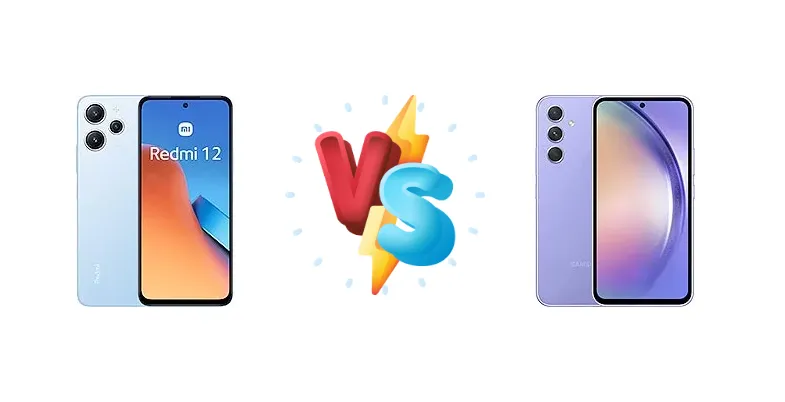
The Samsung Galaxy A54 and Xiaomi Redmi 12 represent two distinct approaches to the mid-range smartphone market. The A54 aims for a premium experience with a more powerful chipset and refined display, while the Redmi 12 focuses on delivering essential features at an aggressively competitive price. This comparison dissects their key differences to determine which device best suits your needs.
🏆 Quick Verdict
For most users, the Samsung Galaxy A54 is the superior choice. Its Exynos 1380 chipset provides a significantly smoother experience, especially for demanding tasks, and its brighter, higher-quality display enhances media consumption. However, the Redmi 12 remains a compelling option for budget-conscious buyers prioritizing battery life and basic functionality.
| Network |
|---|
| 2G bands | GSM 850 / 900 / 1800 / 1900 | GSM 850 / 900 / 1800 / 1900 |
| 3G bands | HSDPA 850 / 900 / 2100 | HSDPA 850 / 900 / 1700(AWS) / 1900 / 2100 |
| 4G bands | 1, 3, 5, 7, 8, 20, 28, 38, 40, 41 | 1, 2, 3, 4, 5, 7, 8, 12, 17, 20, 26, 28, 32, 38, 40, 41, 66 - International |
| 5G bands | - | 1, 3, 7, 8, 20, 28, 38, 40, 41, 77, 78 SA/NSA/Sub6 - International |
| Speed | HSPA, LTE | HSPA, LTE, 5G |
| Technology | GSM / HSPA / LTE | GSM / HSPA / LTE / 5G |
| | - | 25, 41, 66, 71 SA/NSA/Sub6/mmWave - USA |
| Launch |
|---|
| Announced | 2023, June 15 | 2023, March 15 |
| Status | Available. Released 2023, June 15 | Available. Released 2023, March 24 |
| Body |
|---|
| Build | Glass front, plastic frame, glass back | Glass front (Gorilla Glass 5), glass back (Gorilla Glass 5), plastic frame |
| Dimensions | 168.6 x 76.3 x 8.2 mm (6.64 x 3.00 x 0.32 in) | 158.2 x 76.7 x 8.2 mm (6.23 x 3.02 x 0.32 in) |
| SIM | Nano-SIM + Nano-SIM | · Nano-SIM + eSIM· Nano-SIM + Nano-SIM |
| Weight | 198.5 g (7.02 oz) | 202 g (7.13 oz) |
| | - | IP67 dust/water resistant (up to 1m for 30 min) |
| Display |
|---|
| Protection | - | Corning Gorilla Glass 5 |
| Resolution | 1080 x 2460 pixels (~396 ppi density) | 1080 x 2340 pixels, 19.5:9 ratio (~403 ppi density) |
| Size | 6.79 inches, 109.5 cm2 (~85.1% screen-to-body ratio) | 6.4 inches, 100.5 cm2 (~82.9% screen-to-body ratio) |
| Type | IPS LCD, 90Hz, 550 nits (peak) | Super AMOLED, 120Hz, HDR10+, 1000 nits (HBM) |
| Platform |
|---|
| CPU | Octa-core (2x2.0 GHz Cortex-A75 & 6x1.8 GHz Cortex-A55) | Octa-core (4x2.4 GHz Cortex-A78 & 4x2.0 GHz Cortex-A55) |
| Chipset | Mediatek MT6769H Helio G88 (12 nm) | Exynos 1380 (5 nm) |
| GPU | Mali-G52 MC2 | Mali-G68 MP5 |
| OS | Android 13, upgradable to Android 14, HyperOS | Android 13, up to 4 major Android upgrades, One UI 7 |
| Memory |
|---|
| Card slot | microSDXC (uses shared SIM slot) | microSDXC (uses shared SIM slot) |
| Internal | 128GB 2GB RAM, 128GB 4GB RAM, 128GB 6GB RAM, 128GB 8GB RAM, 256GB 4GB RAM, 256GB 8GB RAM | 128GB 4GB RAM, 128GB 6GB RAM, 128GB 8GB RAM, 256GB 6GB RAM, 256GB 8GB RAM |
| Main Camera |
|---|
| Features | LED flash, HDR | LED flash, panorama, HDR |
| Single | - | 32 MP, f/2.2, 26mm (wide), 1/2.8", 0.8µm |
| Triple | 50 MP, f/1.8, (wide), PDAF
8 MP, f/2.2, 120˚ (ultrawide)
2 MP (macro) | 50 MP, f/1.8, 23mm (wide), 1/1.56", 1.0µm, PDAF, OIS
12 MP, f/2.2, 13mm, 123˚ (ultrawide), 1/3.X", 1.12µm
5 MP (macro) |
| Video | 1080p@30fps | 4K@30fps, 1080p@30/60fps, 720p@480fps, gyro-EIS |
| Selfie camera |
|---|
| Single | 8 MP, f/2.1, (wide) | 32 MP, f/2.2, 26mm (wide), 1/2.8", 0.8µm |
| Video | 1080p@30fps | 4K@30fps, 1080p@30/60fps |
| Sound |
|---|
| 3.5mm jack | - | No |
| 35mm jack | Yes | No |
| Loudspeaker | Yes | Yes, with stereo speakers |
| Comms |
|---|
| Bluetooth | 5.3, A2DP, LE | 5.3, A2DP, LE |
| Infrared port | Yes | - |
| NFC | Yes (market/region dependent) | Yes (market/region dependent) |
| Positioning | GPS, GLONASS, BDS, GALILEO | GPS, GLONASS, GALILEO, BDS |
| Radio | FM radio | No |
| USB | USB Type-C | USB Type-C 2.0, OTG |
| WLAN | Wi-Fi 802.11 a/b/g/n/ac, dual-band | Wi-Fi 802.11 a/b/g/n/ac/6, dual-band, Wi-Fi Direct |
| Features |
|---|
| Sensors | Fingerprint (side-mounted), accelerometer, compass | Fingerprint (under display, optical), accelerometer, gyro, compass, barometer (USA only) |
| | - | Virtual proximity sensing |
| Battery |
|---|
| Charging | 18W wired, PD | 25W wired |
| Type | Li-Po 5000 mAh | 5000 mAh |
| Misc |
|---|
| Colors | Midnight Black, Sky Blue, Polar Silver, Moonstone Silver | Lime, Graphite, Violet, White |
| Models | 23053RN02A, 23053RN02Y, 23053RN02I, 23053RN02L, 23077RABDC | SM-A546V, SM-A546U, SM-A546U1, SM-A546B, SM-A546B/DS, SM-A546E, SM-A546E/DS, SM-A5460, SM-A546M, SM-A546M/DS, SM-A546W |
| Price | € 109.00 / $ 139.99 / £ 84.99 / ₹ 9,899 | € 210.00 / $ 119.11 / £ 169.95 / ₹ 28,999 |
| SAR | 1.09 W/kg (head) 1.06 W/kg (body) | 0.81 W/kg (head) 0.67 W/kg (body) |
| SAR EU | 0.99 W/kg (head) 0.99 W/kg (body) | 0.69 W/kg (head) 1.34 W/kg (body) |
| Tests |
|---|
| Battery life | - |
Endurance rating 119h
|
| Camera | - |
Photo / Video |
| Display | - |
Contrast ratio: Infinite (nominal) |
| Loudspeaker | - |
-26.6 LUFS (Good)
|
| Performance | - |
AnTuTu: 506678 (v9)
GeekBench: 2703 (v5.1), 2797 (v6)
GFXBench: 25fps (ES 3.1 onscreen) |
Xiaomi Redmi 12
- Superior performance with the Exynos 1380 chipset
- Brighter and higher-quality display for better viewing experience
- Faster 25W charging for quicker top-ups
- Higher price point compared to the Redmi 12
- Potentially less battery life with heavy usage (though comparable endurance)
Samsung Galaxy A54
- More affordable price point
- Excellent battery endurance
- Reliable performance for basic tasks
- Slower processor and less responsive performance
- Dimmer and lower-quality display
- Slower 18W charging
Display Comparison
The Samsung Galaxy A54 boasts a significantly brighter display, reaching 980 nits compared to the Redmi 12’s 541 nits. This translates to better visibility outdoors under direct sunlight. While the Redmi 12 achieves a respectable 1507:1 contrast ratio, Samsung’s display is listed as 'Infinite' (nominal), suggesting superior black levels and overall image quality. The lack of information on panel technology for the Redmi 12 suggests it likely uses a standard IPS LCD, while the A54 likely employs a Super AMOLED panel, offering richer colors and wider viewing angles. This difference is crucial for media consumption and gaming.
Camera Comparison
Both phones offer photo and video capabilities, but details are limited. The absence of sensor size information makes a direct comparison difficult. However, Samsung’s image processing algorithms are generally more refined, resulting in better dynamic range and color accuracy. While both likely feature a standard multi-camera setup, the A54’s superior processing power will likely translate to better low-light performance and more detailed images. The Redmi 12’s camera is likely adequate for casual snapshots, but the A54 offers a more capable and versatile camera experience.
Performance
The core difference lies in the chipsets: the Samsung Galaxy A54 utilizes the Exynos 1380 (5nm) while the Redmi 12 is powered by the MediaTek Helio G88 (12nm). The 5nm fabrication process of the Exynos 1380 is far more efficient, leading to better performance and thermal management. The A54’s CPU configuration – 4x2.4 GHz Cortex-A78 & 4x2.0 GHz Cortex-A55 – is architecturally superior to the Redmi 12’s 2x2.0 GHz Cortex-A75 & 6x1.8 GHz Cortex-A55, offering faster processing speeds and improved multi-tasking capabilities. This will be noticeable in app launch times, scrolling smoothness, and demanding games.
Battery Life
Both devices exhibit similar endurance ratings at 119 hours, despite the Redmi 12 having a larger battery (implied, as only endurance is given). This suggests the more efficient Exynos 1380 in the A54 offsets the Redmi 12’s potentially larger capacity. The A54 also supports faster 25W wired charging compared to the Redmi 12’s 18W, meaning quicker top-ups. While the Redmi 12 might last slightly longer on a single charge with conservative use, the A54’s faster charging and comparable endurance make it more convenient for power users.
Buying Guide
Buy the Xiaomi Redmi 12 if you need a reliable, long-lasting phone for everyday tasks like calling, texting, and social media, and prioritize maximizing battery endurance above all else. Buy the Samsung Galaxy A54 if you prefer a more responsive and visually appealing experience, enjoy mobile gaming, and value a more sophisticated camera system, even if it means spending more.
Frequently Asked Questions
❓ Does the Exynos 1380 in the Galaxy A54 tend to overheat during prolonged gaming sessions?
The Exynos 1380, built on a 5nm process, is generally efficient and well-managed in the Galaxy A54. While it can get warm during extended gaming, Samsung’s thermal management system typically prevents significant throttling, maintaining consistent performance for longer periods compared to the Redmi 12’s Helio G88.
❓ Is the 2MP macro camera on the Redmi 12 actually useful for taking detailed close-up photos?
Generally, 2MP macro cameras on budget phones like the Redmi 12 offer limited utility. The low resolution results in images lacking detail and sharpness. While they can capture close-up shots, the quality is often subpar compared to using the main camera with digital zoom.
❓ Can the Samsung Galaxy A54 reliably run PUBG Mobile at 60fps with high graphics settings?
Yes, the Exynos 1380 and the A54’s GPU are capable of running PUBG Mobile at 60fps with high graphics settings. The phone’s thermal management system will help maintain stable frame rates during extended gaming sessions, providing a smooth and enjoyable experience.
❓ What type of charging protocol does the Redmi 12 support beyond PD, and how does that affect compatibility with different chargers?
The Redmi 12 supports Power Delivery (PD), which is a widely adopted standard. However, it doesn't explicitly list support for Quick Charge or other proprietary fast-charging protocols. This means while it will charge with many USB-C PD chargers, it may not achieve the full 18W charging speed with all chargers.