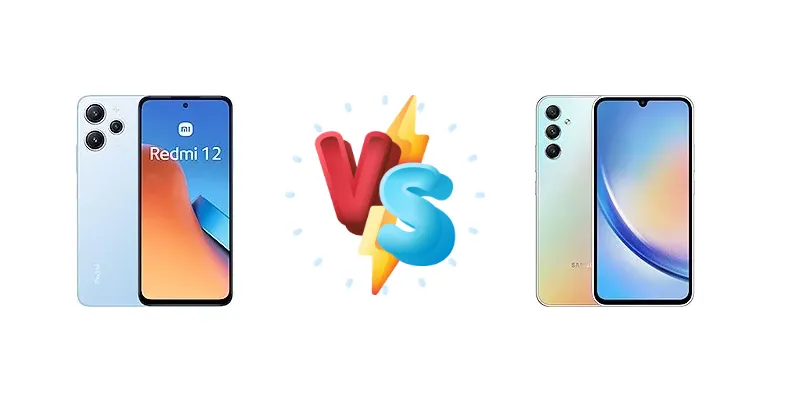
The Samsung Galaxy A34 and Xiaomi Redmi 12 represent compelling options in the crowded mid-range smartphone market. The A34 aims for a more premium experience with a brighter display and a more powerful chipset, while the Redmi 12 focuses on delivering essential features at an aggressively competitive price point. This comparison dissects their key differences to help you determine which device best suits your needs.
🏆 Quick Verdict
For most users, the Samsung Galaxy A34 is the superior choice. Its significantly brighter display (1009 nits vs 541 nits) and more powerful Dimensity 1080 chipset provide a smoother, more responsive experience. While the Redmi 12 offers excellent battery endurance, the A34’s performance advantage justifies the price difference.
| Network |
|---|
| 2G bands | GSM 850 / 900 / 1800 / 1900 | GSM 850 / 900 / 1800 / 1900 |
| 3G bands | HSDPA 850 / 900 / 2100 | HSDPA 850 / 900 / 1700(AWS) / 1900 / 2100 |
| 4G bands | 1, 3, 5, 7, 8, 20, 28, 38, 40, 41 | 1, 2, 3, 4, 5, 7, 8, 12, 17, 20, 26, 28, 32, 38, 40, 41, 66 |
| 5G bands | - | 1, 3, 7, 8, 20, 28, 38, 40, 41, 77, 78 SA/NSA/Sub6 |
| Speed | HSPA, LTE | HSPA, LTE, 5G |
| Technology | GSM / HSPA / LTE | GSM / HSPA / LTE / 5G |
| Launch |
|---|
| Announced | 2023, June 15 | 2023, March 14 |
| Status | Available. Released 2023, June 15 | Available. Released 2023, March 24 |
| Body |
|---|
| Build | Glass front, plastic frame, glass back | Glass front (Gorilla Glass 5), plastic frame, plastic back |
| Dimensions | 168.6 x 76.3 x 8.2 mm (6.64 x 3.00 x 0.32 in) | 161.3 x 78.1 x 8.2 mm (6.35 x 3.07 x 0.32 in) |
| SIM | Nano-SIM + Nano-SIM | · Nano-SIM· Nano-SIM + Nano-SIM |
| Weight | 198.5 g (7.02 oz) | 199 g (7.02 oz) |
| | - | IP67 dust/water resistant (up to 1m for 30 min) |
| Display |
|---|
| Protection | - | Corning Gorilla Glass 5 |
| Resolution | 1080 x 2460 pixels (~396 ppi density) | 1080 x 2340 pixels, 19.5:9 ratio (~390 ppi density) |
| Size | 6.79 inches, 109.5 cm2 (~85.1% screen-to-body ratio) | 6.6 inches, 106.9 cm2 (~84.9% screen-to-body ratio) |
| Type | IPS LCD, 90Hz, 550 nits (peak) | Super AMOLED, 120Hz, 1000 nits (HBM) |
| Platform |
|---|
| CPU | Octa-core (2x2.0 GHz Cortex-A75 & 6x1.8 GHz Cortex-A55) | Octa-core (2x2.6 GHz Cortex-A78 & 6x2.0 GHz Cortex-A55) |
| Chipset | Mediatek MT6769H Helio G88 (12 nm) | Mediatek Dimensity 1080 (6 nm) |
| GPU | Mali-G52 MC2 | Mali-G68 MC4 |
| OS | Android 13, upgradable to Android 14, HyperOS | Android 13, up to 4 major Android upgrades, One UI 6.1 |
| Memory |
|---|
| Card slot | microSDXC (uses shared SIM slot) | microSDXC (uses shared SIM slot) |
| Internal | 128GB 2GB RAM, 128GB 4GB RAM, 128GB 6GB RAM, 128GB 8GB RAM, 256GB 4GB RAM, 256GB 8GB RAM | 128GB 4GB RAM, 128GB 6GB RAM, 128GB 8GB RAM, 256GB 6GB RAM, 256GB 8GB RAM |
| Main Camera |
|---|
| Features | LED flash, HDR | LED flash, panorama, HDR |
| Triple | 50 MP, f/1.8, (wide), PDAF
8 MP, f/2.2, 120˚ (ultrawide)
2 MP (macro) | 48 MP, f/1.8, 26mm (wide), 1/2.0", 0.8µm, PDAF, OIS
8 MP, f/2.2, 123˚, (ultrawide), 1/4.0", 1.12µm
5 MP (macro) |
| Video | 1080p@30fps | 4K@30fps, 1080p@30/60fps, 720p@480fps |
| Selfie camera |
|---|
| Single | 8 MP, f/2.1, (wide) | 13 MP, f/2.2, 26mm (wide), 1/3.1", 1.12µm |
| Video | 1080p@30fps | 4K@30fps, 1080p@30fps |
| Sound |
|---|
| 3.5mm jack | - | No |
| 35mm jack | Yes | No |
| Loudspeaker | Yes | Yes, with stereo speakers |
| Comms |
|---|
| Bluetooth | 5.3, A2DP, LE | 5.3, A2DP, LE |
| Infrared port | Yes | - |
| NFC | Yes (market/region dependent) | Yes (market/region dependent) |
| Positioning | GPS, GLONASS, BDS, GALILEO | GPS, GLONASS, GALILEO, BDS |
| Radio | FM radio | No |
| USB | USB Type-C | USB Type-C 2.0, OTG |
| WLAN | Wi-Fi 802.11 a/b/g/n/ac, dual-band | Wi-Fi 802.11 a/b/g/n/ac, dual-band, Wi-Fi Direct |
| Features |
|---|
| Sensors | Fingerprint (side-mounted), accelerometer, compass | Fingerprint (under display, optical), accelerometer, gyro, compass |
| | - | Virtual proximity sensing |
| Battery |
|---|
| Charging | 18W wired, PD | 25W wired |
| Type | Li-Po 5000 mAh | Li-Ion 5000 mAh |
| Misc |
|---|
| Colors | Midnight Black, Sky Blue, Polar Silver, Moonstone Silver | Lime, Graphite, Violet, Silver |
| Models | 23053RN02A, 23053RN02Y, 23053RN02I, 23053RN02L, 23077RABDC | SM-A346E, SM-A346B, SM-A346B/DS, SM-A346B/DSN, SM-A346E/DS, SM-A346E/DSN, SM-A346M, SM-A346M/N, SM-A346M/DSN, SM-A3460 |
| Price | € 109.00 / $ 139.99 / £ 84.99 / ₹ 9,899 | € 169.99 / $ 175.00 / £ 164.99 / ₹ 23,999 |
| SAR | 1.09 W/kg (head) 1.06 W/kg (body) | - |
| SAR EU | 0.99 W/kg (head) 0.99 W/kg (body) | 0.55 W/kg (head) 1.49 W/kg (body) |
| Tests |
|---|
| Battery life | - |
Endurance rating 133h
|
| Camera | - |
Photo / Video |
| Display | - |
Contrast ratio: Infinite (nominal) |
| Loudspeaker | - |
-26.1 LUFS (Good)
|
| Performance | - |
AnTuTu: 472126 (v9)
GeekBench: 2316 (v5.5), 2518 (v6)
GFXBench: 23fps (ES 3.1 onscreen) |
Xiaomi Redmi 12
- Brighter and potentially more color-accurate display
- Significantly faster and more efficient processor
- Faster charging speeds (25W)
- Likely superior camera image processing
- Higher price point
- Potentially less battery endurance than Redmi 12
Samsung Galaxy A34
- More affordable price
- Excellent battery endurance (117h)
- Reliable performance for basic tasks
- PD charging support
- Dimmer display, less visible outdoors
- Slower processor, struggles with demanding tasks
- Slower charging speeds (18W)
Display Comparison
The Samsung Galaxy A34 boasts a significantly brighter display, reaching 1009 nits compared to the Redmi 12’s 541 nits. This translates to much better visibility outdoors under direct sunlight. While the Redmi 12 offers a respectable 1507:1 contrast ratio, Samsung’s ‘Infinite’ contrast ratio (likely a marketing term for a high-quality AMOLED panel, though not explicitly stated) suggests deeper blacks and more vivid colors. The lack of information on panel type for the Redmi 12 suggests it's an IPS LCD, which typically doesn't match the color accuracy or viewing angles of Samsung's AMOLED technology.
Camera Comparison
Both phones feature photo and video capabilities, but detailed sensor information is lacking. Without specifics, it’s difficult to make a definitive judgment. However, Samsung generally excels in image processing, often delivering more vibrant and detailed photos. The A34’s processor also provides more headroom for computational photography features. The Redmi 12 likely relies more heavily on software optimization to compensate for potentially less capable hardware. We can assume the A34 will offer a more refined camera experience, especially in challenging lighting conditions.
Performance
The core difference lies in the chipsets. The Samsung Galaxy A34’s MediaTek Dimensity 1080 (6nm) is a substantial upgrade over the Redmi 12’s MediaTek Helio G88 (12nm). The Dimensity 1080 utilizes more efficient 6nm fabrication, resulting in better power efficiency and sustained performance. Its CPU configuration – 2x2.6 GHz Cortex-A78 & 6x2.0 GHz Cortex-A55 – is faster than the Redmi 12’s 2x2.0 GHz Cortex-A75 & 6x1.8 GHz Cortex-A55. This means the A34 will handle demanding apps and games with greater ease and less lag. The 6nm process also implies better thermal management, reducing the likelihood of performance throttling during extended use.
Battery Life
The Samsung Galaxy A34 offers an endurance rating of 133 hours, slightly exceeding the Redmi 12’s 117 hours. While the Redmi 12’s battery capacity isn’t specified, its longer endurance suggests a larger battery. However, the A34 compensates with faster 25W wired charging (PD support) compared to the Redmi 12’s 18W charging. This means the A34 can replenish its battery more quickly, minimizing downtime. The efficiency gains from the Dimensity 1080 also contribute to the A34’s competitive battery life despite the slightly lower endurance rating.
Buying Guide
Buy the Xiaomi Redmi 12 if you prioritize maximum battery life and are on a strict budget, needing a reliable device for basic tasks like calling, texting, and light social media. Buy the Samsung Galaxy A34 if you value a brighter, more vibrant display, smoother performance for gaming and multitasking, and faster charging speeds, even if it means spending a bit more.
Frequently Asked Questions
❓ Does the MediaTek Dimensity 1080 in the Galaxy A34 get hot during prolonged gaming sessions?
The Dimensity 1080’s 6nm process is designed for improved thermal efficiency compared to the Redmi 12’s Helio G88. While some heat generation is inevitable during intensive gaming, the A34 is less likely to experience significant throttling, maintaining smoother frame rates for longer periods. Samsung’s software also likely includes thermal management features to mitigate overheating.
❓ Is the 18W charging on the Redmi 12 slow compared to the A34’s 25W charging?
Yes, 18W charging is noticeably slower than 25W. While both support PD (Power Delivery), the A34 will replenish its battery much faster, reducing downtime. Expect a significant difference in 0-100% charge times, with the A34 potentially taking around 90-120 minutes, while the Redmi 12 could take upwards of 2 hours.
❓ How does the Redmi 12’s performance hold up when multitasking with several apps open?
The Helio G88 in the Redmi 12 is adequate for basic multitasking, but it may struggle with numerous demanding apps simultaneously. You might experience some lag or app reloading when switching between applications. The A34’s Dimensity 1080 and potentially more RAM will provide a much smoother multitasking experience.