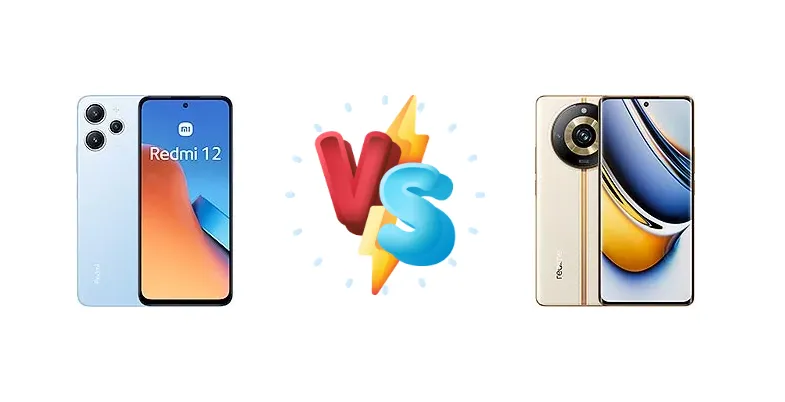
The Xiaomi Redmi 12 and Realme 11 Pro+ represent distinct approaches to the budget and mid-range smartphone market. The Redmi 12 prioritizes long-lasting battery life and affordability, while the Realme 11 Pro+ aims for a more premium experience with faster charging and a more powerful processor. This comparison dissects their key differences to help you determine which device best suits your needs.
🏆 Quick Verdict
For the average user prioritizing performance and fast charging, the Realme 11 Pro+ is the clear winner. Its Dimensity 7050 chipset and 100W charging significantly outperform the Redmi 12’s Helio G88 and 18W charging. However, the Redmi 12 remains a compelling option for those on a tighter budget who value endurance.
| Network |
|---|
| 2G bands | GSM 850 / 900 / 1800 / 1900 | GSM 850 / 900 / 1800 / 1900 |
| 3G bands | HSDPA 850 / 900 / 2100 | HSDPA 850 / 900 / 2100 |
| 4G bands | 1, 3, 5, 7, 8, 20, 28, 38, 40, 41 | 1, 3, 5, 8, 28, 38, 40, 41 - India |
| 5G bands | - | 1, 3, 5, 8, 28, 40, 41, 77, 78 SA/NSA - International |
| Speed | HSPA, LTE | HSPA, LTE, 5G |
| Technology | GSM / HSPA / LTE | GSM / CDMA / HSPA / CDMA2000 / LTE / 5G |
| | - | CDMA2000 1x |
| Launch |
|---|
| Announced | 2023, June 15 | 2023, May 10 |
| Status | Available. Released 2023, June 15 | Available. Released 2023, May 15 |
| Body |
|---|
| Build | Glass front, plastic frame, glass back | Glass front, leather or plastic back, plastic frame |
| Dimensions | 168.6 x 76.3 x 8.2 mm (6.64 x 3.00 x 0.32 in) | 161.6 x 73.9 x 8.2 mm or 8.7 mm |
| SIM | Nano-SIM + Nano-SIM | Nano-SIM + Nano-SIM |
| Weight | 198.5 g (7.02 oz) | 183 g or 189 g (6.46 oz) |
| Display |
|---|
| Resolution | 1080 x 2460 pixels (~396 ppi density) | 1080 x 2412 pixels, 20:9 ratio (~394 ppi density) |
| Size | 6.79 inches, 109.5 cm2 (~85.1% screen-to-body ratio) | 6.7 inches, 108.0 cm2 (~90.5% screen-to-body ratio) |
| Type | IPS LCD, 90Hz, 550 nits (peak) | AMOLED, 1B colors, HDR10+, 120Hz, 950 nits (peak) |
| Platform |
|---|
| CPU | Octa-core (2x2.0 GHz Cortex-A75 & 6x1.8 GHz Cortex-A55) | Octa-core (2x2.6 GHz Cortex-A78 & 6x2.0 GHz Cortex-A55) |
| Chipset | Mediatek MT6769H Helio G88 (12 nm) | Mediatek Dimensity 7050 (6 nm) |
| GPU | Mali-G52 MC2 | Mali-G68 MC4 |
| OS | Android 13, upgradable to Android 14, HyperOS | Android 13, up to 2 major Android upgrades, Realme UI 5.0 |
| Memory |
|---|
| Card slot | microSDXC (uses shared SIM slot) | No |
| Internal | 128GB 2GB RAM, 128GB 4GB RAM, 128GB 6GB RAM, 128GB 8GB RAM, 256GB 4GB RAM, 256GB 8GB RAM | 256GB 8GB RAM, 256GB 12GB RAM, 512GB 12GB RAM, 1TB 12GB RAM |
| Main Camera |
|---|
| Features | LED flash, HDR | LED flash, HDR, panorama |
| Triple | 50 MP, f/1.8, (wide), PDAF
8 MP, f/2.2, 120˚ (ultrawide)
2 MP (macro) | 200 MP, f/1.7, 23mm (wide), 1/1.4", 0.56µm, PDAF, OIS
8 MP, f/2.2, 16mm, 112˚ (ultrawide)
2 MP (macro) |
| Video | 1080p@30fps | 4K@30fps, 1080p@30/60/120/480fps, 720p@960fps, gyro-EIS |
| Selfie camera |
|---|
| Features | - | Panorama |
| Single | 8 MP, f/2.1, (wide) | 32 MP, f/2.5, 22mm (wide) |
| Video | 1080p@30fps | 1080p@30fps |
| Sound |
|---|
| 3.5mm jack | - | No |
| 35mm jack | Yes | No |
| Loudspeaker | Yes | Yes, with stereo speakers |
| | - | 24-bit/192kHz audio |
| Comms |
|---|
| Bluetooth | 5.3, A2DP, LE | 5.2, A2DP, LE, aptX HD |
| Infrared port | Yes | - |
| NFC | Yes (market/region dependent) | Yes |
| Positioning | GPS, GLONASS, BDS, GALILEO | GPS, GLONASS, GALILEO, BDS, QZSS, NavIC |
| Radio | FM radio | No |
| USB | USB Type-C | USB Type-C 2.0 |
| WLAN | Wi-Fi 802.11 a/b/g/n/ac, dual-band | Wi-Fi 802.11 a/b/g/n/ac/6, dual-band |
| Features |
|---|
| Sensors | Fingerprint (side-mounted), accelerometer, compass | Fingerprint (under display, optical), accelerometer, gyro, proximity, compass |
| Battery |
|---|
| Charging | 18W wired, PD | 100W wired |
| Type | Li-Po 5000 mAh | 5000 mAh |
| Misc |
|---|
| Colors | Midnight Black, Sky Blue, Polar Silver, Moonstone Silver | Astral Black, Sunrise Beige, Oasis Green |
| Models | 23053RN02A, 23053RN02Y, 23053RN02I, 23053RN02L, 23077RABDC | RMX3740, RMX3741 |
| Price | € 109.00 / $ 139.99 / £ 84.99 / ₹ 9,899 | € 399.90 / ₹ 27,990 |
| SAR | 1.09 W/kg (head) 1.06 W/kg (body) | - |
| SAR EU | 0.99 W/kg (head) 0.99 W/kg (body) | - |
Xiaomi Redmi 12
- Excellent battery endurance (117h)
- Higher contrast ratio for deeper blacks
- More affordable price point
- Slower processor (Helio G88)
- Significantly slower charging (18W)
Realme 11 Pro+
- Faster processor (Dimensity 7050)
- Ultra-fast 100W charging
- Brighter display for outdoor visibility
- Slightly lower battery endurance (112h)
- Potentially higher price
Display Comparison
The Realme 11 Pro+ boasts a brighter display, reaching 793 nits compared to the Redmi 12’s 541 nits. This translates to better visibility outdoors under direct sunlight. While both displays offer adequate viewing angles, the higher peak brightness of the Realme 11 Pro+ provides a more vibrant and comfortable viewing experience. Contrast ratio is significantly higher on the Redmi 12 at 1507:1, suggesting deeper blacks, but this advantage is offset by the lower overall brightness. Neither device specifies refresh rate, implying standard 60Hz panels, which is a common trade-off at this price point.
Camera Comparison
Both devices are listed as having Photo/Video capabilities, but detailed sensor information is missing. Given the Realme 11 Pro+'s positioning, it likely features a larger main sensor and potentially optical image stabilization (OIS), offering better low-light performance and sharper images. The Redmi 12, while capable, will likely rely more on software processing to compensate for a potentially smaller sensor. Without specific details, it’s safe to assume the Realme 11 Pro+ offers a more versatile and higher-quality camera experience, especially for video recording. The presence of a 2MP macro camera on either device is largely inconsequential.
Performance
The core difference lies in the chipsets. The Realme 11 Pro+ utilizes the Mediatek Dimensity 7050, built on a more efficient 6nm process, featuring two Cortex-A78 cores clocked at 2.6 GHz. This is a substantial upgrade over the Redmi 12’s Mediatek Helio G88 (12nm), which uses older Cortex-A75 cores at 2.0 GHz. The 6nm process of the Dimensity 7050 translates to better thermal efficiency, reducing throttling during sustained workloads like gaming. The CPU architecture difference means the Realme 11 Pro+ will handle demanding apps and multitasking with greater ease. While both phones likely feature similar RAM configurations, the faster processor in the Realme 11 Pro+ will be the bottleneck for performance.
Battery Life
The Redmi 12 has an endurance rating of 117 hours, slightly better than the Realme 11 Pro+'s 112 hours. However, this doesn’t tell the whole story. The Realme 11 Pro+ compensates with its blazing-fast 100W wired charging, capable of fully charging the device in a fraction of the time compared to the Redmi 12’s 18W charging. While the Redmi 12 offers longer unplugged time, the convenience of quickly topping up the Realme 11 Pro+ is a significant advantage for users who frequently use their phones throughout the day. The Redmi 12 supports PD charging, offering some level of fast charging compatibility, but it’s nowhere near the speed of the Realme’s solution.
Buying Guide
Buy the Xiaomi Redmi 12 if you need a reliable, long-lasting phone for everyday tasks and prioritize battery life over raw performance. It’s ideal for users who primarily browse, use social media, and make calls. Buy the Realme 11 Pro+ if you prefer a smoother, faster experience for gaming, multitasking, and content creation, and if you value the convenience of incredibly fast charging.
Frequently Asked Questions
❓ Does the Mediatek Dimensity 7050 in the Realme 11 Pro+ get hot during extended gaming sessions?
The Dimensity 7050 is built on a 6nm process, which is more efficient than the Redmi 12’s Helio G88. This means it generates less heat under load. While some warming is expected during prolonged gaming, the 11 Pro+ is designed to manage thermal throttling more effectively, maintaining consistent performance for longer periods.
❓ Is the 18W charging on the Redmi 12 slow compared to other phones in its price range?
Yes, 18W charging is relatively slow compared to the increasingly common 33W or 67W charging solutions found in competing devices. While it will still charge overnight, it lacks the convenience of quickly topping up the battery when you're short on time. The Realme 11 Pro+'s 100W charging is a significant advantage in this regard.
❓ Will the Redmi 12 struggle with demanding apps like video editors or graphically intensive games?
The Helio G88 in the Redmi 12 is a capable processor for everyday tasks, but it will likely struggle with demanding applications. Expect longer loading times, occasional stuttering, and potentially lower graphics settings in games. The Realme 11 Pro+'s Dimensity 7050 offers a much smoother experience for these types of workloads.