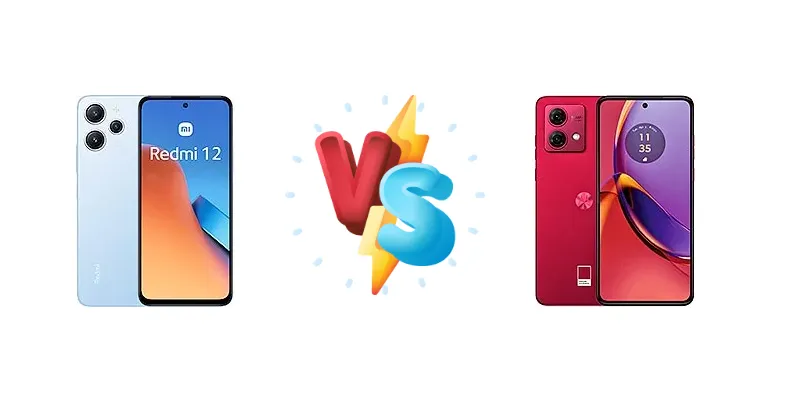
The sub-$200 smartphone market is fiercely competitive. The Xiaomi Redmi 12 and Motorola Moto G84 both aim to deliver 5G connectivity and a modern smartphone experience without breaking the bank. However, they take different approaches – the Redmi 12 focuses on endurance and a large display, while the Moto G84 prioritizes a more efficient chipset and faster charging. This comparison dissects their key differences to determine which phone offers the best value.
🏆 Quick Verdict
For the average user prioritizing future-proofing and smoother performance, the Motorola Moto G84 is the better choice. Its Snapdragon 695 5G chipset, built on a 6nm process, offers a noticeable performance advantage over the Redmi 12’s Helio G88, despite both phones sharing an identical 117-hour endurance rating.
| Network |
|---|
| 2G bands | GSM 850 / 900 / 1800 / 1900 | GSM 850 / 900 / 1800 / 1900 |
| 3G bands | HSDPA 850 / 900 / 2100 | HSDPA 850 / 900 / 1700(AWS) / 1900 / 2100 - LATAM |
| 4G bands | 1, 3, 5, 7, 8, 20, 28, 38, 40, 41 | 1, 2, 3, 4, 5, 7, 8, 12, 13, 17, 25, 26, 28, 38, 40, 41, 42, 66 - LATAM |
| 5G bands | - | 1, 2, 3, 5, 7, 26, 28, 40, 66, 78 SA/NSA/Sub6 - LATAM |
| Speed | HSPA, LTE | HSPA, LTE, 5G |
| Technology | GSM / HSPA / LTE | GSM / HSPA / LTE / 5G |
| Launch |
|---|
| Announced | 2023, June 15 | 2023, August 24 |
| Status | Available. Released 2023, June 15 | Available. Released 2023, September 08 |
| Body |
|---|
| Build | Glass front, plastic frame, glass back | Glass front, plastic frame, plastic back or eco leather back |
| Dimensions | 168.6 x 76.3 x 8.2 mm (6.64 x 3.00 x 0.32 in) | 160 x 74.4 x 7.6 mm (6.30 x 2.93 x 0.30 in) |
| SIM | Nano-SIM + Nano-SIM | Nano-SIM + Nano-SIM |
| Weight | 198.5 g (7.02 oz) | 166.8 g (5.86 oz) |
| Display |
|---|
| Resolution | 1080 x 2460 pixels (~396 ppi density) | 1080 x 2400 pixels, 20:9 ratio (~405 ppi density) |
| Size | 6.79 inches, 109.5 cm2 (~85.1% screen-to-body ratio) | 6.5 inches, 102.0 cm2 (~85.7% screen-to-body ratio) |
| Type | IPS LCD, 90Hz, 550 nits (peak) | P-OLED, 1B colors, 120Hz, 1300 nits (peak) |
| Platform |
|---|
| CPU | Octa-core (2x2.0 GHz Cortex-A75 & 6x1.8 GHz Cortex-A55) | Octa-core (2x2.2 GHz Kryo 660 Gold & 6x1.7 GHz Kryo 660 Silver) |
| Chipset | Mediatek MT6769H Helio G88 (12 nm) | Qualcomm SM6375 Snapdragon 695 5G (6 nm) |
| GPU | Mali-G52 MC2 | Adreno 619 |
| OS | Android 13, upgradable to Android 14, HyperOS | Android 13, upgradable to Android 15 |
| Memory |
|---|
| Card slot | microSDXC (uses shared SIM slot) | microSDXC (uses shared SIM slot) |
| Internal | 128GB 2GB RAM, 128GB 4GB RAM, 128GB 6GB RAM, 128GB 8GB RAM, 256GB 4GB RAM, 256GB 8GB RAM | 256GB 8GB RAM, 256GB 12GB RAM |
| Main Camera |
|---|
| Dual | - | 50 MP, f/1.9 (wide), 1/1.5", 1.0µm, PDAF, OIS
8 MP, f/2.2, 120˚ (ultrawide), 1/4.0", 1.12µm, AF |
| Features | LED flash, HDR | LED flash, HDR, panorama |
| Triple | 50 MP, f/1.8, (wide), PDAF
8 MP, f/2.2, 120˚ (ultrawide)
2 MP (macro) | - |
| Video | 1080p@30fps | 1080p@30/60fps |
| Selfie camera |
|---|
| Single | 8 MP, f/2.1, (wide) | 16 MP, f/2.5, (wide), 1.0µm |
| Video | 1080p@30fps | 1080p@30fps |
| Sound |
|---|
| 35mm jack | Yes | Yes |
| Loudspeaker | Yes | Yes, with stereo speakers |
| Comms |
|---|
| Bluetooth | 5.3, A2DP, LE | 5.1, A2DP, LE |
| Infrared port | Yes | - |
| NFC | Yes (market/region dependent) | Yes (market/region dependent) |
| Positioning | GPS, GLONASS, BDS, GALILEO | GPS, GLONASS, GALILEO |
| Radio | FM radio | FM radio (market/region dependent) |
| USB | USB Type-C | USB Type-C 2.0 |
| WLAN | Wi-Fi 802.11 a/b/g/n/ac, dual-band | Wi-Fi 802.11 a/b/g/n/ac, dual-band, Wi-Fi Direct |
| Features |
|---|
| Sensors | Fingerprint (side-mounted), accelerometer, compass | Fingerprint (under display, optical), accelerometer, gyro, proximity, compass |
| Battery |
|---|
| Charging | 18W wired, PD | 30W wired |
| Type | Li-Po 5000 mAh | Li-Po 5000 mAh |
| Misc |
|---|
| Colors | Midnight Black, Sky Blue, Polar Silver, Moonstone Silver | Marshmallow Blue, Midnight Blue, Viva Magenta |
| Models | 23053RN02A, 23053RN02Y, 23053RN02I, 23053RN02L, 23077RABDC | XT2347, XT2347-1, XT2347-2 |
| Price | € 109.00 / $ 139.99 / £ 84.99 / ₹ 9,899 | $ 399.00 / £ 189.99 / € 169.00 |
| SAR | 1.09 W/kg (head) 1.06 W/kg (body) | - |
| SAR EU | 0.99 W/kg (head) 0.99 W/kg (body) | - |
Xiaomi Redmi 12
- Potentially deeper blacks due to higher contrast ratio.
- Long battery endurance (117h).
- More affordable price point (likely).
- Less efficient Helio G88 chipset.
- Slower 18W charging.
- Lower peak display brightness.
Motorola Moto G84
- More efficient Snapdragon 695 5G chipset.
- Faster 30W charging with PD.
- Significantly brighter display (996 nits).
- Potentially less battery endurance in demanding use cases.
- May be slightly more expensive.
- Contrast ratio not specified.
Display Comparison
Both phones offer large displays, but differ significantly in brightness. The Moto G84 boasts a peak brightness of 996 nits, substantially brighter than the Redmi 12’s 541 nits. This translates to significantly better outdoor visibility for the Moto G84. While both lack high refresh rates, the brightness difference is a key differentiator. Contrast ratios are also different, with the Redmi 12 achieving 1507:1 compared to an unlisted value for the Moto G84, suggesting potentially deeper blacks on the Redmi 12, though the brighter panel on the Moto G84 will likely be more pleasing in most scenarios.
Camera Comparison
Both phones are equipped with photo and video capabilities, but detailed sensor information is lacking. Without specifics, it’s difficult to make a definitive judgment. However, the Snapdragon 695 typically offers better image signal processing (ISP) capabilities than the Helio G88, potentially leading to improved image quality on the Moto G84, particularly in low-light conditions. The absence of details regarding sensor size and aperture makes a precise comparison impossible, but the chipset advantage leans towards the Motorola.
Performance
The core difference lies in the chipsets. The Motorola Moto G84 utilizes the Qualcomm Snapdragon 695 5G (6nm), while the Redmi 12 features the MediaTek Helio G88 (12nm). The 6nm process of the Snapdragon 695 offers superior power efficiency and thermal performance. The CPU architecture also favors the Moto G84, with 2x2.2 GHz Kryo 660 Gold cores versus the Redmi 12’s 2x2.0 GHz Cortex-A75 cores. This translates to snappier app launches and smoother multitasking on the Moto G84. While both are octa-core CPUs, the Snapdragon’s architecture is more modern and efficient.
Battery Life
Interestingly, both phones share an endurance rating of 117 hours. However, this doesn’t tell the whole story. The Moto G84 compensates for potentially lower battery capacity with significantly faster 30W wired charging (with PD support), compared to the Redmi 12’s 18W charging. This means the Moto G84 can replenish its battery much quicker, minimizing downtime. The Snapdragon 695’s efficiency also contributes to better real-world battery performance despite the Redmi 12’s potentially larger capacity.
Buying Guide
Buy the Xiaomi Redmi 12 if you need maximum battery life and a large screen for media consumption, and are less concerned with demanding applications or future software updates. Buy the Motorola Moto G84 if you prefer a more responsive user experience, faster charging, and the benefits of a more modern, efficient chipset, even if it means slightly less emphasis on raw battery capacity.
Frequently Asked Questions
❓ Will the Snapdragon 695 in the Moto G84 handle demanding games like PUBG Mobile?
The Snapdragon 695 is capable of running PUBG Mobile, but you'll likely need to stick to medium graphics settings for a consistently smooth experience. The Helio G88 in the Redmi 12 will struggle more with demanding titles, requiring lower settings and potentially experiencing more frame drops.
❓ How long will it take to fully charge each phone from 0%?
With its 30W charging and PD support, the Motorola Moto G84 should fully charge in approximately 1 hour and 30 minutes to 2 hours. The Xiaomi Redmi 12’s 18W charging will take considerably longer, likely exceeding 2.5 to 3 hours for a full charge.
❓ Does the Moto G84 support carrier aggregation for faster 5G speeds?
The Snapdragon 695 generally supports carrier aggregation, which can significantly improve 5G download speeds depending on your carrier and location. The Redmi 12's Helio G88 support is less certain and may be limited, potentially resulting in slower 5G speeds.
❓ Is the camera on either phone good enough for casual social media posting?
Both phones should be adequate for casual social media photography in good lighting conditions. However, the Moto G84's potentially superior image processing, thanks to the Snapdragon 695, will likely produce more detailed and vibrant photos, especially in challenging lighting.