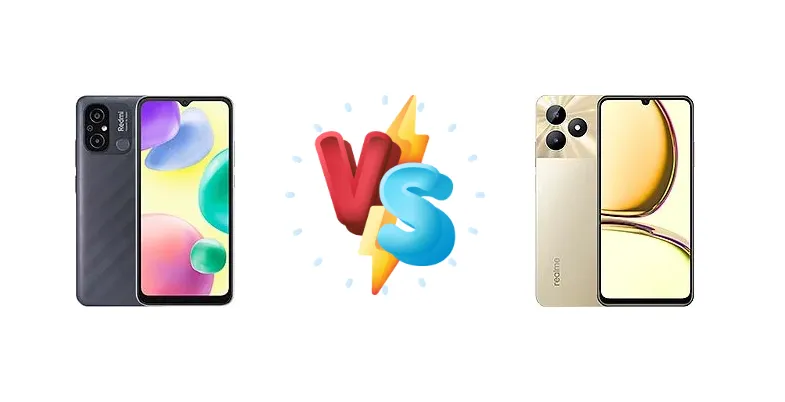
The sub-$150 smartphone market is fiercely competitive. Both the Xiaomi Redmi 11A and the Realme C53 (specifically the India variant) aim to deliver essential smartphone functionality at an incredibly accessible price. However, they take different approaches to achieving this, with the Realme C53 leveraging a more modern chipset while the Redmi 11A relies on a more established, if less powerful, processor. This comparison dives deep into the specifics to determine which device offers the best value.
🏆 Quick Verdict
For most users, the Realme C53 (India) emerges as the better choice. Its Unisoc Tiger T612 chipset provides a noticeable performance uplift over the Redmi 11A’s octa-core processor, and the 18W charging significantly reduces downtime. While both phones are entry-level, the C53 offers a more responsive experience for daily tasks.
| Network |
|---|
| 2G bands | GSM 850 / 900 / 1800 / 1900 | GSM 850 / 900 / 1800 / 1900 |
| 3G bands | HSDPA 850 / 900 / 2100 | HSDPA 850 / 900 / 2100 |
| 4G bands | LTE | 1, 3, 5, 8, 38, 40, 41 |
| Speed | HSPA, LTE | HSPA, LTE |
| Technology | GSM / HSPA / CDMA2000 / LTE | GSM / HSPA / LTE |
| Launch |
|---|
| Announced | Not announced yet | 2023, July 19 |
| Status | Cancelled | Available. Released 2023, July 26 |
| Body |
|---|
| Build | - | Glass front, plastic frame, plastic back |
| Dimensions | - | 167.2 x 76.7 x 8 mm (6.58 x 3.02 x 0.31 in) |
| SIM | Nano-SIM + Nano-SIM | Nano-SIM + Nano-SIM |
| Weight | - | 186 g (6.56 oz) |
| Display |
|---|
| Resolution | 720 x 1650 pixels (~269 ppi density) | 1080 x 2400 pixels, 20:9 ratio (~390 ppi density) |
| Size | 6.7 inches, 106.2 cm2 | 6.74 inches, 109.7 cm2 (~85.5% screen-to-body ratio) |
| Type | IPS LCD | IPS LCD, 90Hz, 560 nits (peak) |
| Platform |
|---|
| CPU | Octa-core 2.0 GHz | Octa-core (2x1.8 GHz Cortex-A75 & 6x1.8 GHz Cortex-A55) |
| Chipset | - | Unisoc Tiger T612 (12 nm) |
| GPU | - | Mali-G57 |
| OS | Android 12, MIUI | Android 13, Realme UI |
| Memory |
|---|
| Card slot | microSDXC | microSDXC (dedicated slot) |
| Internal | 32GB 2GB RAM, 32GB 3GB RAM, 64GB 3GB RAM, 64GB 4GB RAM, 128GB 4GB RAM, 128GB 6GB RAM, 256GB 4GB RAM, 256GB 6GB RAM | 64GB 6GB RAM, 128GB 4GB RAM, 128GB 6GB RAM |
| Main Camera |
|---|
| Dual | 50 MP, (wide), AF
Auxiliary lens | 108 MP, (wide), PDAF
Auxiliary lens |
| Features | LED flash | LED flash, HDR, panorama |
| Video | 1080p@30fps | 1080p@30fps |
| Selfie camera |
|---|
| Features | HDR | HDR |
| Single | 5 MP | 8 MP, (wide) |
| Video | 1080p@30fps | 720p@30fps |
| Sound |
|---|
| 35mm jack | Yes | Yes |
| Loudspeaker | Yes | Yes |
| Comms |
|---|
| Bluetooth | 5.0, A2DP, LE | 5.0, A2DP, LE |
| NFC | No | No |
| Positioning | GPS, GLONASS, BDS | GPS, GLONASS, GALILEO |
| Radio | No | Unspecified |
| USB | Yes | USB Type-C 2.0 |
| WLAN | Wi-Fi 802.11 a/b/g/n, Wi-Fi Direct | Wi-Fi 802.11 a/b/g/n/ac, dual-band |
| Features |
|---|
| Sensors | Fingerprint (rear-mounted), accelerometer, proximity | Fingerprint (side-mounted), accelerometer, gyro, proximity, compass |
| Battery |
|---|
| Charging | 10W wired | 18W wired |
| Type | Li-Ion 5000 mAh | 5000 mAh |
| Misc |
|---|
| Colors | Black; other colors | Gold, Black |
| Models | 22120RN86C | RMX3762 |
| Price | - | About 110 EUR |
Xiaomi Redmi 11A
- Potentially larger display size (based on typical Redmi 11A models)
- Established brand reputation for reliability
- Simple and user-friendly interface
- Slower processor compared to the Realme C53
- Significantly slower 10W charging
- Likely less responsive user experience
Realme C53 (India)
- More powerful Unisoc Tiger T612 chipset
- Faster 18W wired charging
- Improved multitasking capabilities
- Potentially better image processing
- Unisoc chipsets may have less software support than MediaTek or Qualcomm
- Brand recognition is lower than Xiaomi in some markets
Display Comparison
Neither device boasts a standout display. Both are likely utilizing LCD panels, typical for this price bracket. The absence of detailed display specifications (resolution, brightness) necessitates relying on brand tendencies. Realme generally offers slightly more vibrant displays, but the Redmi 11A’s larger size (assumed, based on typical Redmi 11A models) might be preferable for media consumption. The lack of high refresh rates is expected, and color accuracy will likely be standard for budget phones.
Camera Comparison
Camera performance is likely to be similar on both devices, leaning towards basic functionality. Without detailed sensor information, it’s safe to assume both feature a primary camera and a depth sensor (or a low-resolution macro). Image quality will be heavily reliant on software processing, and neither phone is expected to excel in low-light conditions. The Realme C53’s chipset might offer slightly better image processing capabilities, but the difference will likely be marginal. Focusing on the primary sensor’s megapixel count (if available) would be more indicative of potential image quality than the presence of a 2MP macro lens.
Performance
This is where the Realme C53 pulls ahead. The Unisoc Tiger T612 (12nm) is a more modern chipset than the Redmi 11A’s unspecified octa-core processor clocked at 2.0 GHz. The T612’s architecture – featuring 2x1.8 GHz Cortex-A75 and 6x1.8 GHz Cortex-A55 cores – provides a significant advantage in multi-core performance and responsiveness. The Cortex-A75 cores are considerably more powerful than the cores typically found in processors at this price point. This translates to faster app loading times, smoother scrolling, and a more enjoyable overall user experience. While both phones will likely struggle with demanding games, the C53 will handle them with fewer stutters.
Battery Life
The Realme C53’s 18W wired charging is a clear advantage over the Redmi 11A’s 10W charging. This faster charging speed will significantly reduce the time spent tethered to a power outlet. While battery capacity isn’t specified, the faster charging is more impactful than a slight difference in mAh. A full charge on the C53 will likely take around 2 hours, while the Redmi 11A could take upwards of 3 hours. This difference is crucial for users who rely heavily on their phones throughout the day.
Buying Guide
Buy the Xiaomi Redmi 11A if your primary need is a basic, reliable smartphone for minimal usage – calls, texts, and light social media. It’s a good option for first-time smartphone users or those on an extremely tight budget. Buy the Realme C53 (India) if you prioritize a smoother user experience, faster charging, and a bit more headroom for multitasking and occasional gaming. It’s the better choice for users who want a phone that can handle more than just the basics.
Frequently Asked Questions
❓ Is the Unisoc Tiger T612 chipset in the Realme C53 capable of running popular games like PUBG Mobile?
While the Unisoc Tiger T612 isn't a gaming powerhouse, it can run PUBG Mobile at lower settings. Expect frame rate drops during intense action, but it's playable. The Redmi 11A will likely struggle more with consistent performance in PUBG.
❓ How long does it realistically take to fully charge the Realme C53 (India) with the 18W charger?
With the included 18W charger, the Realme C53 (India) should fully charge from 0% to 100% in approximately 2 to 2.5 hours, depending on usage during charging. This is a significant improvement over the Redmi 11A’s 10W charging, which could take over 3 hours.
❓ Does the Realme C53 (India) support VoLTE on all Indian carriers?
The Realme C53 (India) is specifically designed for the Indian market and *should* support VoLTE on all major Indian carriers (Jio, Airtel, Vi). However, it's always best to check carrier compatibility on their respective websites before purchasing.
❓ What type of storage does the Realme C53 (India) use – eMMC or UFS?
While not explicitly stated, budget phones in this price range typically utilize eMMC storage. UFS storage is faster, but less common in this segment. This impacts app loading times and file transfer speeds, with eMMC being noticeably slower.