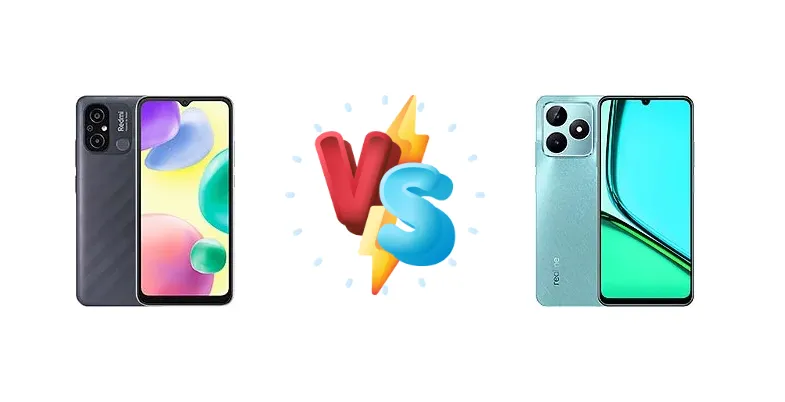
The sub-$150 smartphone market is fiercely competitive, and the Xiaomi Redmi 11A and Realme C51s are two contenders vying for your attention. While both aim to deliver essential smartphone functionality at an accessible price, they take different approaches to achieving this. The Redmi 11A relies on a MediaTek-based octa-core processor, while the C51s opts for Unisoc’s Tiger T612 chipset, and crucially, a significantly faster charging solution. This comparison will dissect their strengths and weaknesses to determine which device offers the best value.
🏆 Quick Verdict
For most users, the Realme C51s emerges as the better choice. Its Unisoc Tiger T612 chipset offers a more nuanced CPU configuration, and the 33W fast charging is a game-changer in this price bracket, reducing downtime considerably. While the Redmi 11A is still a capable device, it lags behind in both processing efficiency and charging convenience.
| Network |
|---|
| 2G bands | GSM 850 / 900 / 1800 / 1900 | GSM 850 / 900 / 1800 / 1900 |
| 3G bands | HSDPA 850 / 900 / 2100 | HSDPA 900 / 2100 |
| 4G bands | LTE | 1, 3, 5, 8, 38, 40 |
| Speed | HSPA, LTE | HSPA, LTE |
| Technology | GSM / HSPA / CDMA2000 / LTE | GSM / HSPA / LTE |
| Launch |
|---|
| Announced | Not announced yet | 2024, March 15 |
| Status | Cancelled | Available. Released 2024, March 15 |
| Body |
|---|
| Build | - | Glass front, plastic frame, plastic back |
| Dimensions | - | 167.2 x 76.7 x 7.5 mm (6.58 x 3.02 x 0.30 in) |
| SIM | Nano-SIM + Nano-SIM | Nano-SIM + Nano-SIM |
| Weight | - | 182 g (6.42 oz) |
| Display |
|---|
| Resolution | 720 x 1650 pixels (~269 ppi density) | 720 x 1600 pixels, 20:9 ratio (~260 ppi density) |
| Size | 6.7 inches, 106.2 cm2 | 6.74 inches, 109.7 cm2 (~85.5% screen-to-body ratio) |
| Type | IPS LCD | IPS LCD, 90Hz, 560 nits (peak) |
| Platform |
|---|
| CPU | Octa-core 2.0 GHz | Octa-core (2x1.8 GHz Cortex-A75 & 6x1.8 GHz Cortex-A55) |
| Chipset | - | Unisoc Tiger T612 (12 nm) |
| GPU | - | Mali-G57 |
| OS | Android 12, MIUI | Android 13, Realme UI |
| Memory |
|---|
| Card slot | microSDXC | microSDXC (dedicated slot) |
| Internal | 32GB 2GB RAM, 32GB 3GB RAM, 64GB 3GB RAM, 64GB 4GB RAM, 128GB 4GB RAM, 128GB 6GB RAM, 256GB 4GB RAM, 256GB 6GB RAM | 128GB 6GB RAM |
| Main Camera |
|---|
| Dual | 50 MP, (wide), AF
Auxiliary lens | - |
| Features | LED flash | LED flash, HDR, panorama |
| Single | - | 50 MP, f/1.8, 27mm (wide), 1/2.76", 0.64µm, PDAF
Auxiliary lens |
| Video | 1080p@30fps | 1080p@30fps |
| Selfie camera |
|---|
| Features | HDR | HDR |
| Single | 5 MP | 5 MP, f/2.2, 28mm (wide), 1/5.0", 1.12µm |
| Video | 1080p@30fps | 720p@30fps |
| Sound |
|---|
| 35mm jack | Yes | Yes |
| Loudspeaker | Yes | Yes |
| Comms |
|---|
| Bluetooth | 5.0, A2DP, LE | 5.0, A2DP, LE |
| NFC | No | Yes, 360˚ (market/region dependent) |
| Positioning | GPS, GLONASS, BDS | GPS, GLONASS, GALILEO |
| Radio | No | Unspecified |
| USB | Yes | USB Type-C |
| WLAN | Wi-Fi 802.11 a/b/g/n, Wi-Fi Direct | Wi-Fi 802.11 a/b/g/n/ac, dual-band |
| Features |
|---|
| Sensors | Fingerprint (rear-mounted), accelerometer, proximity | Fingerprint (side-mounted), accelerometer, gyro, proximity, compass |
| Battery |
|---|
| Charging | 10W wired | 33W wired, 0-50% in 28 min |
| Type | Li-Ion 5000 mAh | 5000 mAh |
| Misc |
|---|
| Colors | Black; other colors | Shiny Green, Mighty Black |
| Models | 22120RN86C | RMX3765 |
| Price | - | About 100 EUR |
Xiaomi Redmi 11A
- Simple and straightforward Android experience
- Potentially lower price point (depending on retailer)
- Familiar Xiaomi ecosystem
- Slow 10W charging
- Less powerful processor for multitasking
- Likely limited software updates
Realme C51s
- Faster 33W charging
- More efficient Unisoc Tiger T612 chipset
- Improved multitasking capabilities
- Potentially better image processing
- Unisoc chipset may have less software support
- Realme UI can be divisive
Display Comparison
Neither Xiaomi nor Realme provide display specifications beyond the basic resolution. However, given the price point, both likely utilize IPS LCD panels. The Realme C51s’s advantage isn’t in panel technology, but in the overall system optimization that the Unisoc chipset allows. Without detailed brightness or color accuracy data, it’s difficult to declare a clear winner, but the C51s’s processor may allow for more efficient display power management.
Camera Comparison
Both devices are expected to feature basic camera setups geared towards casual photography. Without detailed sensor information, it’s difficult to make a definitive judgment. However, the Realme C51s’s chipset may offer slightly better image signal processing (ISP) capabilities, potentially leading to improved image quality in favorable lighting conditions. The prevalence of 2MP macro lenses on both devices suggests they are largely marketing features and shouldn’t be a primary consideration for buyers.
Performance
The Realme C51s’s Unisoc Tiger T612 (12 nm) chipset is architecturally more sophisticated than the Redmi 11A’s octa-core 2.0 GHz processor. The T612 features a dual-cluster configuration with 2x1.8 GHz Cortex-A75 cores for demanding tasks and 6x1.8 GHz Cortex-A55 cores for efficiency. This contrasts with the Redmi 11A’s likely homogenous core setup, suggesting the C51s will handle multitasking and more intensive apps with greater fluidity. The 12nm process node of the Unisoc chip also contributes to improved power efficiency compared to a potentially larger node used in the Redmi 11A.
Battery Life
The Redmi 11A’s 10W wired charging is a significant drawback in today’s market. While battery capacity isn’t specified, 10W charging will require substantial time to fully replenish the battery. The Realme C51s, with its 33W wired charging, offers a dramatically faster charging experience, claiming a 0-50% charge in just 28 minutes. This difference in charging speed is a major advantage for users who prioritize convenience and minimal downtime. Even with a potentially smaller battery capacity, the C51s’s faster charging mitigates this concern.
Buying Guide
Buy the Xiaomi Redmi 11A if you prioritize simplicity and a familiar Android experience with minimal frills, and your usage is limited to basic tasks like calls, texts, and light social media. Buy the Realme C51s if you value faster performance for multitasking and occasional gaming, and especially if you frequently find yourself needing to quickly top up your battery – the 33W charging is a significant advantage for busy users.
Frequently Asked Questions
❓ Is the Unisoc Tiger T612 in the Realme C51s capable of handling popular games like PUBG Mobile?
The Unisoc Tiger T612 is capable of running PUBG Mobile, but expect to play at medium settings to maintain a stable frame rate. The dual-cluster CPU configuration provides a performance boost over simpler processors, but it’s not a gaming powerhouse. Lowering graphics settings will be necessary for a smoother experience.
❓ How much faster is the 33W charging on the Realme C51s compared to the 10W charging on the Redmi 11A in real-world use?
The difference is substantial. The Realme C51s can reach 50% charge in approximately 28 minutes, while the Redmi 11A will take well over two hours to achieve the same level. This means you can quickly top up the C51s during a short break, whereas the Redmi 11A requires overnight charging for a full replenishment.
❓ Does the Realme C51s support software updates and security patches for an extended period?
Realme’s software update policy for budget devices is typically less extensive than for flagship models. While you can expect some updates, the long-term support may be limited compared to Xiaomi’s offerings. Check Realme’s official website for the latest update schedule for the C51s.