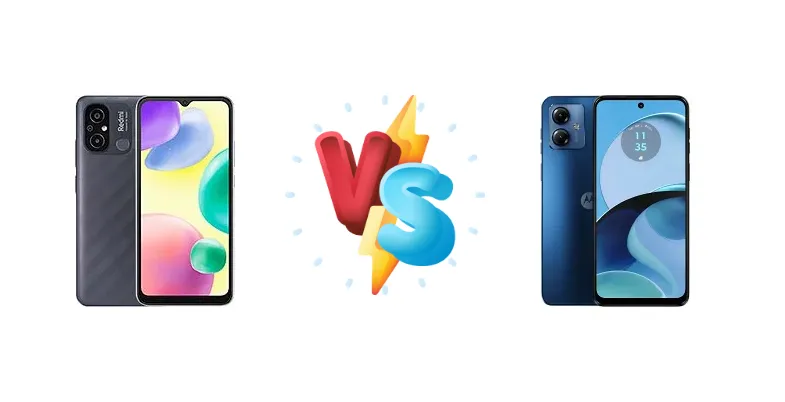
The sub-$150 smartphone market is fiercely competitive. Both the Xiaomi Redmi 11A and Motorola Moto G14 aim to deliver essential smartphone functionality at an accessible price. However, they take different approaches to achieving this, with the Moto G14 leveraging a newer chipset architecture while the Redmi 11A relies on a simpler, if less efficient, processor.
🏆 Quick Verdict
For most users, the Motorola Moto G14 is the better choice. Its Unisoc Tiger T616 chipset, built on a 12nm process, offers a more balanced performance profile and improved efficiency compared to the Redmi 11A’s octa-core processor. The faster 15W (or 20W in India) charging also provides a practical advantage.
| Network |
|---|
| 2G bands | GSM 850 / 900 / 1800 / 1900 | GSM 850 / 900 / 1800 / 1900 |
| 3G bands | HSDPA 850 / 900 / 2100 | HSDPA 850 / 900 / 1900 / 2100 |
| 4G bands | LTE | 1, 2, 3, 5, 7, 8, 20, 28, 38, 40, 41 |
| Speed | HSPA, LTE | HSPA, LTE |
| Technology | GSM / HSPA / CDMA2000 / LTE | GSM / HSPA / LTE |
| Launch |
|---|
| Announced | Not announced yet | 2023, August 01 |
| Status | Cancelled | Available. Released 2023, August 08 |
| Body |
|---|
| Build | - | Glass front (Panda glass), plastic frame, plastic back |
| Dimensions | - | 161.5 x 73.8 x 8 mm (6.36 x 2.91 x 0.31 in) |
| SIM | Nano-SIM + Nano-SIM | Nano-SIM + Nano-SIM |
| Weight | - | 177 g (6.24 oz) |
| Display |
|---|
| Protection | - | Panda glass |
| Resolution | 720 x 1650 pixels (~269 ppi density) | 1080 x 2400 pixels, 20:9 ratio (~405 ppi density) |
| Size | 6.7 inches, 106.2 cm2 | 6.5 inches, 102.0 cm2 (~85.6% screen-to-body ratio) |
| Type | IPS LCD | IPS LCD |
| Platform |
|---|
| CPU | Octa-core 2.0 GHz | Octa-core (2x2.0 GHz Cortex-A75 & 6x1.8 GHz Cortex-A55) |
| Chipset | - | Unisoc Tiger T616 (12 nm) |
| GPU | - | Mali-G57 MP1 |
| OS | Android 12, MIUI | Android 13, planned upgrade to Android 14 |
| Memory |
|---|
| Card slot | microSDXC | microSDXC (dedicated slot) |
| Internal | 32GB 2GB RAM, 32GB 3GB RAM, 64GB 3GB RAM, 64GB 4GB RAM, 128GB 4GB RAM, 128GB 6GB RAM, 256GB 4GB RAM, 256GB 6GB RAM | 128GB 4GB RAM, 256GB 8GB RAM |
| Main Camera |
|---|
| Dual | 50 MP, (wide), AF
Auxiliary lens | 50 MP, f/1.8, (wide), 0.64µm, PDAF
2 MP (macro) |
| Features | LED flash | LED flash, HDR, panorama |
| Video | 1080p@30fps | 1080p@30fps |
| Selfie camera |
|---|
| Features | HDR | - |
| Single | 5 MP | 8 MP, f/2.0, (wide), 1/4.0", 1.12µm |
| Video | 1080p@30fps | 1080p@30fps |
| Sound |
|---|
| 35mm jack | Yes | Yes |
| Loudspeaker | Yes | Yes, with stereo speakers |
| Comms |
|---|
| Bluetooth | 5.0, A2DP, LE | 5.0, A2DP, LE |
| NFC | No | Yes (market/region dependent) |
| Positioning | GPS, GLONASS, BDS | GPS, GLONASS, GALILEO |
| Radio | No | FM radio |
| USB | Yes | USB Type-C 2.0 |
| WLAN | Wi-Fi 802.11 a/b/g/n, Wi-Fi Direct | Wi-Fi 802.11 a/b/g/n/ac, dual-band |
| Features |
|---|
| Sensors | Fingerprint (rear-mounted), accelerometer, proximity | Fingerprint (side-mounted), accelerometer, gyro, proximity, compass (market/region dependent) |
| Battery |
|---|
| Charging | 10W wired | 15W wired
20W wired (India) |
| Type | Li-Ion 5000 mAh | Li-Po 5000 mAh |
| Misc |
|---|
| Colors | Black; other colors | Steel Gray, Sky Blue, Butter Cream, Pale Lilac |
| Models | 22120RN86C | PAYF0010IN |
| Price | - | $ 190.00 / £ 89.99 / € 149.90 |
Xiaomi Redmi 11A
- Potentially lower price point
- Simple and straightforward user experience
- Reliable brand reputation
- Less efficient processor
- Slower charging speed
- Likely lower performance in demanding tasks
Motorola Moto G14
- More efficient Unisoc Tiger T616 chipset
- Faster 15W/20W charging
- Improved multitasking capabilities
- May be slightly more expensive
- Unisoc chipset may have less software support
- Camera performance likely similar to Redmi 11A
Display Comparison
Neither device boasts a standout display. Both are likely to feature LCD panels, common in this price bracket. The Redmi 11A’s display specifications are not provided, but given its positioning, it’s likely a 720p+ resolution. The Moto G14’s display details are also missing, but we can expect similar resolution. The key difference will likely be color accuracy and peak brightness, areas where Motorola often provides a slight edge. Without specific nit ratings, it’s difficult to declare a clear winner.
Camera Comparison
Camera performance is likely to be similar on both devices, leaning towards basic functionality. Both will likely feature a primary camera and depth sensor, with the Redmi 11A’s camera specs being unavailable. The Moto G14’s camera details are also missing. Given the price point, image quality will be acceptable in good lighting conditions but will suffer in low light. The inclusion of a 2MP macro camera on either device is largely a marketing gimmick and offers limited practical benefit. Without sensor size or aperture information, a definitive comparison is impossible.
Performance
The Motorola Moto G14’s Unisoc Tiger T616 chipset is the performance standout. While both phones feature an octa-core CPU clocked at 2.0 GHz, the T616’s architecture – utilizing 2x Cortex-A75 and 6x Cortex-A55 cores – is significantly more efficient than a generic octa-core setup. The Cortex-A75 cores provide a noticeable boost in single-core performance, crucial for app launch speeds and general responsiveness. The Redmi 11A’s processor, lacking this architectural advantage, will likely struggle with more demanding tasks. The 12nm process node of the T616 further contributes to better thermal management, reducing the likelihood of throttling during sustained use.
Battery Life
The Moto G14’s 15W (or 20W in India) charging is a clear advantage over the Redmi 11A’s 10W charging. While battery capacity isn’t specified for either device, the faster charging speed translates to significantly less time tethered to a wall outlet. A full charge on the Redmi 11A will take considerably longer. This difference is particularly impactful for users who rely heavily on their smartphones throughout the day.
Buying Guide
Buy the Xiaomi Redmi 11A if your primary need is a basic, functional smartphone for essential tasks like calls, messaging, and light social media use, and you prioritize simplicity above all else. Buy the Motorola Moto G14 if you want a more responsive experience for multitasking, occasional gaming, and appreciate faster charging speeds, making it a better all-rounder for daily use.
Frequently Asked Questions
❓ Will the Unisoc Tiger T616 in the Moto G14 struggle with graphically intensive games like PUBG Mobile?
While the T616 isn't a gaming powerhouse, it's capable of running PUBG Mobile at medium settings with reasonable frame rates. Expect some frame drops during intense action. The Redmi 11A’s processor will likely offer a less smooth gaming experience.
❓ Does the Motorola Moto G14 support fast charging protocols beyond the 15W/20W standard?
The Moto G14 supports USB Power Delivery (USB-PD) for charging, allowing it to potentially charge faster with a compatible charger. However, the included charger is likely a 15W/20W unit. The Redmi 11A only supports 10W charging and lacks advanced charging protocols.
❓ How does the software experience differ between Xiaomi's MIUI and Motorola's near-stock Android on these phones?
Motorola's software is closer to stock Android, offering a cleaner, less cluttered experience with fewer pre-installed apps. Xiaomi's MIUI is heavily customized, offering more features but also potentially more bloatware and a steeper learning curve.