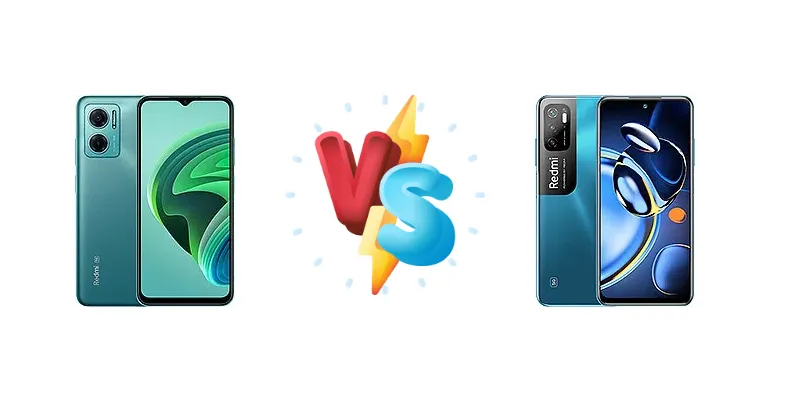
The Xiaomi Redmi 11 and Redmi Note 11SE present a curious case: two phones released by the same manufacturer, targeting similar price points, and – crucially – powered by the exact same Mediatek Dimensity 700 chipset. This comparison dissects the nuances between these devices to determine which offers the best value for your money, focusing on where potential software or regional variations might sway the decision.
🏆 Quick Verdict
For the average user prioritizing value, the Xiaomi Redmi 11 emerges as the slightly better choice. While both phones offer identical core performance thanks to the Dimensity 700, the Redmi 11's generally lower price point makes it a more compelling option, especially considering the shared 18W charging and chipset.
| Network |
|---|
| 2G bands | GSM 850 / 900 / 1800 / 1900 | GSM 850 / 900 / 1800 / 1900 |
| 3G bands | HSDPA 850 / 900 / 1700(AWS) / 1900 / 2100 | HSDPA 850 / 900 / 1900 / 2100 |
| 4G bands | 1, 2, 3, 4, 5, 7, 8, 12, 13, 17, 18, 19, 20, 26, 28, 32, 38, 40, 41, 66 | 1, 3, 5, 7, 8, 34, 38, 39, 40, 41 |
| 5G bands | 1, 3, 5, 7, 8, 20, 28, 38, 40, 41, 66, 77, 78 SA/NSA | 1, 41, 78 SA/NSA |
| Speed | HSPA, LTE, 5G | HSPA, LTE, 5G |
| Technology | GSM / HSPA / LTE / 5G | GSM / CDMA / HSPA / EVDO / LTE / 5G |
| | - | CDMA2000 1xEV-DO |
| Launch |
|---|
| Announced | Not announced yet | 2022, May 24 |
| Status | Cancelled | Available. Released 2022, May 31 |
| Body |
|---|
| Dimensions | - | 161.8 x 75.3 x 8.9 mm (6.37 x 2.96 x 0.35 in) |
| SIM | Nano-SIM + Nano-SIM | Nano-SIM + Nano-SIM |
| Weight | - | 190 g (6.70 oz) |
| Display |
|---|
| Protection | Unspecified | - |
| Resolution | 1080 x 2408 pixels, 20:9 ratio (~401 ppi density) | 1080 x 2400 pixels, 20:9 ratio (~405 ppi density) |
| Size | 6.58 inches, 104.3 cm2 | 6.5 inches, 102.0 cm2 (~83.7% screen-to-body ratio) |
| Type | IPS LCD, 90Hz | IPS LCD, 90Hz, 400 nits (typ) |
| Platform |
|---|
| CPU | Octa-core (2x2.2 GHz Cortex-A76 & 6x2.0 GHz Cortex-A55) | Octa-core (2x2.2 GHz Cortex-A76 & 6x2.0 GHz Cortex-A55) |
| Chipset | Mediatek Dimensity 700 (7 nm) | Mediatek Dimensity 700 (7 nm) |
| GPU | Mali-G57 MC2 | Mali-G57 MC2 |
| OS | Android 11, MIUI 13 | Android 11, MIUI 12.5 |
| Memory |
|---|
| Card slot | microSDXC | No |
| Internal | 64GB 4GB RAM, 128GB 4GB RAM, 128GB 6GB RAM | 128GB 4GB RAM, 128GB 8GB RAM |
| | - | UFS 2.2 |
| Main Camera |
|---|
| Dual | 50 MP, f/1.8, (wide), PDAF
Auxiliary lens | 48 MP, f/1.8, (wide), 1/2.0", 0.8µm, PDAF
2 MP (macro) |
| Features | LED flash, HDR, panorama | Dual-LED dual-tone flash, HDR, panorama |
| Single | - | 8 MP, f/2.0, (wide), 1/4.0", 1.12µm |
| Video | 1080p@30fps | 1080p@30fps |
| Selfie camera |
|---|
| Features | HDR | - |
| Single | 5 MP, f/2.0 | 8 MP, f/2.0, (wide), 1/4.0", 1.12µm |
| Video | 1080p@30fps | 1080p@30fps |
| Sound |
|---|
| 3.5mm jack | - | Yes |
| 35mm jack | Yes | Yes |
| Loudspeaker | Yes | Yes |
| Comms |
|---|
| Bluetooth | 5.1, A2DP, LE | 5.1, A2DP, LE |
| Infrared port | Yes | Yes |
| NFC | Yes (market/region dependent) | Yes |
| Positioning | GPS, GLONASS, BDS, GALILEO | GPS, GLONASS, GALILEO, BDS |
| Radio | - | No |
| USB | USB Type-C 2.0, OTG | USB Type-C 2.0, OTG |
| WLAN | Wi-Fi 802.11 a/b/g/n/ac, dual-band, Wi-Fi Direct | Wi-Fi 802.11 a/b/g/n/ac, dual-band, Wi-Fi Direct |
| Features |
|---|
| Sensors | Fingerprint (side-mounted), accelerometer, proximity, compass | Fingerprint (side-mounted), accelerometer, gyro, proximity, compass |
| | - | 24-bit/192kHz audio |
| Battery |
|---|
| Charging | 18W wired | 18W wired |
| Type | Li-Po 5000 mAh | Li-Po 5000 mAh |
| Misc |
|---|
| Colors | Gray; other colors | Blue, Black |
| Price | About 170 EUR | About 150 EUR |
Xiaomi Redmi 11
- Generally lower price point
- Identical performance to Note 11SE
- Reliable Mediatek Dimensity 700 chipset
- May have less aggressive marketing
- Potential for limited software updates
Xiaomi Redmi Note 11SE
- Potentially better regional availability
- May receive exclusive software features
- Identical performance to Redmi 11
- Typically priced slightly higher
- No significant hardware advantages
Display Comparison
Both the Redmi 11 and Note 11SE are expected to feature similar LCD panels, given their price bracket. Without specific display specs like peak brightness or color gamut coverage, it's safe to assume a comparable viewing experience. The absence of high refresh rates (90Hz or 120Hz) is typical for this segment, focusing instead on power efficiency. Bezels are likely to be similar, prioritizing cost-effectiveness over premium aesthetics. Color accuracy will likely be standard for the price point, suitable for everyday use but not ideal for color-critical work.
Camera Comparison
Camera performance is where subtle software differences *could* emerge, but the underlying hardware is likely similar. Both phones will likely feature a primary camera, an ultrawide, and potentially a macro or depth sensor. Without specific sensor sizes or aperture details, it's difficult to assess image quality definitively. However, the Dimensity 700's ISP capabilities are adequate for producing acceptable photos in good lighting conditions. Expect image processing to lean towards vibrant colors, a common Xiaomi trait. The inclusion of a 2MP macro camera is largely a marketing feature and offers limited practical benefit. OIS (Optical Image Stabilization) is unlikely to be present at this price point.
Performance
The heart of both devices is the Mediatek Dimensity 700 (7nm). This octa-core processor, with its 2x2.2 GHz Cortex-A76 and 6x2.0 GHz Cortex-A55 configuration, delivers consistent performance for everyday tasks like browsing, social media, and video streaming. The identical chipset means gaming performance will be virtually indistinguishable; expect playable frame rates in titles like PUBG Mobile at medium settings. RAM configurations are likely similar, impacting multitasking capabilities. Thermal management will be a key factor, and the 7nm process should provide reasonable efficiency, but sustained heavy loads could lead to throttling. The lack of LPDDR5X RAM, common in higher-end devices, is a limitation but expected at this price point.
Battery Life
Both the Redmi 11 and Note 11SE feature 18W wired charging, suggesting similar charging speeds – approximately 2-3 hours for a full charge. Battery capacity is not specified, but a 5000mAh battery is a common configuration for phones in this segment. The Dimensity 700's efficiency contributes to reasonable battery life, potentially lasting a full day with moderate usage. The 18W charging, while not the fastest available, is sufficient for topping up the battery overnight.
Buying Guide
Buy the Xiaomi Redmi 11 if you need a reliable, everyday smartphone with decent performance for basic tasks and light gaming, and are prioritizing the lowest possible price. Buy the Xiaomi Redmi Note 11SE if you find it at a comparable price *and* prefer the specific software features or regional availability offered in your market, as the hardware is fundamentally the same.
Frequently Asked Questions
❓ Will the Dimensity 700 struggle with demanding games like Genshin Impact?
The Dimensity 700 can run Genshin Impact, but you'll need to lower the graphics settings significantly to achieve playable frame rates. Expect compromises in visual fidelity to maintain a smooth gaming experience. It's better suited for less demanding titles.
❓ Are software updates guaranteed for both the Redmi 11 and Redmi Note 11SE?
Xiaomi's software update policy can vary by region and model. While both phones will likely receive security updates, major Android version updates are not guaranteed. Check Xiaomi's official website or community forums for specific update information for your region.
❓ Is the 18W charging slow compared to other phones?
18W charging is relatively slow compared to the 33W, 67W, or even 120W charging found on more expensive phones. However, it's adequate for overnight charging and won't damage the battery. Expect a full charge to take around 2-3 hours.