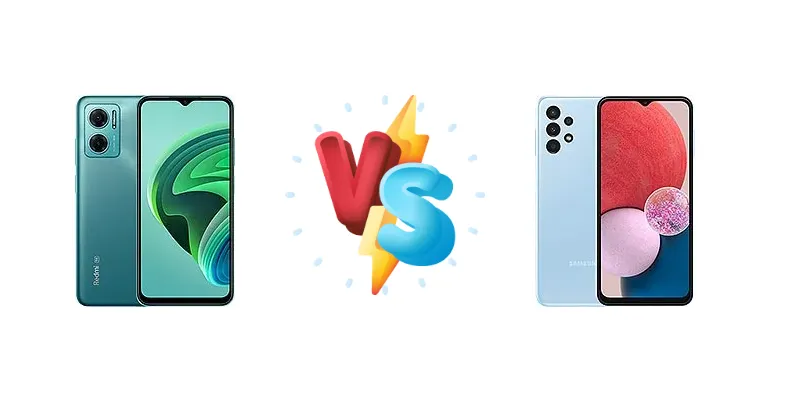
The Xiaomi Redmi 11 and Samsung Galaxy A13 represent compelling options in the ultra-competitive sub-$200 smartphone market. While both aim to deliver essential features at an accessible price, they diverge significantly in their core hardware, particularly in their chipsets. This comparison dissects those differences, revealing which phone offers the best value for various user needs.
🏆 Quick Verdict
For most users, the Xiaomi Redmi 11 emerges as the stronger choice. Its Mediatek Dimensity 700, built on a more efficient 7nm process, provides a noticeable performance advantage over the Samsung Galaxy A13’s 12nm Helio G80, translating to smoother multitasking and gaming. While the A13 offers Samsung’s brand recognition, the Redmi 11 delivers superior processing power for the price.
| Network |
|---|
| 2G bands | GSM 850 / 900 / 1800 / 1900 | GSM 850 / 900 / 1800 / 1900 |
| 3G bands | HSDPA 850 / 900 / 1700(AWS) / 1900 / 2100 | HSDPA 850 / 900 / 2100 |
| 4G bands | 1, 2, 3, 4, 5, 7, 8, 12, 13, 17, 18, 19, 20, 26, 28, 32, 38, 40, 41, 66 | 1, 3, 5, 7, 8, 20, 28, 38, 40, 41 |
| 5G bands | 1, 3, 5, 7, 8, 20, 28, 38, 40, 41, 66, 77, 78 SA/NSA | - |
| Speed | HSPA, LTE, 5G | HSPA, LTE |
| Technology | GSM / HSPA / LTE / 5G | GSM / HSPA / LTE |
| Launch |
|---|
| Announced | Not announced yet | 2022, June |
| Status | Cancelled | Available. Released 2022, July |
| Body |
|---|
| Build | - | Glass front (Gorilla Glass 5), plastic frame, plastic back |
| Dimensions | - | 165.1 x 76.4 x 8.8 mm (6.5 x 3.01 x 0.35 in) |
| SIM | Nano-SIM + Nano-SIM | · Nano-SIM· Nano-SIM + Nano-SIM |
| Weight | - | 195 g (6.88 oz) |
| Display |
|---|
| Protection | Unspecified | Corning Gorilla Glass 5 |
| Resolution | 1080 x 2408 pixels, 20:9 ratio (~401 ppi density) | 1080 x 2408 pixels, 20:9 ratio (~400 ppi density) |
| Size | 6.58 inches, 104.3 cm2 | 6.6 inches, 104.9 cm2 (~83.2% screen-to-body ratio) |
| Type | IPS LCD, 90Hz | PLS LCD |
| Platform |
|---|
| CPU | Octa-core (2x2.2 GHz Cortex-A76 & 6x2.0 GHz Cortex-A55) | Octa-core (2x2.0 GHz Cortex-A75 & 6x1.8 GHz Cortex-A55) |
| Chipset | Mediatek Dimensity 700 (7 nm) | Mediatek MT6769V/CU Helio G80 (12 nm) |
| GPU | Mali-G57 MC2 | Mali-G52 MC2 |
| OS | Android 11, MIUI 13 | Android 12, upgradable to Android 14, One UI 6.1 |
| Memory |
|---|
| Card slot | microSDXC | microSDXC (dedicated slot) |
| Internal | 64GB 4GB RAM, 128GB 4GB RAM, 128GB 6GB RAM | 32GB 3GB RAM, 32GB 4GB RAM, 64GB 4GB RAM, 128GB 4GB RAM |
| | - | eMMC 5.1 |
| Main Camera |
|---|
| Dual | 50 MP, f/1.8, (wide), PDAF
Auxiliary lens | - |
| Features | LED flash, HDR, panorama | LED flash, panorama, HDR |
| Quad | - | 50 MP, f/1.8, (wide), PDAF
5 MP, f/2.2, 123˚ (ultrawide), 1/5.0", 1.12µm
2 MP (macro)
Auxiliary lens |
| Single | - | 8 MP, f/2.2, (wide) |
| Video | 1080p@30fps | 1080p@30fps |
| Selfie camera |
|---|
| Features | HDR | - |
| Single | 5 MP, f/2.0 | 8 MP, f/2.2, (wide) |
| Video | 1080p@30fps | 1080p@30fps |
| Sound |
|---|
| 3.5mm jack | - | Yes |
| 35mm jack | Yes | Yes |
| Loudspeaker | Yes | Yes |
| Comms |
|---|
| Bluetooth | 5.1, A2DP, LE | 5.2, A2DP, LE |
| Infrared port | Yes | - |
| NFC | Yes (market/region dependent) | Yes |
| Positioning | GPS, GLONASS, BDS, GALILEO | GPS, GLONASS, GALILEO, BDS |
| Radio | - | No |
| USB | USB Type-C 2.0, OTG | USB Type-C 2.0, OTG |
| WLAN | Wi-Fi 802.11 a/b/g/n/ac, dual-band, Wi-Fi Direct | Wi-Fi 802.11 a/b/g/n/ac, dual-band, Wi-Fi Direct |
| Features |
|---|
| Sensors | Fingerprint (side-mounted), accelerometer, proximity, compass | Fingerprint (side-mounted), accelerometer, compass |
| | - | Virtual proximity sensing |
| Battery |
|---|
| Charging | 18W wired | 15W wired |
| Type | Li-Po 5000 mAh | Li-Po 5000 mAh |
| Misc |
|---|
| Colors | Gray; other colors | Black, White, Blue |
| Models | - | SM-A137F, SM-A137F/DSN, SM-A137F/DS |
| Price | About 170 EUR | About 180 EUR |
| SAR EU | - | 0.35 W/kg (head) 1.22 W/kg (body) |
Xiaomi Redmi 11
- Superior chipset performance with the Dimensity 700
- More efficient 7nm process for better battery life
- Faster 18W wired charging
- Xiaomi’s MIUI software can be polarizing
- Potential for more bloatware compared to Samsung
Samsung Galaxy A13 (SM-A137)
- Samsung’s One UI offers a refined software experience
- Strong brand recognition and customer support
- Potentially more readily available in certain markets
- Less powerful Helio G80 chipset
- Slower 15W wired charging
- 12nm process is less efficient
Display Comparison
Neither device boasts a standout display. Both likely utilize LCD panels, a common trait in this price bracket. However, detailed specs like resolution and peak brightness are missing. The key difference lies in the underlying processing power impacting UI smoothness. While the display specs are unknown, the Redmi 11’s faster processor will contribute to a more responsive user experience when navigating the interface.
Camera Comparison
Without detailed sensor information, a direct camera comparison is difficult. However, it’s reasonable to assume both phones feature a primary camera alongside supporting lenses (likely including a depth and macro sensor). The image signal processor (ISP) within the Dimensity 700 likely offers more advanced image processing capabilities than the Helio G80’s ISP, potentially resulting in better dynamic range and noise reduction in the Redmi 11’s photos. The prevalence of 2MP macro sensors on both devices suggests limited utility for detailed close-up photography; these are primarily for marketing purposes.
Performance
The core of the difference lies in the chipsets. The Redmi 11’s Mediatek Dimensity 700 (7nm) is a clear step up from the Galaxy A13’s Helio G80 (12nm). The 7nm process node inherently offers better power efficiency and transistor density, allowing for more complex designs and improved performance. The Dimensity 700’s CPU configuration – 2x2.2 GHz Cortex-A76 & 6x2.0 GHz Cortex-A55 – is also more modern and efficient than the A13’s 2x2.0 GHz Cortex-A75 & 6x1.8 GHz Cortex-A55. This translates to faster app loading times, smoother multitasking, and a more enjoyable gaming experience on the Redmi 11. The A13’s Helio G80, while capable, will likely exhibit more noticeable slowdowns under heavy load.
Battery Life
The Redmi 11 features 18W wired charging, while the Galaxy A13 is limited to 15W. While battery capacity isn’t specified, the more efficient Dimensity 700 in the Redmi 11 will likely contribute to longer battery life despite potentially having a similar capacity to the A13. The faster charging speed on the Redmi 11 also means less time tethered to a wall outlet, offering a tangible benefit for users on the go. A full charge on the Redmi 11 will likely be achieved faster than on the Galaxy A13.
Buying Guide
Buy the Xiaomi Redmi 11 if you prioritize performance for gaming, streaming, or demanding apps, and value a more modern chipset architecture. Buy the Samsung Galaxy A13 (SM-A137) if you strongly prefer the Samsung One UI experience, prioritize brand familiarity, and your usage is primarily focused on basic communication and light social media browsing. The A13 may also appeal to those who prefer a slightly more conservative design aesthetic.
Frequently Asked Questions
❓ Will the Helio G80 in the Galaxy A13 struggle with graphically intensive games like PUBG Mobile?
The Helio G80 is capable of running PUBG Mobile, but you’ll likely need to lower the graphics settings to achieve a consistently smooth frame rate. Expect occasional stuttering and frame drops, especially during intense firefights. The Redmi 11’s Dimensity 700 will provide a noticeably better gaming experience with higher and more stable frame rates.
❓ Does the Redmi 11’s MIUI software have a lot of pre-installed bloatware?
Xiaomi’s MIUI is known for including a fair amount of pre-installed apps, some of which may be considered bloatware. However, many of these apps can be uninstalled or disabled. While it requires some initial effort, you can significantly clean up the software experience on the Redmi 11.
❓ Is the 15W charging on the Galaxy A13 significantly slower than the 18W charging on the Redmi 11?
Yes, while 3W may not seem like a large difference, it translates to a noticeable time saving during charging. Expect the Redmi 11 to reach a full charge approximately 20-30 minutes faster than the Galaxy A13, depending on battery capacity.