
Xiaomi Redmi 11 vs OnePlus Nord CE 2 Lite 5G: A Detailed Comparison
| Phones Images | |||||
|---|---|---|---|---|---|
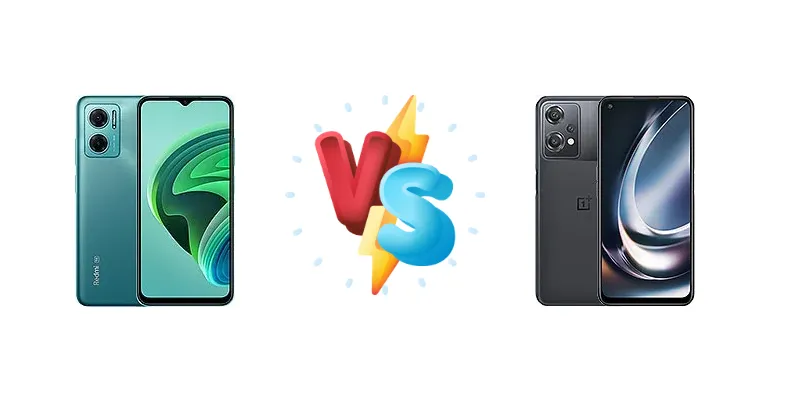
|
🏆 Quick Verdict
For the average user prioritizing faster charging and a slightly more refined software experience, the OnePlus Nord CE 2 Lite 5G emerges as the winner. Its 33W charging significantly reduces downtime, and the Snapdragon 695 offers a small but noticeable performance edge in sustained tasks. However, the Redmi 11 remains a strong contender for those on a tighter budget.
| PHONES | ||
|---|---|---|
| Phone Names | Xiaomi Redmi 11 | OnePlus Nord CE 2 Lite 5G |
| Network | ||
|---|---|---|
| 2G bands | GSM 850 / 900 / 1800 / 1900 | GSM 850 / 900 / 1800 / 1900 |
| 3G bands | HSDPA 850 / 900 / 1700(AWS) / 1900 / 2100 | HSDPA 800 / 850 / 900 / 1700(AWS) / 1900 / 2100 |
| 4G bands | 1, 2, 3, 4, 5, 7, 8, 12, 13, 17, 18, 19, 20, 26, 28, 32, 38, 40, 41, 66 | 1, 2, 3, 4, 5, 7, 8, 12, 13, 17, 18, 19, 20, 26, 28, 38, 39, 40, 41, 66 - Europe |
| 5G bands | 1, 3, 5, 7, 8, 20, 28, 38, 40, 41, 66, 77, 78 SA/NSA | 1, 3, 5, 7, 8, 20, 28, 38, 40, 41, 66, 77, 78 SA/NSA - Europe |
| Speed | HSPA, LTE, 5G | HSPA, LTE, 5G |
| Technology | GSM / HSPA / LTE / 5G | GSM / HSPA / LTE / 5G |
| Launch | ||
|---|---|---|
| Announced | Not announced yet | 2022, April 28 |
| Status | Cancelled | Available. Released 2022, April 30 |
| Body | ||
|---|---|---|
| Build | - | Glass front, plastic frame, plastic back |
| Dimensions | - | 164.3 x 75.6 x 8.5 mm (6.47 x 2.98 x 0.33 in) |
| SIM | Nano-SIM + Nano-SIM | Nano-SIM + Nano-SIM |
| Weight | - | 195 g (6.88 oz) |
| Display | ||
|---|---|---|
| Protection | Unspecified | - |
| Resolution | 1080 x 2408 pixels, 20:9 ratio (~401 ppi density) | 1080 x 2412 pixels, 20:9 ratio (~401 ppi density) |
| Size | 6.58 inches, 104.3 cm2 | 6.59 inches, 104.5 cm2 (~84.1% screen-to-body ratio) |
| Type | IPS LCD, 90Hz | IPS LCD, 120Hz |
| Platform | ||
|---|---|---|
| CPU | Octa-core (2x2.2 GHz Cortex-A76 & 6x2.0 GHz Cortex-A55) | Octa-core (2x2.2 GHz Kryo 660 Gold & 6x1.7 GHz Kryo 660 Silver) |
| Chipset | Mediatek Dimensity 700 (7 nm) | Qualcomm SM6375 Snapdragon 695 5G (6 nm) |
| GPU | Mali-G57 MC2 | Adreno 619 |
| OS | Android 11, MIUI 13 | Android 12, upgradable to Android 13, OxygenOS 13 |
| Memory | ||
|---|---|---|
| Card slot | microSDXC | microSDXC (uses shared SIM slot) |
| Internal | 64GB 4GB RAM, 128GB 4GB RAM, 128GB 6GB RAM | 128GB 6GB RAM, 128GB 8GB RAM |
| Main Camera | ||
|---|---|---|
| Dual | 50 MP, f/1.8, (wide), PDAF Auxiliary lens | - |
| Features | LED flash, HDR, panorama | LED flash, HDR, panorama |
| Triple | - | 64 MP, f/1.7, 26mm (wide), 0.7µm, PDAF 2 MP (macro) Auxiliary lens |
| Video | 1080p@30fps | 1080p@30fps |
| Selfie camera | ||
|---|---|---|
| Features | HDR | HDR |
| Single | 5 MP, f/2.0 | 16 MP, f/2.0, (wide), 1/3.0", 1.0µm |
| Video | 1080p@30fps | 1080p@30fps |
| Sound | ||
|---|---|---|
| 3.5mm jack | - | Yes |
| 35mm jack | Yes | Yes |
| Loudspeaker | Yes | Yes |
| Comms | ||
|---|---|---|
| Bluetooth | 5.1, A2DP, LE | 5.2, A2DP, LE, aptX HD |
| Infrared port | Yes | - |
| NFC | Yes (market/region dependent) | Yes (market/region dependent) |
| Positioning | GPS, GLONASS, BDS, GALILEO | GPS, GLONASS, GALILEO, BDS, QZSS |
| Radio | - | Unspecified |
| USB | USB Type-C 2.0, OTG | USB Type-C 2.0, OTG |
| WLAN | Wi-Fi 802.11 a/b/g/n/ac, dual-band, Wi-Fi Direct | Wi-Fi 802.11 a/b/g/n/ac, dual-band, Wi-Fi Direct |
| Features | ||
|---|---|---|
| Sensors | Fingerprint (side-mounted), accelerometer, proximity, compass | Fingerprint (side-mounted), accelerometer, gyro, proximity, compass |
| Battery | ||
|---|---|---|
| Charging | 18W wired | 33W wired |
| Type | Li-Po 5000 mAh | Li-Po 5000 mAh |
| Misc | ||
|---|---|---|
| Colors | Gray; other colors | Black Dusk, Blue Tide |
| Models | - | CPH2381, CPH2409 |
| Price | About 170 EUR | About 220 EUR |
| SAR | - | 1.19 W/kg (head) 0.71 W/kg (body) |
Xiaomi Redmi 11
- More affordable price point
- Potentially longer battery life due to efficient chipset
- Reliable Mediatek Dimensity 700 performance for everyday tasks
- Significantly slower 18W charging
- Less advanced ISP for potentially lower image quality
OnePlus Nord CE 2 Lite 5G
- Faster 33W wired charging
- More efficient Snapdragon 695 chipset
- Potentially better sustained performance and thermal management
- Slightly higher price tag
- May not offer a dramatically different camera experience
Display Comparison
Neither device boasts a standout display. Both likely feature LCD panels, common in this price bracket. The key difference lies under the hood: processing power. While display specs aren't provided, the focus here is on the chipsets driving the UI. The Redmi 11's Dimensity 700 will handle basic display tasks adequately, but the Snapdragon 695 in the Nord CE 2 Lite may offer smoother scrolling and transitions, especially with more complex animations.
Camera Comparison
Without detailed camera specs, a direct comparison is difficult. However, the market positioning suggests the Nord CE 2 Lite may prioritize camera features slightly more. Both phones likely feature a primary camera and depth/macro sensors. The Snapdragon 695’s ISP (Image Signal Processor) is generally more advanced than the Dimensity 700’s, potentially leading to better image processing, especially in low-light conditions. Users should expect similar performance in good lighting, but the Nord CE 2 Lite may have an edge in challenging scenarios.
Performance
The core of the difference lies in the chipsets. The OnePlus Nord CE 2 Lite 5G’s Qualcomm Snapdragon 695 (6nm) benefits from a more modern fabrication process compared to the Redmi 11’s Mediatek Dimensity 700 (7nm). This 6nm process generally translates to improved power efficiency and potentially better sustained performance. While both CPUs feature a 2x2.2 GHz core configuration, the Snapdragon utilizes Kryo 660 Gold cores, known for their efficiency, while the Redmi 11 uses Cortex-A76 cores. This means the Nord CE 2 Lite is likely to exhibit less thermal throttling during extended gaming sessions or demanding applications.
Battery Life
The Redmi 11’s 18W charging is a significant disadvantage compared to the Nord CE 2 Lite’s 33W charging. While battery capacity isn’t specified, the faster charging of the Nord CE 2 Lite will dramatically reduce the time spent tethered to a wall outlet. A full charge on the Nord CE 2 Lite is likely to take under an hour, while the Redmi 11 could easily exceed 2 hours. This difference is crucial for users who rely heavily on their phones throughout the day.
Buying Guide
Buy the Xiaomi Redmi 11 if you need a reliable, affordable 5G phone and prioritize maximizing battery life over rapid charging. It’s ideal for users who primarily browse, use social media, and make occasional calls. Buy the OnePlus Nord CE 2 Lite 5G if you prefer quicker charging speeds, a slightly more responsive user experience, and are willing to spend a bit more for those benefits. This phone suits users who frequently game, stream videos, or heavily multitask.