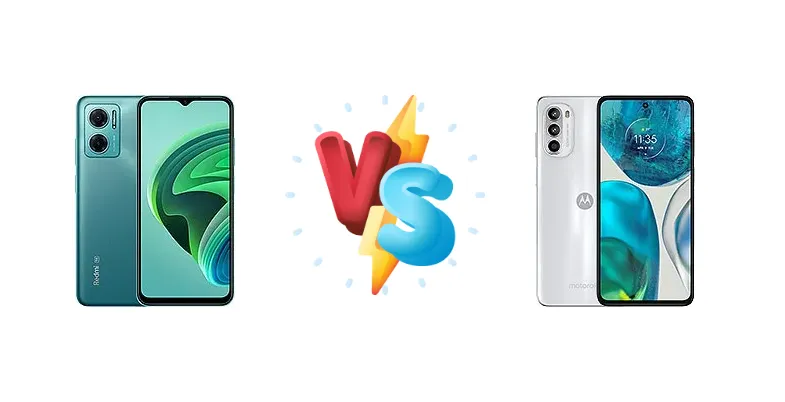
The Xiaomi Redmi 11 and Motorola Moto G52 represent compelling options in the crowded budget smartphone market. Both aim to deliver essential features at an accessible price point, but they take different approaches to achieving this. The Redmi 11 leverages MediaTek's Dimensity 700, prioritizing a balance of performance and 5G connectivity, while the Moto G52 opts for Qualcomm's Snapdragon 680, focusing on efficiency and a streamlined Android experience. This comparison will dissect their key differences to help you determine which device best suits your needs.
🏆 Quick Verdict
For the average user prioritizing consistent performance and future-proofing with 5G, the Xiaomi Redmi 11 emerges as the stronger choice. While the Moto G52 boasts faster 30W charging, the Redmi 11’s Dimensity 700 chipset offers a noticeable performance edge in demanding tasks and gaming, making it a more versatile device overall.
| Network |
|---|
| 2G bands | GSM 850 / 900 / 1800 / 1900 | GSM 850 / 900 / 1800 / 1900 |
| 3G bands | HSDPA 850 / 900 / 1700(AWS) / 1900 / 2100 | HSDPA 850 / 900 / 1700(AWS) / 1900 / 2100 |
| 4G bands | 1, 2, 3, 4, 5, 7, 8, 12, 13, 17, 18, 19, 20, 26, 28, 32, 38, 40, 41, 66 | LTE |
| 5G bands | 1, 3, 5, 7, 8, 20, 28, 38, 40, 41, 66, 77, 78 SA/NSA | - |
| Speed | HSPA, LTE, 5G | HSPA, LTE |
| Technology | GSM / HSPA / LTE / 5G | GSM / HSPA / LTE |
| Launch |
|---|
| Announced | Not announced yet | 2022, April 12 |
| Status | Cancelled | Available. Released 2022, April 20 |
| Body |
|---|
| Dimensions | - | 160.1 x 74.5 x 8 mm (6.30 x 2.93 x 0.31 in) |
| SIM | Nano-SIM + Nano-SIM | Nano-SIM + Nano-SIM |
| Weight | - | 169 g (5.96 oz) |
| | - | Water-repellent design |
| Display |
|---|
| Protection | Unspecified | - |
| Resolution | 1080 x 2408 pixels, 20:9 ratio (~401 ppi density) | 1080 x 2400 pixels, 20:9 ratio (~402 ppi density) |
| Size | 6.58 inches, 104.3 cm2 | 6.6 inches, 103.6 cm2 (~86.9% screen-to-body ratio) |
| Type | IPS LCD, 90Hz | AMOLED, 90Hz |
| Platform |
|---|
| CPU | Octa-core (2x2.2 GHz Cortex-A76 & 6x2.0 GHz Cortex-A55) | Octa-core (4x2.4 GHz Kryo 265 Gold & 4x1.9 GHz Kryo 265 Silver) |
| Chipset | Mediatek Dimensity 700 (7 nm) | Qualcomm SM6225 Snapdragon 680 4G (6 nm) |
| GPU | Mali-G57 MC2 | Adreno 610 |
| OS | Android 11, MIUI 13 | Android 12, planned upgrade to Android 13 |
| Memory |
|---|
| Card slot | microSDXC | microSDXC (uses shared SIM slot) |
| Internal | 64GB 4GB RAM, 128GB 4GB RAM, 128GB 6GB RAM | 64GB 4GB RAM, 128GB 4GB RAM, 128GB 6GB RAM, 256GB 6GB RAM |
| Main Camera |
|---|
| Dual | 50 MP, f/1.8, (wide), PDAF
Auxiliary lens | - |
| Features | LED flash, HDR, panorama | LED flash, HDR, panorama |
| Triple | - | 50 MP, f/1.8 (wide), 1/2.76", 0.64µm, PDAF
8 MP, f/2.2, 118˚ (ultrawide), 1/4.0", 1.12µm
2 MP (macro) |
| Video | 1080p@30fps | 1080p@30fps |
| Selfie camera |
|---|
| Features | HDR | - |
| Single | 5 MP, f/2.0 | 16 MP, f/2.5, (wide), 1.0µm |
| Video | 1080p@30fps | 1080p@30fps |
| Sound |
|---|
| 3.5mm jack | - | Yes |
| 35mm jack | Yes | Yes |
| Loudspeaker | Yes | Yes, with stereo speakers |
| Comms |
|---|
| Bluetooth | 5.1, A2DP, LE | 5.0, A2DP, LE |
| Infrared port | Yes | - |
| NFC | Yes (market/region dependent) | Yes (market/region dependent) |
| Positioning | GPS, GLONASS, BDS, GALILEO | GPS, GLONASS, GALILEO |
| Radio | - | Unspecified |
| USB | USB Type-C 2.0, OTG | USB Type-C 2.0 |
| WLAN | Wi-Fi 802.11 a/b/g/n/ac, dual-band, Wi-Fi Direct | Wi-Fi 802.11 a/b/g/n/ac, dual-band, Wi-Fi Direct |
| Features |
|---|
| Sensors | Fingerprint (side-mounted), accelerometer, proximity, compass | Fingerprint (side-mounted), accelerometer, gyro, proximity, compass |
| Battery |
|---|
| Charging | 18W wired | 30W wired |
| Type | Li-Po 5000 mAh | Li-Po 5000 mAh |
| Misc |
|---|
| Colors | Gray; other colors | Charcoal Gray, Porcelain White |
| Models | - | XT2221-1, XT2221-2 |
| Price | About 170 EUR | About 470 EUR |
Xiaomi Redmi 11
- Stronger processor for gaming and multitasking
- 5G connectivity for faster data speeds
- Potentially better image processing from the Dimensity 700 ISP
- Slower 18W charging
- Potentially less battery efficiency due to 7nm process
Motorola Moto G52
- Faster 30W wired charging
- Potentially better battery life due to 6nm Snapdragon 680
- Cleaner software experience (typically Motorola's strength)
- Less powerful processor for demanding tasks
- Limited to 4G connectivity
Display Comparison
Neither device boasts a standout display. Both likely utilize LCD panels, a common cost-saving measure in this segment. However, without specific display specs (resolution, brightness, color gamut), we can infer that the Moto G52’s focus on efficiency might translate to slightly better battery life during display-intensive tasks. The absence of high refresh rates on either device suggests a focus on power conservation over visual fluidity.
Camera Comparison
Without detailed camera specs beyond the presence of sensors, a direct comparison is difficult. However, the chipset plays a role. The Dimensity 700 typically offers better image signal processing (ISP) capabilities than the Snapdragon 680, potentially leading to improved image quality, especially in low-light conditions. The absence of Optical Image Stabilization (OIS) on either device suggests reliance on software stabilization, which can introduce artifacts. The usefulness of any included 2MP macro lens on either phone is questionable, serving primarily as a marketing feature.
Performance
The core difference lies in the chipsets. The Redmi 11’s MediaTek Dimensity 700 (7nm) features a dual-cluster CPU design with two Cortex-A76 cores for performance and six Cortex-A55 cores for efficiency. This contrasts with the Moto G52’s Qualcomm Snapdragon 680 (6nm), which employs a Kryo architecture. The 6nm process of the Snapdragon 680 *should* offer better power efficiency, but the Dimensity 700’s Cortex-A76 cores provide a significant uplift in single-core performance, crucial for responsive app launching and smoother multitasking. The Redmi 11 will likely handle graphically demanding games with higher frame rates. The Snapdragon 680’s Kryo 265 Gold cores, while clocked higher at 2.4 GHz, are architecturally less powerful than the A76 cores.
Battery Life
The Moto G52’s 30W wired charging is a clear advantage over the Redmi 11’s 18W charging. This translates to significantly faster top-up times. However, battery life isn’t solely determined by charging speed. The Snapdragon 680’s 6nm efficiency could offset a potentially smaller battery capacity (spec not provided) compared to the Redmi 11. The Dimensity 700, while powerful, is built on a larger 7nm node, potentially consuming more power under sustained load. The Moto G52 will likely offer quicker bursts of charging, while the Redmi 11 might provide longer sustained usage due to its chipset’s architecture.
Buying Guide
Buy the Xiaomi Redmi 11 if you need a phone capable of handling moderate gaming, benefit from 5G connectivity for faster data speeds, and prioritize overall processing power. Buy the Motorola Moto G52 if you prefer a cleaner software experience with minimal bloatware, value faster charging speeds, and primarily use your phone for basic tasks like calling, texting, and social media.
Frequently Asked Questions
❓ Will the Redmi 11’s Dimensity 700 overheat during prolonged gaming sessions?
While the Dimensity 700 is a capable chipset, its 7nm process means it will generate more heat than the Moto G52’s 6nm Snapdragon 680. However, the Redmi 11 likely incorporates thermal management solutions to mitigate overheating. Expect some throttling during extended, graphically intensive gaming, but it shouldn’t be severe enough to render the phone unusable.
❓ Is Motorola’s My UX software on the Moto G52 significantly better than Xiaomi’s MIUI?
Motorola’s My UX is known for its near-stock Android experience with minimal bloatware and a focus on simplicity. Xiaomi’s MIUI, while feature-rich, often includes pre-installed apps and a more customized interface. Users who prefer a clean, uncluttered Android experience will likely find My UX more appealing. However, MIUI offers greater customization options.
❓ Does the Snapdragon 680 in the Moto G52 support VoLTE and VoWiFi on all carriers?
Support for VoLTE (Voice over LTE) and VoWiFi (Voice over Wi-Fi) depends on the carrier and region. While the Snapdragon 680 *supports* these technologies, Motorola must specifically enable them for each carrier. It’s crucial to check compatibility with your specific carrier before purchasing the Moto G52.