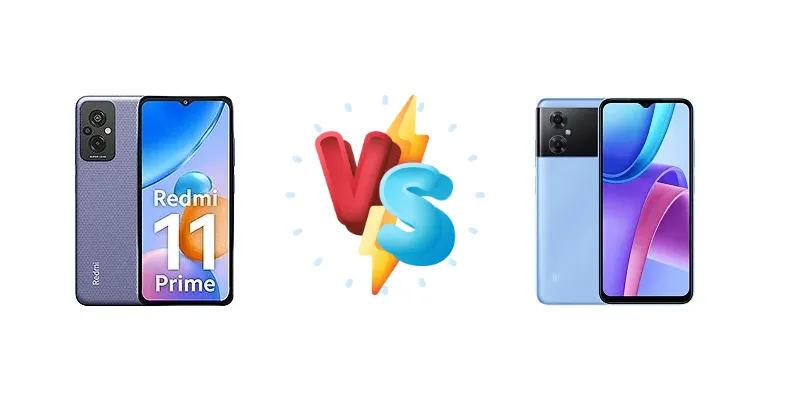
Xiaomi's Redmi series consistently delivers impressive value, but choosing between models can be tricky. The Redmi 11 Prime and Redmi Note 11R are both contenders in the budget smartphone arena. Let's break down their strengths and weaknesses to help you make the right choice.
🏆 Quick Verdict
The Redmi Note 11R edges out the 11 Prime thanks to its more efficient 7nm Dimensity 700 chipset, offering better overall performance and potentially improved battery life. While both are solid budget options, the Note 11R provides a slightly more polished experience.
| Network |
|---|
| 2G bands | GSM 850 / 900 / 1800 / 1900 | GSM 850 / 900 / 1800 / 1900 |
| 3G bands | HSDPA 850 / 900 / 2100 | HSDPA 850 / 900 / 1900 / 2100 |
| 4G bands | 40, 41 | 1, 3, 5, 7, 8, 34, 38, 39, 40, 41 |
| 5G bands | - | 1, 5, 8, 28, 41, 78 |
| Speed | HSPA, LTE | HSPA, LTE, 5G |
| Technology | GSM / HSPA / LTE | GSM / CDMA / HSPA / LTE / 5G |
| | - | CDMA 800 |
| Launch |
|---|
| Announced | 2022, September 06 | 2022, September 30 |
| Status | Available. Released 2022, September 23 | Available. Released 2022, September 30 |
| Body |
|---|
| Build | Glass front (Gorilla Glass 3), plastic frame, plastic back | Glass front, plastic frame, plastic back |
| Dimensions | 164 x 76.1 x 8.9 mm (6.46 x 3.00 x 0.35 in) | 164 x 76.1 x 8.9 mm (6.46 x 3.00 x 0.35 in) |
| SIM | Nano-SIM + Nano-SIM | Nano-SIM + Nano-SIM |
| Weight | 201 g (7.09 oz) | 201 g (7.09 oz) |
| Display |
|---|
| Protection | Corning Gorilla Glass 3 | - |
| Resolution | 1080 x 2408 pixels, 20:9 ratio (~401 ppi density) | 1080 x 2408 pixels, 20:9 ratio (~401 ppi density) |
| Size | 6.58 inches, 104.3 cm2 (~83.6% screen-to-body ratio) | 6.58 inches, 104.3 cm2 (~83.6% screen-to-body ratio) |
| Type | IPS LCD, 90Hz, 400 nits (typ) | IPS LCD, 90Hz, 400 nits (typ) |
| Platform |
|---|
| CPU | Octa-core (2x2.2 GHz Cortex-A76 & 6x2.0 GHz Cortex-A55) | Octa-core (2x2.2 GHz Cortex-A76 & 6x2.0 GHz Cortex-A55) |
| Chipset | Mediatek Helio G99 (6 nm) | Mediatek Dimensity 700 (7 nm) |
| GPU | Mali-G57 MC2 | Mali-G57 MC2 |
| OS | Android 12, MIUI 13 | Android 12, MIUI 13 |
| Memory |
|---|
| Card slot | microSDXC (dedicated slot) | microSDXC (dedicated slot) |
| Internal | 64GB 4GB RAM, 128GB 6GB RAM | 128GB 4GB RAM, 128GB 6GB RAM, 128GB 8GB RAM |
| | UFS 2.2 | UFS 2.2 |
| Main Camera |
|---|
| Dual | 50 MP, f/1.8, (wide), PDAF
2 MP (macro)
Auxiliary lens | 13 MP, f/2.2, (wide), PDAF
Auxiliary lens |
| Features | LED flash, HDR, panorama | LED flash, HDR, panorama |
| Video | 1080p@30fps | 1080p@30fps |
| Selfie camera |
|---|
| Features | HDR | HDR |
| Single | 8 MP | 5 MP, f/2.2, (wide) |
| Video | 1080p@30fps | 1080p@30fps |
| Sound |
|---|
| 3.5mm jack | Yes | Yes |
| 35mm jack | Yes | Yes |
| Loudspeaker | Yes | Yes |
| | 24-bit/192kHz audio | 24-bit/192kHz audio |
| Comms |
|---|
| Bluetooth | 5.1, A2DP, LE | 5.1, A2DP, LE |
| Infrared port | Yes | Yes |
| NFC | Yes | No |
| Positioning | GPS, GLONASS, BDS, GALILEO | GPS, GLONASS, GALILEO, BDS |
| Radio | FM radio | No |
| USB | USB Type-C 2.0, OTG | USB Type-C 2.0, OTG |
| WLAN | Wi-Fi 802.11 a/b/g/n/ac, dual-band | Wi-Fi 802.11 a/b/g/n/ac, dual-band, Wi-Fi Direct |
| Features |
|---|
| Sensors | Fingerprint (side-mounted), accelerometer, proximity, compass | Fingerprint (side-mounted), accelerometer, proximity, compass |
| Battery |
|---|
| Charging | 18W wired
5W reverse wired | 18W wired |
| Type | Li-Po 5000 mAh | Li-Po 5000 mAh |
| Misc |
|---|
| Colors | Playful Green, Flashy Black, Peppy Purple | Black, Blue, Gray |
| Models | 22071219AI | 22095RA98C |
| Price | About 160 EUR | About 160 EUR |
Xiaomi Redmi 11 Prime
- Larger screen (potentially)
- Reverse wired charging
- Competitive price
- Less efficient chipset
- Potentially lower battery life
- Older chipset architecture
Xiaomi Redmi Note 11R
- More efficient Dimensity 700 chipset
- Potentially better battery life
- Smoother performance
- No reverse wired charging
- Potentially slightly higher price
Display Comparison
Both phones likely feature a 6.67-inch FHD+ display, potentially with a 120Hz refresh rate. While both offer a similar size and resolution, panel technology (AMOLED vs IPS) could differ, impacting color accuracy and viewing angles. The 11 Prime might have slightly better brightness.
Camera Comparison
Camera specs are likely similar, potentially featuring a 50MP main sensor. However, image processing algorithms and software optimizations can significantly impact photo quality. The Note 11R's more powerful chipset might allow for better image processing, resulting in slightly improved photos, especially in low light. Both likely have a depth sensor and a front-facing camera around 16MP.
Performance
The Redmi Note 11R's Dimensity 700 (7nm) chipset is a significant advantage over the 11 Prime's Helio G99 (6nm). The Dimensity 700 generally offers better power efficiency and smoother multitasking, especially noticeable in demanding apps and games. The G99 is still capable, but the Note 11R will likely feel snappier.
Battery Life
Both phones likely have a 5000mAh battery. However, the Redmi Note 11R's more efficient Dimensity 700 chipset should translate to better battery life in real-world usage. Both support 18W wired charging, but the 11 Prime has 5W reverse wired charging, a useful feature for topping up accessories.
Buying Guide
The Xiaomi Redmi 11 Prime is ideal for users prioritizing a slightly larger screen and reverse charging capabilities on a tight budget. The Xiaomi Redmi Note 11R is better suited for those seeking smoother performance, potentially longer battery life, and a more modern chipset.
Frequently Asked Questions
❓ Is the Redmi Note 11R worth the extra money?
If performance and battery life are priorities, the Note 11R's Dimensity 700 chipset makes it a worthwhile upgrade. However, if you're on a very tight budget and value reverse charging, the 11 Prime remains a solid option.
❓ Which phone is better for gaming?
The Redmi Note 11R's Dimensity 700 will generally provide a smoother gaming experience, especially for more demanding titles. The 11 Prime can still handle casual games, but may struggle with sustained performance.