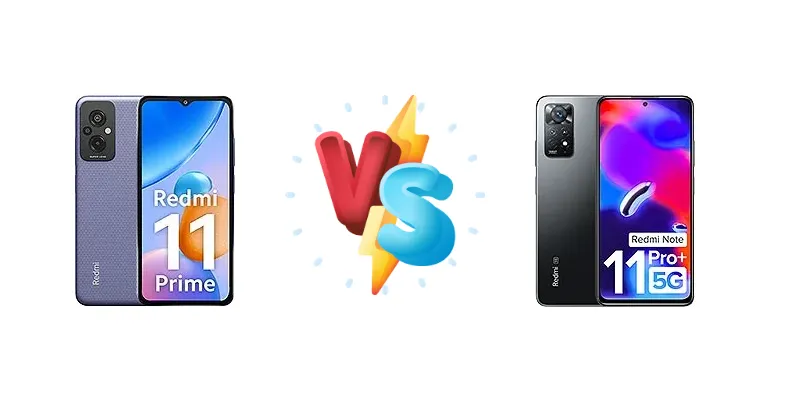
Xiaomi’s Redmi series consistently delivers compelling value, but navigating the numerous models can be tricky. We’re pitting the Redmi 11 Prime, a strong contender in the budget segment, against the more premium Redmi Note 11 Pro+ 5G (India) to determine which offers the best blend of performance, features, and price. The key difference lies in their chipsets and charging capabilities, impacting everything from gaming to daily usability.
🏆 Quick Verdict
For the average user prioritizing fast charging and a smoother overall experience, the Redmi Note 11 Pro+ 5G (India) is the clear winner. Its 67W charging dramatically reduces downtime, and the Snapdragon 695 offers a more consistent performance profile. However, the Redmi 11 Prime remains a viable option for budget-conscious users who don't demand peak performance.
| Network |
|---|
| 2G bands | GSM 850 / 900 / 1800 / 1900 | GSM 850 / 900 / 1800 / 1900 - SIM 1 & SIM 2 |
| 3G bands | HSDPA 850 / 900 / 2100 | HSDPA 850 / 900 / 1900 / 2100 |
| 4G bands | 40, 41 | 1, 3, 5, 8, 40, 41 |
| 5G bands | - | 1, 3, 5, 8, 28, 40, 78 SA/NSA |
| Speed | HSPA, LTE | HSPA, LTE-A (CA), 5G |
| Technology | GSM / HSPA / LTE | GSM / HSPA / LTE / 5G |
| Launch |
|---|
| Announced | 2022, September 06 | 2022, March 09 |
| Status | Available. Released 2022, September 23 | Available. Released 2022, March 15 |
| Body |
|---|
| Build | Glass front (Gorilla Glass 3), plastic frame, plastic back | Glass front (Gorilla Glass 5), glass back |
| Dimensions | 164 x 76.1 x 8.9 mm (6.46 x 3.00 x 0.35 in) | 164.2 x 76.1 x 8.1 mm (6.46 x 3.00 x 0.32 in) |
| SIM | Nano-SIM + Nano-SIM | Hybrid Dual SIM (Nano-SIM, dual stand-by) |
| Weight | 201 g (7.09 oz) | 202 g (7.13 oz) |
| | - | IP53, dust and splash resistant |
| Display |
|---|
| Protection | Corning Gorilla Glass 3 | Corning Gorilla Glass 5 |
| Resolution | 1080 x 2408 pixels, 20:9 ratio (~401 ppi density) | 1080 x 2400 pixels, 20:9 ratio (~395 ppi density) |
| Size | 6.58 inches, 104.3 cm2 (~83.6% screen-to-body ratio) | 6.67 inches, 107.4 cm2 (~86.0% screen-to-body ratio) |
| Type | IPS LCD, 90Hz, 400 nits (typ) | Super AMOLED, 120Hz, 700 nits, 1200 nits (peak) |
| Platform |
|---|
| CPU | Octa-core (2x2.2 GHz Cortex-A76 & 6x2.0 GHz Cortex-A55) | Octa-core (2x2.2 GHz Kryo 660 Gold & 6x1.7 GHz Kryo 660 Silver) |
| Chipset | Mediatek Helio G99 (6 nm) | Qualcomm SM6375 Snapdragon 695 5G (6 nm) |
| GPU | Mali-G57 MC2 | Adreno 619 |
| OS | Android 12, MIUI 13 | Android 11, MIUI 13 |
| Memory |
|---|
| Card slot | microSDXC (dedicated slot) | microSDXC (uses shared SIM slot) |
| Internal | 64GB 4GB RAM, 128GB 6GB RAM | 64GB 6GB RAM, 128GB 6GB RAM, 128GB 8GB RAM, 256GB 8GB RAM |
| | UFS 2.2 | UFS 2.2 |
| Main Camera |
|---|
| Dual | 50 MP, f/1.8, (wide), PDAF
2 MP (macro)
Auxiliary lens | - |
| Features | LED flash, HDR, panorama | LED flash, HDR, panorama |
| Triple | - | 108 MP, f/1.9, 26mm (wide), 1/1.52", 0.7µm, PDAF
8 MP, f/2.2, 118˚ (ultrawide)
2 MP, f/2.4, (macro) |
| Video | 1080p@30fps | 1080p@30fps |
| Selfie camera |
|---|
| Features | HDR | - |
| Single | 8 MP | 16 MP, f/2.5, (wide), 1/3.06" 1.0µm |
| Video | 1080p@30fps | 1080p@30fps |
| Sound |
|---|
| 3.5mm jack | Yes | Yes |
| 35mm jack | Yes | - |
| Loudspeaker | Yes | Yes, with stereo speakers |
| | 24-bit/192kHz audio | 24-bit/192kHz audio |
| Comms |
|---|
| Bluetooth | 5.1, A2DP, LE | 5.1, A2DP, LE |
| Infrared port | Yes | Yes |
| NFC | Yes | No |
| Positioning | GPS, GLONASS, BDS, GALILEO | GPS, GLONASS, BDS, GALILEO |
| Radio | FM radio | Unspecified |
| USB | USB Type-C 2.0, OTG | USB Type-C 2.0, OTG |
| WLAN | Wi-Fi 802.11 a/b/g/n/ac, dual-band | Wi-Fi 802.11 a/b/g/n/ac, dual-band, Wi-Fi Direct |
| Features |
|---|
| Sensors | Fingerprint (side-mounted), accelerometer, proximity, compass | Fingerprint (side-mounted), accelerometer, gyro, proximity, compass |
| Battery |
|---|
| Charging | 18W wired
5W reverse wired | 67W wired, PD3.0, QC3, 50% in 15 min, 100% in 42 min (advertised) |
| Type | Li-Po 5000 mAh | Li-Po 5000 mAh, non-removable |
| Misc |
|---|
| Colors | Playful Green, Flashy Black, Peppy Purple | Mirage Blue, Phantom White, Stealth Black |
| Models | 22071219AI | 2201116SI |
| Price | About 160 EUR | About 250 EUR |
Xiaomi Redmi 11 Prime
- More affordable price point
- Efficient Mediatek Helio G99 chipset
- Reverse wired charging capability
- Slow 18W charging
- Potentially lower sustained performance
Xiaomi Redmi Note 11 Pro+ 5G (India)
- Ultra-fast 67W charging
- More efficient Snapdragon 695 chipset
- Likely superior image processing
- Higher price tag
- May not offer a dramatically different experience for basic users
Display Comparison
While both devices likely feature similar LCD panels, the comparison focuses on performance. Details on panel type, resolution, and refresh rate are missing, but the core difference lies elsewhere. The absence of high refresh rate information suggests both are likely 60Hz, making the chipset and charging more critical differentiators.
Camera Comparison
Without detailed camera specs beyond the main sensor, a direct comparison is limited. However, the Redmi Note 11 Pro+ 5G (India) likely benefits from Qualcomm’s image signal processor (ISP), which generally offers superior image processing capabilities compared to Mediatek’s equivalent. This translates to better dynamic range, noise reduction, and overall image quality, particularly in challenging lighting conditions. The absence of OIS information on either device suggests reliance on software stabilization.
Performance
The chipset is where these phones diverge significantly. The Redmi 11 Prime utilizes the Mediatek Helio G99 (6nm), featuring a dual-core Cortex-A76 setup clocked at 2.2 GHz, paired with six Cortex-A55 cores at 2.0 GHz. The Redmi Note 11 Pro+ 5G (India) employs the Qualcomm Snapdragon 695 5G (6nm) with a dual-core Kryo 660 Gold configuration at 2.2 GHz and six Kryo 660 Silver cores at 1.7 GHz. While both are 6nm chips, the Snapdragon 695 generally exhibits better sustained performance and thermal management due to Qualcomm’s optimizations. The lower clock speed on the Silver cores of the Snapdragon 695 is offset by its more efficient architecture, potentially leading to less throttling during extended gaming sessions. The G99 prioritizes raw clock speed, which can be beneficial in short bursts, but may struggle with prolonged workloads.
Battery Life
The Redmi 11 Prime’s 18W charging is a significant drawback compared to the Redmi Note 11 Pro+ 5G (India)’s 67W charging. The Note 11 Pro+ advertises a 50% charge in 15 minutes and 100% in 42 minutes. While battery capacity isn’t specified, the faster charging speed dramatically reduces downtime. The Redmi 11 Prime will require considerably longer to fully charge, impacting usability for power users. The difference in charging speed is the most substantial practical advantage of the Note 11 Pro+.
Buying Guide
Buy the Xiaomi Redmi 11 Prime if you need a reliable daily driver for basic tasks, social media, and light gaming, and prioritize maximizing value for your money. Buy the Xiaomi Redmi Note 11 Pro+ 5G (India) if you prefer faster charging, a more capable chipset for demanding apps and games, and are willing to spend a bit more for a noticeably smoother user experience.
Frequently Asked Questions
❓ Will the Snapdragon 695 in the Redmi Note 11 Pro+ 5G (India) handle demanding games like Genshin Impact?
The Snapdragon 695 is capable of running Genshin Impact, but you’ll likely need to lower the graphics settings to medium or low to maintain a stable frame rate. The Helio G99 in the Redmi 11 Prime will struggle more with this title, requiring even lower settings and potentially experiencing noticeable lag.
❓ How much faster is the 67W charging on the Redmi Note 11 Pro+ 5G (India) compared to the 18W charging on the Redmi 11 Prime in real-world use?
The 67W charging on the Note 11 Pro+ can fully charge the phone in approximately 42 minutes (advertised), while the 18W charging on the 11 Prime will likely take over 2 hours. This difference is substantial and significantly impacts convenience, especially for users who frequently need to top up their battery.
❓ Is the difference in chipset performance between the Helio G99 and Snapdragon 695 noticeable for everyday tasks like browsing and social media?
For basic tasks, the difference will be minimal. Both chipsets are capable of handling everyday tasks smoothly. However, when multitasking or running more demanding apps, the Snapdragon 695 will provide a more responsive and fluid experience.