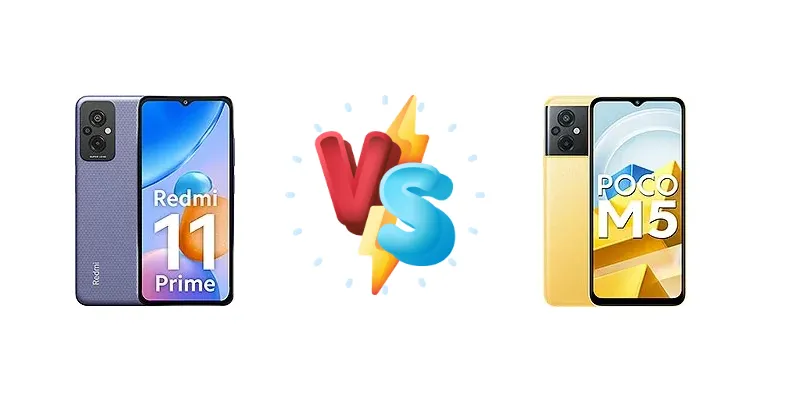
Xiaomi's budget phone lineup is incredibly competitive, making it tough to choose between models. The Redmi 11 Prime and Poco M5 both offer compelling features at affordable prices, but which one reigns supreme? This comprehensive comparison will break down their strengths and weaknesses to help you make the right decision.
🏆 Quick Verdict
The Poco M5 edges out the Redmi 11 Prime primarily due to its exceptional battery life and slightly better display brightness. Both share the same chipset, but the Poco M5's optimized software and longer endurance make it the more practical choice for most users.
| Network |
|---|
| 2G bands | GSM 850 / 900 / 1800 / 1900 | GSM 850 / 900 / 1800 / 1900 |
| 3G bands | HSDPA 850 / 900 / 2100 | HSDPA 850 / 900 / 1700(AWS) / 1900 / 2100 |
| 4G bands | 40, 41 | 1, 2, 3, 4, 5, 7, 8, 20, 28, 38, 40, 41 |
| Speed | HSPA, LTE | HSPA, LTE |
| Technology | GSM / HSPA / LTE | GSM / HSPA / LTE |
| Launch |
|---|
| Announced | 2022, September 06 | 2022, September 05 |
| Status | Available. Released 2022, September 23 | Available. Released 2022, September 13 |
| Body |
|---|
| Build | Glass front (Gorilla Glass 3), plastic frame, plastic back | Glass front (Gorilla Glass 3), plastic frame, plastic back |
| Dimensions | 164 x 76.1 x 8.9 mm (6.46 x 3.00 x 0.35 in) | 164 x 76.1 x 8.9 mm (6.46 x 3.00 x 0.35 in) |
| SIM | Nano-SIM + Nano-SIM | Nano-SIM + Nano-SIM |
| Weight | 201 g (7.09 oz) | 201 g (7.09 oz) |
| Display |
|---|
| Protection | Corning Gorilla Glass 3 | Corning Gorilla Glass 3 |
| Resolution | 1080 x 2408 pixels, 20:9 ratio (~401 ppi density) | 1080 x 2408 pixels, 20:9 ratio (~401 ppi density) |
| Size | 6.58 inches, 104.3 cm2 (~83.6% screen-to-body ratio) | 6.58 inches, 104.3 cm2 (~83.6% screen-to-body ratio) |
| Type | IPS LCD, 90Hz, 400 nits (typ) | IPS LCD, 90Hz, 500 nits (HBM) |
| Platform |
|---|
| CPU | Octa-core (2x2.2 GHz Cortex-A76 & 6x2.0 GHz Cortex-A55) | Octa-core (2x2.2 GHz Cortex-A76 & 6x2.0 GHz Cortex-A55) |
| Chipset | Mediatek Helio G99 (6 nm) | Mediatek Helio G99 (6 nm) |
| GPU | Mali-G57 MC2 | Mali-G57 MC2 |
| OS | Android 12, MIUI 13 | Android 12, upgradable to Android 14, HyperOS |
| Memory |
|---|
| Card slot | microSDXC (dedicated slot) | microSDXC (dedicated slot) |
| Internal | 64GB 4GB RAM, 128GB 6GB RAM | 64GB 4GB RAM, 128GB 4GB RAM, 128GB 6GB RAM |
| | UFS 2.2 | UFS 2.2 |
| Main Camera |
|---|
| Dual | 50 MP, f/1.8, (wide), PDAF
2 MP (macro)
Auxiliary lens | - |
| Features | LED flash, HDR, panorama | LED flash, HDR, panorama |
| Triple | - | 50 MP, f/1.8, (wide), PDAF
2 MP (macro)
Auxiliary lens |
| Video | 1080p@30fps | 1080p@30fps |
| Selfie camera |
|---|
| Features | HDR | - |
| Single | 8 MP | 5 MP, f/2.2, (wide), 1/5.0", 1.12µm |
| Video | 1080p@30fps | 1080p@30fps |
| Sound |
|---|
| 3.5mm jack | Yes | Yes |
| 35mm jack | Yes | Yes |
| Loudspeaker | Yes | Yes |
| | 24-bit/192kHz audio | - |
| Comms |
|---|
| Bluetooth | 5.1, A2DP, LE | 5.3, A2DP, LE |
| Infrared port | Yes | Yes |
| NFC | Yes | Yes |
| Positioning | GPS, GLONASS, BDS, GALILEO | GPS, GLONASS, GALILEO, BDS |
| Radio | FM radio | FM radio |
| USB | USB Type-C 2.0, OTG | USB Type-C 2.0, OTG |
| WLAN | Wi-Fi 802.11 a/b/g/n/ac, dual-band | Wi-Fi 802.11 a/b/g/n/ac, dual-band, Wi-Fi Direct |
| Features |
|---|
| Sensors | Fingerprint (side-mounted), accelerometer, proximity, compass | Fingerprint (side-mounted), accelerometer, proximity, compass |
| Battery |
|---|
| Charging | 18W wired
5W reverse wired | 18W wired |
| Type | Li-Po 5000 mAh | Li-Po 5000 mAh |
| Misc |
|---|
| Colors | Playful Green, Flashy Black, Peppy Purple | Black, Green, Yellow |
| Models | 22071219AI | 22071219CG |
| Price | About 160 EUR | About 100 EUR |
| SAR | - | 1.04 W/kg (head) 0.83 W/kg (body) |
| SAR EU | - | 0.52 W/kg (head) 0.83 W/kg (body) |
| Tests |
|---|
| Battery life | - |
Endurance rating 121h
|
| Camera | - |
Photo / Video |
| Display | - |
Contrast ratio: 1363:1 |
| Loudspeaker | - |
-27.6 LUFS (Good)
|
| Performance | - |
AnTuTu: 386311 (v9)
GeekBench: 1896 (v5.1)
GFXBench: 12fps (ES 3.1 onscreen) |
Xiaomi Redmi 11 Prime
- Sleek design
- 90Hz refresh rate
- Decent camera
- Shorter battery life
- Potentially less optimized software
Xiaomi Poco M5
- Exceptional battery life
- Bright display
- Good value
- Design may be less appealing to some
- Software updates can be delayed
Display Comparison
Both phones feature a 6.71-inch FHD+ display with a 90Hz refresh rate. However, the Poco M5 boasts a measured peak brightness of 448 nits and a contrast ratio of 1363:1, offering slightly better visibility in bright conditions and richer colors compared to the Redmi 11 Prime. While both are good, the Poco M5 has a slight edge.
Camera Comparison
Camera specs are similar, but image processing differs. The Poco M5 generally produces more vibrant and saturated images, while the Redmi 11 Prime might offer slightly more natural colors. Low-light performance is adequate on both, but not exceptional. Video recording capabilities are comparable.
Performance
Powered by the same Mediatek Helio G99 chipset and Octa-core CPU, performance is largely comparable between the two devices. Real-world performance will depend on software optimization; the Poco M5 often benefits from MIUI's efficiency. Expect smooth everyday usage and decent gaming capabilities on both.
Battery Life
This is where the Poco M5 truly shines. With an endurance rating of 121 hours, it offers significantly longer battery life than the Redmi 11 Prime. The Poco M5 is a champion for users who need a phone that can last through multiple days of moderate use.
Buying Guide
The Xiaomi Redmi 11 Prime is ideal for users prioritizing a slightly more modern design and potentially a better software experience (depending on updates). The Xiaomi Poco M5 is perfect for those who demand all-day (or multi-day) battery life and a vibrant display, even if it means sacrificing some of the latest design trends.
Frequently Asked Questions
❓ Which phone has better gaming performance?
Both phones offer similar gaming performance thanks to the Helio G99 chipset. However, the Poco M5's potentially better thermal management might allow for slightly more sustained performance during extended gaming sessions.
❓ Does the Redmi 11 Prime get faster software updates?
Historically, Redmi devices have sometimes received slightly faster software updates than Poco devices, but this can vary. It's best to check the current update status for both phones before making a decision.