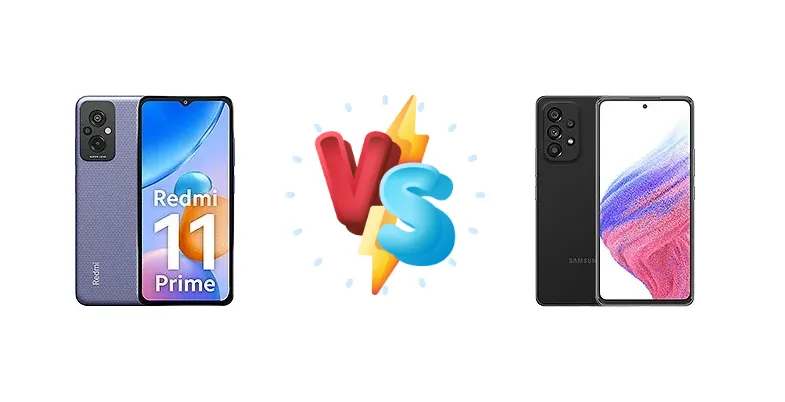
The Xiaomi Redmi 11 Prime and Samsung Galaxy A53 5G represent compelling options in the increasingly competitive mid-range 5G smartphone market. While the A53 5G launched at a higher price point, recent drops position it closer to the Redmi 11 Prime, making a direct comparison crucial for budget-conscious buyers. This analysis dives deep into their key differences, focusing on performance, display quality, camera capabilities, and battery life.
🏆 Quick Verdict
For most users, the Samsung Galaxy A53 5G emerges as the better overall choice. Its brighter display, more refined software experience, and potentially superior camera processing outweigh the Redmi 11 Prime’s slightly more efficient chipset. However, the Redmi 11 Prime offers excellent value for those prioritizing efficiency and a lower upfront cost.
| Network |
|---|
| 2G bands | GSM 850 / 900 / 1800 / 1900 | GSM 850 / 900 / 1800 / 1900 |
| 3G bands | HSDPA 850 / 900 / 2100 | HSDPA 850 / 900 / 1700(AWS) / 1900 / 2100 |
| 4G bands | 40, 41 | 1, 2, 3, 4, 5, 7, 12, 14, 20, 29, 30, 38, 39, 40, 41, 46, 48, 66 - SM-A536U |
| 5G bands | - | 2, 5, 41, 66, 77, 78 SA/NSA/Sub6/mmWave - SM-A536U |
| Speed | HSPA, LTE | HSPA, LTE, 5G |
| Technology | GSM / HSPA / LTE | GSM / HSPA / LTE / 5G |
| | - | 2, 5, 48, 66, 77, 78, 260, 261 SA/NSA/Sub6/mmWave - SM-A536V |
| Launch |
|---|
| Announced | 2022, September 06 | 2022, March 17 |
| Status | Available. Released 2022, September 23 | Available. Released 2022, March 24 |
| Body |
|---|
| Build | Glass front (Gorilla Glass 3), plastic frame, plastic back | Glass front (Gorilla Glass 5), plastic frame, plastic back |
| Dimensions | 164 x 76.1 x 8.9 mm (6.46 x 3.00 x 0.35 in) | 159.6 x 74.8 x 8.1 mm (6.28 x 2.94 x 0.32 in) |
| SIM | Nano-SIM + Nano-SIM | · Nano-SIM· Nano-SIM + Nano-SIM |
| Weight | 201 g (7.09 oz) | 189 g (6.67 oz) |
| | - | IP67 dust/water resistant (up to 1m for 30 min) |
| Display |
|---|
| Protection | Corning Gorilla Glass 3 | Corning Gorilla Glass 5 |
| Resolution | 1080 x 2408 pixels, 20:9 ratio (~401 ppi density) | 1080 x 2400 pixels, 20:9 ratio (~405 ppi density) |
| Size | 6.58 inches, 104.3 cm2 (~83.6% screen-to-body ratio) | 6.5 inches, 102.0 cm2 (~85.4% screen-to-body ratio) |
| Type | IPS LCD, 90Hz, 400 nits (typ) | Super AMOLED, 120Hz, 800 nits (HBM) |
| Platform |
|---|
| CPU | Octa-core (2x2.2 GHz Cortex-A76 & 6x2.0 GHz Cortex-A55) | Octa-core (2x2.4 GHz Cortex-A78 & 6x2.0 GHz Cortex-A55) |
| Chipset | Mediatek Helio G99 (6 nm) | Exynos 1280 (5 nm) |
| GPU | Mali-G57 MC2 | Mali-G68 |
| OS | Android 12, MIUI 13 | Android 12, up to 4 major Android upgrades, One UI 8 |
| Memory |
|---|
| Card slot | microSDXC (dedicated slot) | microSDXC (uses shared SIM slot) |
| Internal | 64GB 4GB RAM, 128GB 6GB RAM | 128GB 4GB RAM, 128GB 6GB RAM, 128GB 8GB RAM, 256GB 6GB RAM, 256GB 8GB RAM |
| | UFS 2.2 | - |
| Main Camera |
|---|
| Dual | 50 MP, f/1.8, (wide), PDAF
2 MP (macro)
Auxiliary lens | - |
| Features | LED flash, HDR, panorama | LED flash, panorama, HDR |
| Quad | - | 64 MP, f/1.8, 26mm (wide), 1/1.7X", 0.8µm, PDAF, OIS
12 MP, f/2.2, 123˚ (ultrawide), 1.12µm
5 MP (macro)
Auxiliary lens |
| Single | - | 32 MP, f/2.2, 26mm (wide), 1/2.8", 0.8µm |
| Video | 1080p@30fps | 4K@30fps, 1080p@30/60fps; gyro-EIS |
| Selfie camera |
|---|
| Features | HDR | HDR |
| Single | 8 MP | 32 MP, f/2.2, 26mm (wide), 1/2.8", 0.8µm |
| Video | 1080p@30fps | 4K@30fps, 1080p@30fps |
| Sound |
|---|
| 3.5mm jack | Yes | No |
| 35mm jack | Yes | No |
| Loudspeaker | Yes | Yes, with stereo speakers |
| | 24-bit/192kHz audio | - |
| Comms |
|---|
| Bluetooth | 5.1, A2DP, LE | 5.1, A2DP, LE |
| Infrared port | Yes | - |
| NFC | Yes | Yes (market/region dependent) |
| Positioning | GPS, GLONASS, BDS, GALILEO | GPS, GLONASS, GALILEO, BDS |
| Radio | FM radio | No |
| USB | USB Type-C 2.0, OTG | USB Type-C 2.0, OTG |
| WLAN | Wi-Fi 802.11 a/b/g/n/ac, dual-band | Wi-Fi 802.11 a/b/g/n/ac, dual-band, Wi-Fi Direct |
| Features |
|---|
| Sensors | Fingerprint (side-mounted), accelerometer, proximity, compass | Fingerprint (under display, optical), accelerometer, gyro, compass, barometer (market/region dependent) |
| | - | Virtual proximity sensing |
| Battery |
|---|
| Charging | 18W wired
5W reverse wired | 25W wired |
| Type | Li-Po 5000 mAh | Li-Po 5000 mAh |
| Misc |
|---|
| Colors | Playful Green, Flashy Black, Peppy Purple | Black, White, Blue, Peach |
| Models | 22071219AI | SM-A536B, SM-A536B/DS, SM-A536U, SM-A536U1, SM-A5360, SM-A536E, SM-A536E/DS, SM-A536V, SM-A536W, SM-A536N, SM-S536DL |
| Price | About 160 EUR | $ 151.42 / £ 185.00 / € 169.14 |
| SAR | - | 0.75 W/kg (head) 1.58 W/kg (body) |
| SAR EU | - | 0.89 W/kg (head) 1.60 W/kg (body) |
| Tests |
|---|
| Battery life | - |
Endurance rating 113h
|
| Camera | - |
Photo / Video |
| Display | - |
Contrast ratio: Infinite (nominal) |
| Loudspeaker | - |
-26.5 LUFS (Good)
|
| Performance | - |
AnTuTu: 329802 (v8), 379313 (v9)
GeekBench: 1891 (v5.1)
GFXBench: 19fps (ES 3.1 onscreen) |
Xiaomi Redmi 11 Prime
- More efficient chipset (Helio G99)
- Reverse wired charging
- Lower price point
- Less powerful CPU and GPU
- Likely lower display brightness
- Less refined software experience
Samsung Galaxy A53 5G
- Brighter and more vibrant display
- More powerful processor (Exynos 1280)
- Faster charging (25W)
- Potentially lower battery efficiency
- Higher price
- MIUI can be bloated
Display Comparison
The Samsung Galaxy A53 5G boasts a significantly brighter display, reaching a measured 830 nits, compared to the Redmi 11 Prime’s unspecified peak brightness (likely lower). This difference is immediately noticeable in outdoor visibility. While both likely utilize AMOLED panels, Samsung’s ‘Infinite’ contrast ratio suggests deeper blacks and more vivid colors. The A53’s larger display size also contributes to a more immersive viewing experience. The Redmi 11 Prime’s display specifications are less detailed, leaving questions about color accuracy and refresh rate unanswered, potentially impacting its suitability for media consumption.
Camera Comparison
Both devices feature capable camera systems, but the Samsung Galaxy A53 5G likely holds an edge in image processing. While both are listed as having Photo/Video capabilities, the A53 benefits from Samsung’s established camera software algorithms. Sensor sizes and lens apertures are not specified for either device, making a direct comparison difficult. However, Samsung’s history suggests a focus on detail preservation and dynamic range optimization. The Redmi 11 Prime may offer a more saturated, contrast-boosted look, appealing to some users, but likely lacks the refinement of Samsung’s processing. The inclusion of a 2MP macro camera on the Redmi 11 Prime is largely a marketing feature with limited practical utility.
Performance
The Samsung Galaxy A53 5G’s Exynos 1280 (5nm) chipset offers a performance advantage over the Redmi 11 Prime’s MediaTek Helio G99 (6nm). The Exynos 1280 features more powerful Cortex-A78 cores (2x2.4 GHz) compared to the Redmi’s Cortex-A76 cores (2x2.2 GHz), resulting in faster application loading and smoother multitasking. While the 6nm process of the Helio G99 offers efficiency gains, the architectural advantage of the Exynos 1280 translates to superior overall performance, particularly in demanding tasks like gaming. The A53’s potential for sustained performance is also higher due to the more advanced fabrication process.
Battery Life
Both the Redmi 11 Prime and Samsung Galaxy A53 5G achieve an impressive endurance rating of 113 hours, indicating similar real-world battery life. However, the charging speeds differ significantly. The Galaxy A53 5G supports 25W wired charging, while the Redmi 11 Prime is limited to 18W. This means the A53 5G can replenish its battery faster, reducing downtime. The Redmi 11 Prime does offer 5W reverse wired charging, a useful feature for topping up accessories, but this is offset by the slower primary charging speed. The efficiency of the Helio G99 may partially compensate for the slower charging, but the A53’s faster charging remains a key advantage.
Buying Guide
Buy the Xiaomi Redmi 11 Prime if you need a dependable daily driver with a focus on battery efficiency and are comfortable with Xiaomi’s MIUI software. It’s ideal for users who prioritize affordability and don’t demand the absolute best in gaming or camera performance. Buy the Samsung Galaxy A53 5G if you prefer a brighter, more vibrant display, a more polished software experience with Samsung’s One UI, and potentially better camera image quality, even if it means slightly less battery efficiency.
Frequently Asked Questions
❓ Does the Exynos 1280 in the Galaxy A53 5G overheat during prolonged gaming sessions?
While the Exynos 1280 can get warm under sustained load, it generally doesn't exhibit significant thermal throttling. Samsung's cooling solutions are adequate for most gaming scenarios. However, extremely demanding titles at maximum settings may lead to some performance reduction over extended periods.
❓ Is the 2MP macro camera on the Redmi 11 Prime actually useful for taking detailed close-up photos?
Unfortunately, the 2MP macro camera on the Redmi 11 Prime is largely a marketing feature. The low resolution and lack of autofocus result in images that are often soft and lack detail. It's best to rely on the main camera for close-up shots.
❓ Can the Samsung Galaxy A53 5G reliably maintain 60fps in popular games like PUBG Mobile?
The Galaxy A53 5G can generally maintain 60fps in PUBG Mobile at medium to high graphics settings. However, achieving consistently smooth performance at the highest settings may require some optimization and could result in occasional frame drops, depending on the specific device configuration and background processes.
❓ How long does it realistically take to fully charge the Redmi 11 Prime from 0% to 100%?
With its 18W charging, the Redmi 11 Prime will take approximately 2.5 to 3 hours to fully charge from 0% to 100%. This is considerably slower than the Galaxy A53 5G's 25W charging.