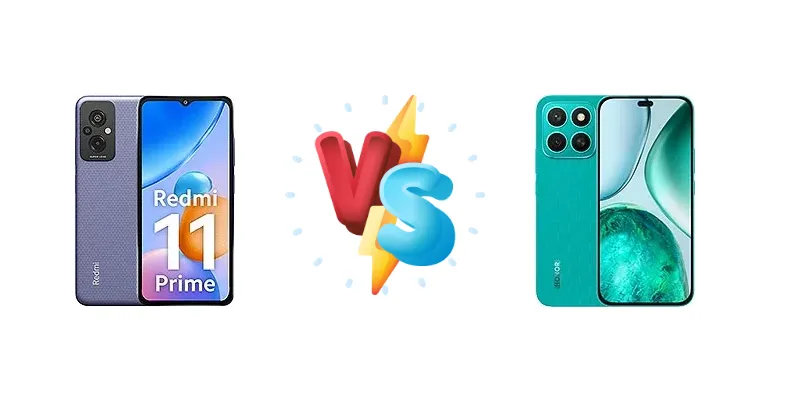
The Xiaomi Redmi 11 Prime and Honor X8c represent compelling options in the crowded sub-$200 smartphone market. Both devices aim to deliver a solid experience without breaking the bank, but they take different approaches to achieving this. The Redmi 11 Prime leverages MediaTek’s Helio G99, focusing on efficient performance, while the Honor X8c opts for Qualcomm’s Snapdragon 685 and prioritizes faster charging. This comparison will dissect their key differences to help you choose the right phone for your needs.
🏆 Quick Verdict
For the average user prioritizing sustained performance and a slightly more efficient chipset, the Xiaomi Redmi 11 Prime is the better choice. However, the Honor X8c’s significantly faster 35W charging is a game-changer for those who frequently find themselves needing a quick power boost, making it ideal for on-the-go users.
| Network |
|---|
| 2G bands | GSM 850 / 900 / 1800 / 1900 | GSM 850 / 900 / 1800 / 1900 |
| 3G bands | HSDPA 850 / 900 / 2100 | HSDPA 850 / 900 / 1900 / 2100 |
| 4G bands | 40, 41 | LTE |
| Speed | HSPA, LTE | HSPA, LTE |
| Technology | GSM / HSPA / LTE | GSM / HSPA / LTE |
| Launch |
|---|
| Announced | 2022, September 06 | 2025, January 14 |
| Status | Available. Released 2022, September 23 | Available. Released 2025, January 20 |
| Body |
|---|
| Build | Glass front (Gorilla Glass 3), plastic frame, plastic back | Glass front, plastic frame, plastic back or silicone polymer back (eco leather) |
| Dimensions | 164 x 76.1 x 8.9 mm (6.46 x 3.00 x 0.35 in) | 161.1 x 74.6 x 7.1 mm (6.34 x 2.94 x 0.28 in) |
| SIM | Nano-SIM + Nano-SIM | Nano-SIM + Nano-SIM |
| Weight | 201 g (7.09 oz) | 174 g (6.14 oz) |
| Display |
|---|
| Protection | Corning Gorilla Glass 3 | - |
| Resolution | 1080 x 2408 pixels, 20:9 ratio (~401 ppi density) | 1080 x 2412 pixels, 20:9 ratio (~394 ppi density) |
| Size | 6.58 inches, 104.3 cm2 (~83.6% screen-to-body ratio) | 6.7 inches, 108.0 cm2 (~89.9% screen-to-body ratio) |
| Type | IPS LCD, 90Hz, 400 nits (typ) | AMOLED, 120Hz, 1200 nits (HBM), 2800 nits (peak) |
| Platform |
|---|
| CPU | Octa-core (2x2.2 GHz Cortex-A76 & 6x2.0 GHz Cortex-A55) | Octa-core (4x2.8 GHz Cortex-A73 & 4x1.9 GHz Cortex-A53) |
| Chipset | Mediatek Helio G99 (6 nm) | Qualcomm SM6225 Snapdragon 685 (6 nm) |
| GPU | Mali-G57 MC2 | Adreno 610 |
| OS | Android 12, MIUI 13 | Android 15, MagicOS 9 |
| Memory |
|---|
| Card slot | microSDXC (dedicated slot) | No |
| Internal | 64GB 4GB RAM, 128GB 6GB RAM | 128GB 6GB RAM, 128GB 8GB RAM, 256GB 8GB RAM, 512GB 8GB RAM |
| | UFS 2.2 | - |
| Main Camera |
|---|
| Dual | 50 MP, f/1.8, (wide), PDAF
2 MP (macro)
Auxiliary lens | 108 MP, f/1.8, 24mm (wide), 1/1.67", PDAF, OIS
5 MP, f/2.2, (ultrawide) |
| Features | LED flash, HDR, panorama | LED flash, HDR, panorama |
| Video | 1080p@30fps | 1080p@30fps, gyro-EIS |
| Selfie camera |
|---|
| Features | HDR | - |
| Single | 8 MP | 50 MP, f/2.1, (wide) |
| Video | 1080p@30fps | 1080p@30fps |
| Sound |
|---|
| 3.5mm jack | Yes | - |
| 35mm jack | Yes | No |
| Loudspeaker | Yes | Yes |
| | 24-bit/192kHz audio | - |
| Comms |
|---|
| Bluetooth | 5.1, A2DP, LE | 5.0/5.1, A2DP, LE |
| Infrared port | Yes | - |
| NFC | Yes | Yes (market/region dependent) |
| Positioning | GPS, GLONASS, BDS, GALILEO | GPS, GLONASS, GALILEO, BDS |
| Radio | FM radio | No |
| USB | USB Type-C 2.0, OTG | USB Type-C 2.0, OTG |
| WLAN | Wi-Fi 802.11 a/b/g/n/ac, dual-band | Wi-Fi 802.11 a/b/g/n/ac, dual-band, Wi-Fi Direct |
| Features |
|---|
| Sensors | Fingerprint (side-mounted), accelerometer, proximity, compass | Fingerprint (under display, optical), accelerometer, gyro, compass, proximity (ultrasonic) |
| Battery |
|---|
| Charging | 18W wired
5W reverse wired | 35W wired |
| Type | Li-Po 5000 mAh | Li-Po 5000 mAh |
| Misc |
|---|
| Colors | Playful Green, Flashy Black, Peppy Purple | Marrs Green, Midnight Black, Moonlight White, Cloud Purple |
| Models | 22071219AI | ABR-LX1, ABR-LX2, ABR-LX3 |
| Price | About 160 EUR | € 190.78 / $ 213.42 / £ 159.00 |
Xiaomi Redmi 11 Prime
- More efficient and sustained CPU performance with Helio G99
- Potentially smoother user experience due to Cortex-A76 cores
- Reverse wired charging for emergency power sharing
- Slower 18W charging speed
- May lack the advanced ISP features of the Snapdragon 685
Honor X8c
- Significantly faster 35W wired charging
- Qualcomm Snapdragon 685 offers good ISP capabilities
- Potentially better image processing
- Less efficient CPU architecture compared to Helio G99
- Older Cortex-A73 cores may throttle under sustained load
Display Comparison
Neither device boasts a standout display. Both likely utilize LCD panels, common in this price bracket. The focus here shifts to processing power, as display specs are not provided. However, the choice of chipset impacts the display’s responsiveness. The Redmi 11 Prime’s Helio G99, with its more powerful Cortex-A76 cores, *could* translate to smoother scrolling and animations, assuming similar display driver optimization on both devices.
Camera Comparison
Without detailed camera specifications, a direct comparison is difficult. Both phones likely feature a multi-camera setup with a primary sensor and supporting lenses. However, the image processing capabilities of the respective chipsets will play a crucial role. Qualcomm’s Snapdragon series generally offers superior image signal processing (ISP) capabilities, potentially leading to better dynamic range and noise reduction in the Honor X8c’s photos. However, the Redmi 11 Prime’s ISP is still capable, and the overall image quality will depend heavily on software optimization. We can assume both phones will include a 2MP macro lens, which offers limited practical benefit.
Performance
The core difference lies in the chipsets. The Redmi 11 Prime’s MediaTek Helio G99 (6nm) features a dual-core Cortex-A76 setup clocked at 2.2 GHz, paired with six Cortex-A55 cores at 2.0 GHz. The Honor X8c’s Qualcomm Snapdragon 685 (6nm) uses a quad-core Cortex-A73 configuration reaching 2.8 GHz, alongside four Cortex-A53 cores at 1.9 GHz. While the Snapdragon 685 boasts higher clock speeds on its primary cores, the Helio G99’s architecture is generally more efficient and offers better sustained performance due to the more modern Cortex-A76 cores. This means the Redmi 11 Prime is likely to handle demanding tasks and gaming for longer periods without significant throttling. The Snapdragon 685’s older Cortex-A73 cores, while fast, are less efficient.
Battery Life
The Honor X8c’s 35W wired charging is a clear advantage over the Redmi 11 Prime’s 18W charging. This translates to significantly faster top-up times, potentially reducing charging from 0-100% by over half. While battery capacity isn’t specified, the faster charging speed effectively mitigates any potential disadvantage if the Honor X8c has a slightly smaller battery. The Redmi 11 Prime’s 18W charging is adequate, but it won’t provide the same level of convenience for users who need a quick charge.
Buying Guide
Buy the Xiaomi Redmi 11 Prime if you need a phone for consistent daily tasks, light gaming, and value long-term efficiency. Its Helio G99 chipset offers a balanced experience. Buy the Honor X8c if you prioritize minimizing downtime with its incredibly fast 35W charging, even if it means slightly less peak CPU performance. This is the phone for users who hate battery anxiety.
Frequently Asked Questions
❓ Will the Snapdragon 685 in the Honor X8c overheat during prolonged gaming sessions?
The Snapdragon 685 is a relatively efficient chipset, but its older Cortex-A73 cores are more prone to throttling under sustained load compared to the Helio G99’s Cortex-A76 cores. While it won’t likely overheat to the point of being unusable, you may experience frame drops and reduced performance during extended gaming sessions.
❓ How long does it realistically take to charge the Honor X8c from 0% to 100% with the 35W charger?
With 35W charging, the Honor X8c should be able to charge from 0% to 100% in approximately 60-75 minutes, depending on battery capacity and usage during charging. This is significantly faster than the Redmi 11 Prime’s 18W charging, which would likely take over 2 hours.
❓ Is the Helio G99 in the Redmi 11 Prime capable of running demanding games like PUBG Mobile at high settings?
The Helio G99 is capable of running PUBG Mobile at medium to high settings with playable frame rates. However, you may need to adjust graphics settings to maintain a smooth experience, especially during intense firefights. The G99’s efficiency will help maintain performance for longer periods compared to the Snapdragon 685.
❓ Does the Redmi 11 Prime's reverse wired charging feature work with all devices?
The Redmi 11 Prime's 5W reverse wired charging is compatible with most devices that charge via USB-C. However, charging speeds will be slow, and it's primarily intended for emergencies or topping up small accessories like wireless earbuds.