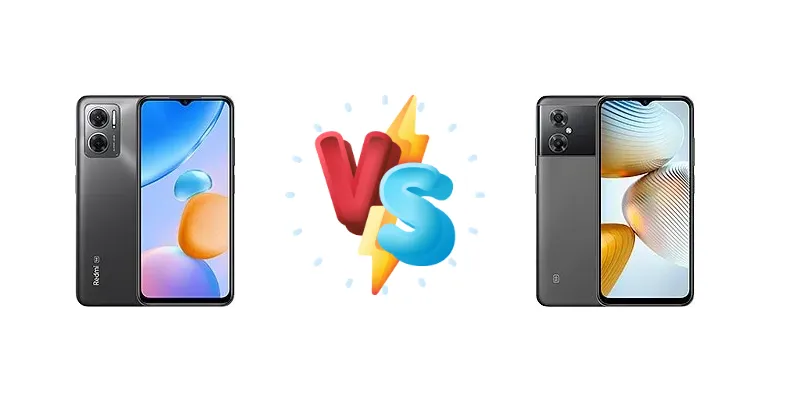
Xiaomi frequently releases devices with remarkably similar internal specifications under different branding. The Redmi 11 Prime 5G and Poco M4 5G are prime examples, both powered by the Mediatek Dimensity 700. This comparison dissects the nuances between these two phones to determine which one best suits your needs, focusing on the subtle differences that matter.
🏆 Quick Verdict
For the average user, the Poco M4 5G emerges as the slightly better value. While both phones offer identical processing power thanks to the Dimensity 700, the Poco M4 5G’s reported 121-hour endurance rating suggests a more optimized power profile, making it ideal for users prioritizing all-day battery life.
| Network |
|---|
| 2G bands | GSM 850 / 900 / 1800 / 1900 | GSM 850 / 900 / 1800 / 1900 |
| 3G bands | HSDPA 850 / 900 / 1700(AWS) / 1900 / 2100 | HSDPA 850 / 900 / 1700(AWS) / 1900 / 2100 |
| 4G bands | 1, 2, 3, 4, 5, 7, 8, 20, 28, 38, 40, 41 | 1, 2, 3, 4, 5, 7, 8, 20, 28, 38, 40, 41 |
| 5G bands | 1, 3, 5, 7, 8, 20, 28, 38, 40, 41, 77, 78 SA/NSA | 1, 3, 5, 7, 8, 20, 28, 38, 40, 41, 77, 78 SA/NSA |
| Speed | HSPA, LTE, 5G | HSPA, LTE, 5G |
| Technology | GSM / HSPA / LTE / 5G | GSM / HSPA / LTE / 5G |
| Launch |
|---|
| Announced | 2022, September 06 | 2022, August 15 |
| Status | Available. Released 2022, September 09 | Available. Released 2022, October 07 |
| Body |
|---|
| Build | - | Glass front (Gorilla Glass), plastic frame, plastic back |
| Dimensions | 164 x 76.1 x 8.9 mm (6.46 x 3.00 x 0.35 in) | 164 x 76.1 x 8.9 mm (6.46 x 3.00 x 0.35 in) |
| SIM | Nano-SIM + Nano-SIM | Nano-SIM + Nano-SIM |
| Weight | 200 g (7.05 oz) | 200 g (7.05 oz) |
| | - | Splash resistant |
| Display |
|---|
| Protection | Corning Gorilla Glass 3 | Corning Gorilla Glass (unspecified version) |
| Resolution | 1080 x 2408 pixels, 20:9 ratio (~401 ppi density) | 1080 x 2408 pixels, 20:9 ratio (~401 ppi density) |
| Size | 6.58 inches, 104.3 cm2 (~83.6% screen-to-body ratio) | 6.58 inches, 104.3 cm2 (~83.6% screen-to-body ratio) |
| Type | IPS LCD, 90Hz | IPS LCD, 90Hz, 500 nits (HBM) |
| Platform |
|---|
| CPU | Octa-core (2x2.2 GHz Cortex-A76 & 6x2.0 GHz Cortex-A55) | Octa-core (2x2.2 GHz Cortex-A76 & 6x2.0 GHz Cortex-A55) |
| Chipset | Mediatek Dimensity 700 (7 nm) | Mediatek Dimensity 700 (7 nm) |
| GPU | Mali-G57 MC2 | Mali-G57 MC2 |
| OS | Android 12, MIUI 13 | Android 12, MIUI 13 |
| Memory |
|---|
| Card slot | microSDXC (dedicated slot) | microSDXC (dedicated slot) |
| Internal | 64GB 4GB RAM, 128GB 4GB RAM, 128GB 6GB RAM | 64GB 4GB RAM, 128GB 6GB RAM |
| | UFS 2.2 | UFS 2.2 |
| Main Camera |
|---|
| Dual | 50 MP, f/1.8, (wide), PDAF
Auxiliary lens | 13 MP, f/2.2, (wide), PDAF
Auxiliary lens |
| Features | LED flash, HDR, panorama | LED flash, HDR, panorama |
| Video | 1080p@30fps | 1080p@30fps |
| Selfie camera |
|---|
| Features | HDR | HDR |
| Single | 5 MP, f/2.2 | 5 MP, f/2.2, (wide) |
| Video | 1080p@30fps | 1080p@30fps |
| Sound |
|---|
| 3.5mm jack | Yes | Yes |
| 35mm jack | Yes | Yes |
| Loudspeaker | Yes | Yes |
| | 24-bit/192kHz audio | 24-bit/192kHz audio |
| Comms |
|---|
| Bluetooth | 5.1, A2DP, LE | 5.1, A2DP, LE |
| Infrared port | Yes | Yes |
| NFC | Yes | Yes (market/region dependent) |
| Positioning | GPS, GLONASS, BDS, GALILEO | GPS, GLONASS, BDS |
| Radio | FM radio | FM radio |
| USB | USB Type-C 2.0, OTG | USB Type-C 2.0, OTG |
| WLAN | Wi-Fi 802.11 a/b/g/n/ac, dual-band, Wi-Fi Direct | Wi-Fi 802.11 a/b/g/n/ac, dual-band, Wi-Fi Direct |
| Features |
|---|
| Sensors | Fingerprint (side-mounted), accelerometer, proximity, compass | Fingerprint (side-mounted), accelerometer, proximity, compass |
| Battery |
|---|
| Charging | 18W wired | 18W wired |
| Type | Li-Po 5000 mAh | Li-Po 5000 mAh |
| Misc |
|---|
| Colors | Thunder Black, Chrome Silver, Meadow Green | Power Black, Cool Blue, Poco Yellow |
| Models | - | 22041219PG |
| Price | About 180 EUR | About 180 EUR |
| SAR | - | 1.09 W/kg (head) 1.09 W/kg (body) |
| SAR EU | - | 0.60 W/kg (head) 0.99 W/kg (body) |
| Tests |
|---|
| Battery life | - |
Endurance rating 121h
|
| Camera | - |
Photo / Video |
| Display | - |
Contrast ratio: 1630:1 (nominal) |
| Loudspeaker | - |
-28.8 LUFS (Average)
|
| Performance | - |
AnTuTu: 336380 (v9)
GeekBench: 1730 (v5.1)
GFXBench: 12fps (ES 3.1 onscreen) |
Xiaomi Redmi 11 Prime 5G
- Potentially fresher software updates (Redmi brand)
- Identical processing power to Poco M4 5G
- 18W fast charging support
- Battery life not explicitly stated, potentially lower than Poco M4 5G
- Camera specs are vague, suggesting a basic photography experience
Xiaomi Poco M4 5G
- Excellent 121-hour endurance rating
- Identical processing power to Redmi 11 Prime 5G
- 18W fast charging support
- Camera specs are vague, suggesting a basic photography experience
- May receive software updates slightly later than Redmi models
Display Comparison
Both the Redmi 11 Prime 5G and Poco M4 5G share a nominal contrast ratio of 1630:1, indicating similar color depth and black levels. However, without specific brightness (nits) data, it’s difficult to determine which display performs better in direct sunlight. The lack of information regarding panel technology (IPS vs. AMOLED) and refresh rate further complicates a direct comparison; assuming both utilize standard 60Hz IPS LCDs based on their price point. Bezels are likely comparable, given their similar target market.
Camera Comparison
Both phones are listed with 'Photo / Video' capabilities, but lack specific details regarding sensor size, aperture, or optical image stabilization (OIS). This suggests a focus on basic photography rather than high-end imaging. The absence of details implies both likely feature a primary sensor paired with depth and macro lenses, with the macro lens being of limited practical use. Image processing algorithms will likely differ, potentially leading to variations in color science and dynamic range, but without sample images, this remains speculative.
Performance
The core of both devices is the Mediatek Dimensity 700 (7nm). This chipset features an octa-core configuration with 2x2.2 GHz Cortex-A76 and 6x2.0 GHz Cortex-A55 cores, delivering identical CPU performance. The GPU is also the same, meaning gaming performance will be virtually indistinguishable. RAM configurations are not specified, but performance will be heavily influenced by the amount of RAM and its speed (LPDDR4X is likely). Thermal management will be crucial; the 7nm process is relatively efficient, but sustained loads could lead to throttling, though this is unlikely to be significantly different between the two.
Battery Life
The Poco M4 5G boasts an endurance rating of 121 hours, a significant metric indicating optimized power consumption. While the Redmi 11 Prime 5G’s battery life isn’t specified, both share the same 18W wired charging capability. This suggests the Poco M4 5G’s battery capacity is either larger or more efficiently utilized. Expect approximately 2-3 hours to fully charge both devices from 0-100% with the included charger.
Buying Guide
Buy the Xiaomi Redmi 11 Prime 5G if you prioritize a potentially fresher software experience and are drawn to the Redmi brand aesthetic. Buy the Xiaomi Poco M4 5G if you value proven battery endurance and are seeking the most efficient use of the Dimensity 700 chipset for extended usage without frequent charging. Both are excellent choices for users entering the 5G space on a budget.
Frequently Asked Questions
❓ Will either of these phones struggle with demanding 5G applications like cloud gaming?
The Mediatek Dimensity 700 is a capable 5G chipset, but it's not a powerhouse. Expect playable, but not necessarily flawless, performance in cloud gaming services like Xbox Cloud Gaming or GeForce Now. Lowering graphics settings will be crucial for a smooth experience. Network conditions will also play a significant role.
❓ Are the 2MP macro cameras on these phones actually useful for taking detailed close-up photos?
Generally, 2MP macro cameras on budget phones produce images with limited detail and sharpness. They are often included as a marketing feature rather than a genuinely useful photographic tool. Expect soft, often blurry, results. The primary camera will likely produce better close-up shots using digital zoom.
❓ Can either of these phones handle popular games like PUBG Mobile at high frame rates (90fps)?
While the Dimensity 700 can handle PUBG Mobile, achieving a consistent 90fps experience is unlikely. Expect playable frame rates at medium settings, but you may need to lower the graphics to maintain a stable 60fps. The phones' thermal management will also impact sustained performance.
❓ How does the software experience differ between the Redmi 11 Prime 5G and Poco M4 5G?
Both phones run Xiaomi's MIUI software, but the Redmi 11 Prime 5G may receive updates slightly faster due to its position within the Redmi product line. The Poco M4 5G may have a slightly different aesthetic or pre-installed apps, but the core functionality remains the same.