
Xiaomi Redmi 11 Prime 5G vs Samsung Galaxy M14: The Ultimate Showdown
| Phones Images | |||||
|---|---|---|---|---|---|
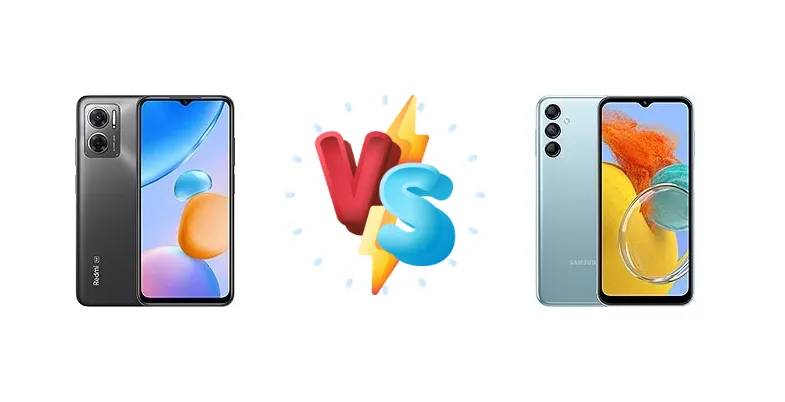
|
🏆 Quick Verdict
The Samsung Galaxy M14 edges out the Redmi 11 Prime 5G thanks to its superior chipset (Exynos 1330), potentially better camera performance, and larger battery. While the Redmi offers 5G connectivity, the M14's overall package provides a more refined experience.
| PHONES | ||
|---|---|---|
| Phone Names | Xiaomi Redmi 11 Prime 5G | Samsung Galaxy M14 |
| Network | ||
|---|---|---|
| 2G bands | GSM 850 / 900 / 1800 / 1900 | GSM 850 / 900 / 1800 / 1900 |
| 3G bands | HSDPA 850 / 900 / 1700(AWS) / 1900 / 2100 | HSDPA 850 / 900 / 1700(AWS) / 1900 / 2100 |
| 4G bands | 1, 2, 3, 4, 5, 7, 8, 20, 28, 38, 40, 41 | 1, 2, 3, 4, 5, 7, 8, 12, 17, 20, 26, 28, 38, 40, 41, 66 |
| 5G bands | 1, 3, 5, 7, 8, 20, 28, 38, 40, 41, 77, 78 SA/NSA | 1, 3, 5, 7, 8, 20, 28, 38, 40, 41, 66, 77, 78 SA/NSA |
| Speed | HSPA, LTE, 5G | HSPA, LTE, 5G |
| Technology | GSM / HSPA / LTE / 5G | GSM / HSPA / LTE / 5G |
| Launch | ||
|---|---|---|
| Announced | 2022, September 06 | 2023, March 08 |
| Status | Available. Released 2022, September 09 | Available. Released 2023, March 08 |
| Body | ||
|---|---|---|
| Build | - | Glass front (Gorilla Glass 5), plastic back, plastic frame |
| Dimensions | 164 x 76.1 x 8.9 mm (6.46 x 3.00 x 0.35 in) | 166.8 x 77.2 x 9.4 mm (6.57 x 3.04 x 0.37 in) |
| SIM | Nano-SIM + Nano-SIM | · Nano-SIM· Nano-SIM + Nano-SIM |
| Weight | 200 g (7.05 oz) | 206 g (7.27 oz) |
| Display | ||
|---|---|---|
| Protection | Corning Gorilla Glass 3 | Corning Gorilla Glass 5 |
| Resolution | 1080 x 2408 pixels, 20:9 ratio (~401 ppi density) | 1080 x 2408 pixels, 20:9 ratio (~400 ppi density) |
| Size | 6.58 inches, 104.3 cm2 (~83.6% screen-to-body ratio) | 6.6 inches, 104.9 cm2 (~81.5% screen-to-body ratio) |
| Type | IPS LCD, 90Hz | PLS LCD, 90Hz |
| Platform | ||
|---|---|---|
| CPU | Octa-core (2x2.2 GHz Cortex-A76 & 6x2.0 GHz Cortex-A55) | Octa-core (2x2.4 GHz Cortex-A78 & 6x2.0 GHz Cortex-A55) |
| Chipset | Mediatek Dimensity 700 (7 nm) | Exynos 1330 (5 nm) |
| GPU | Mali-G57 MC2 | Mali-G68 MP2 |
| OS | Android 12, MIUI 13 | Android 13, One UI core 5.1 |
| Memory | ||
|---|---|---|
| Card slot | microSDXC (dedicated slot) | microSDHC (dedicated slot) |
| Internal | 64GB 4GB RAM, 128GB 4GB RAM, 128GB 6GB RAM | 64GB 4GB RAM, 128GB 4GB RAM, 128GB 6GB RAM |
| UFS 2.2 | - | |
| Main Camera | ||
|---|---|---|
| Dual | 50 MP, f/1.8, (wide), PDAF Auxiliary lens | - |
| Features | LED flash, HDR, panorama | LED flash, panorama, HDR |
| Single | - | 13 MP, f/2.0, (wide) |
| Triple | - | 50 MP, f/1.8, (wide), PDAF 2 MP (macro) Auxiliary lens |
| Video | 1080p@30fps | 1080p@30fps |
| Selfie camera | ||
|---|---|---|
| Features | HDR | - |
| Single | 5 MP, f/2.2 | 13 MP, f/2.0, (wide) |
| Video | 1080p@30fps | 1080p@30fps |
| Sound | ||
|---|---|---|
| 3.5mm jack | Yes | Yes |
| 35mm jack | Yes | Yes |
| Loudspeaker | Yes | Yes |
| 24-bit/192kHz audio | - | |
| Comms | ||
|---|---|---|
| Bluetooth | 5.1, A2DP, LE | 5.2, A2DP, LE |
| Infrared port | Yes | - |
| NFC | Yes | Yes |
| Positioning | GPS, GLONASS, BDS, GALILEO | GPS, GLONASS, GALILEO, BDS, QZSS, NavIC |
| Radio | FM radio | Unspecified |
| USB | USB Type-C 2.0, OTG | USB Type-C 2.0 |
| WLAN | Wi-Fi 802.11 a/b/g/n/ac, dual-band, Wi-Fi Direct | Wi-Fi 802.11 a/b/g/n/ac, dual-band, Wi-Fi Direct |
| Features | ||
|---|---|---|
| Sensors | Fingerprint (side-mounted), accelerometer, proximity, compass | Fingerprint (side-mounted), accelerometer, gyro, proximity, compass |
| Battery | ||
|---|---|---|
| Charging | 18W wired | 15W wired - international 25W wired - India |
| Type | Li-Po 5000 mAh | Li-Po 6000 mAh |
| Misc | ||
|---|---|---|
| Colors | Thunder Black, Chrome Silver, Meadow Green | Navy Blue, Light Blue, Silver |
| Models | - | SM-M146B, SM-M146B/DS, SM-M146B/DSN |
| Price | About 180 EUR | ₹ 10,990 |
| SAR EU | - | 0.48 W/kg (head) 1.53 W/kg (body) |
Xiaomi Redmi 11 Prime 5G
- 5G Connectivity
- Slightly more compact design
- Competitive price
- Less powerful chipset
- Potentially weaker camera
- Slower charging
Samsung Galaxy M14
- Superior chipset (Exynos 1330)
- Larger battery capacity
- Potentially better camera
- Faster charging (India variant)
- Larger size
- May lack 5G in some regions
- Samsung's One UI can be polarizing
Display Comparison
Both phones feature large displays, likely around 6.6 inches, with FHD+ resolution. The Galaxy M14 might offer slightly better color accuracy and brightness due to Samsung's display expertise, but both should provide a satisfactory viewing experience for everyday use. Expect LCD panels on both.
Camera Comparison
While both phones likely feature a triple-camera setup, the Galaxy M14 is expected to have a more capable main sensor and image processing. The Exynos 1330's ISP (Image Signal Processor) is likely superior, resulting in better low-light performance and overall image quality. Redmi 11 Prime 5G camera is decent but not exceptional.
Performance
The Samsung Galaxy M14's Exynos 1330 (5nm) holds a significant advantage over the Redmi 11 Prime 5G's Dimensity 700 (7nm). The Exynos 1330's Cortex-A78 cores offer better single-core performance, and the 5nm process generally leads to improved efficiency. Expect smoother multitasking and gaming on the M14.
Battery Life
The Samsung Galaxy M14 boasts a larger battery capacity (likely 6000mAh) compared to the Redmi 11 Prime 5G (around 5000mAh). Coupled with the more efficient Exynos 1330 chipset, the M14 should offer significantly longer battery life, easily lasting a full day or more on a single charge.
Buying Guide
The Xiaomi Redmi 11 Prime 5G is a good choice for users prioritizing 5G connectivity and a slightly more compact design. The Samsung Galaxy M14 is ideal for those seeking longer battery life, smoother performance, and a more reliable camera system, especially if the Indian variant's 25W charging is available.