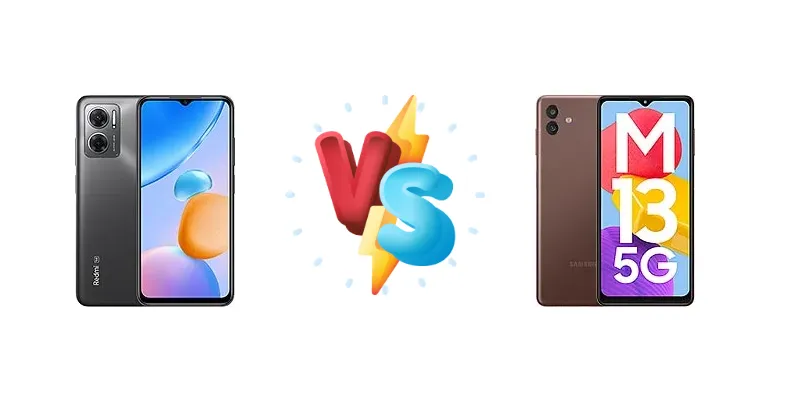
The budget 5G smartphone market is heating up, and the Xiaomi Redmi 11 Prime 5G and Samsung Galaxy M13 5G are two strong contenders. Both offer 5G connectivity at an affordable price, but which one delivers the best overall experience? Let's dive into a detailed comparison to help you make the right choice.
🏆 Quick Verdict
Both phones share the same Dimensity 700 chipset, making performance largely similar. The Redmi 11 Prime 5G edges out the M13 5G with slightly faster charging and potentially a more vibrant display. However, Samsung's brand recognition and software support might sway some buyers.
| Network |
|---|
| 2G bands | GSM 850 / 900 / 1800 / 1900 | GSM 850 / 900 / 1800 / 1900 |
| 3G bands | HSDPA 850 / 900 / 1700(AWS) / 1900 / 2100 | HSDPA 850 / 900 / 1900 / 2100 |
| 4G bands | 1, 2, 3, 4, 5, 7, 8, 20, 28, 38, 40, 41 | 1, 2, 3, 4, 5, 7, 8, 12, 17, 20, 26, 28, 38, 40, 41, 66 |
| 5G bands | 1, 3, 5, 7, 8, 20, 28, 38, 40, 41, 77, 78 SA/NSA | 1, 3, 5, 7, 8, 20, 28, 38, 40, 41, 78 SA/NSA/Sub6 |
| Speed | HSPA, LTE, 5G | HSPA, LTE, 5G |
| Technology | GSM / HSPA / LTE / 5G | GSM / HSPA / LTE / 5G |
| Launch |
|---|
| Announced | 2022, September 06 | 2022, July 14 |
| Status | Available. Released 2022, September 09 | Available. Released 2022, July 23 |
| Body |
|---|
| Build | - | Glass front (Gorilla Glass 3), plastic back, plastic frame |
| Dimensions | 164 x 76.1 x 8.9 mm (6.46 x 3.00 x 0.35 in) | 164.5 x 76.5 x 8.8 mm (6.48 x 3.01 x 0.35 in) |
| SIM | Nano-SIM + Nano-SIM | Nano-SIM + Nano-SIM |
| Weight | 200 g (7.05 oz) | 195 g (6.88 oz) |
| Display |
|---|
| Protection | Corning Gorilla Glass 3 | Corning Gorilla Glass 3 |
| Resolution | 1080 x 2408 pixels, 20:9 ratio (~401 ppi density) | 720 x 1600 pixels, 20:9 ratio (~270 ppi density) |
| Size | 6.58 inches, 104.3 cm2 (~83.6% screen-to-body ratio) | 6.5 inches, 102.0 cm2 (~81.1% screen-to-body ratio) |
| Type | IPS LCD, 90Hz | PLS LCD, 90Hz, 400 nits (typ) |
| Platform |
|---|
| CPU | Octa-core (2x2.2 GHz Cortex-A76 & 6x2.0 GHz Cortex-A55) | Octa-core (2x2.2 GHz Cortex-A76 & 6x2.0 GHz Cortex-A55) |
| Chipset | Mediatek Dimensity 700 (7 nm) | Mediatek Dimensity 700 (7 nm) |
| GPU | Mali-G57 MC2 | Mali-G57 MC2 |
| OS | Android 12, MIUI 13 | Android 12, One UI Core 4 |
| Memory |
|---|
| Card slot | microSDXC (dedicated slot) | microSDXC (dedicated slot) |
| Internal | 64GB 4GB RAM, 128GB 4GB RAM, 128GB 6GB RAM | 64GB 4GB RAM, 128GB 6GB RAM |
| | UFS 2.2 | - |
| Main Camera |
|---|
| Dual | 50 MP, f/1.8, (wide), PDAF
Auxiliary lens | 50 MP, f/1.8, (wide), PDAF
Auxiliary lens |
| Features | LED flash, HDR, panorama | LED flash, panorama, HDR |
| Video | 1080p@30fps | 1080p@30fps |
| Selfie camera |
|---|
| Features | HDR | HDR |
| Single | 5 MP, f/2.2 | 5 MP, f/2.0, (wide) |
| Video | 1080p@30fps | - |
| Sound |
|---|
| 3.5mm jack | Yes | Yes |
| 35mm jack | Yes | Yes |
| Loudspeaker | Yes | Yes |
| | 24-bit/192kHz audio | - |
| Comms |
|---|
| Bluetooth | 5.1, A2DP, LE | 5.0, A2DP, LE |
| Infrared port | Yes | - |
| NFC | Yes | No |
| Positioning | GPS, GLONASS, BDS, GALILEO | GPS, GLONASS, BDS, GALILEO, QZSS |
| Radio | FM radio | Unspecified |
| USB | USB Type-C 2.0, OTG | USB Type-C 2.0 |
| WLAN | Wi-Fi 802.11 a/b/g/n/ac, dual-band, Wi-Fi Direct | Wi-Fi 802.11 a/b/g/n/ac, dual-band |
| Features |
|---|
| Sensors | Fingerprint (side-mounted), accelerometer, proximity, compass | Fingerprint (side-mounted), accelerometer, gyro, compass |
| | - | Virtual proximity sensing |
| Battery |
|---|
| Charging | 18W wired | 15W wired |
| Type | Li-Po 5000 mAh | Li-Po 5000 mAh |
| Misc |
|---|
| Colors | Thunder Black, Chrome Silver, Meadow Green | Midnight Blue, Aqua Green, Stardust Brown |
| Models | - | SM-M136B, SM-M136B/DS |
| Price | About 180 EUR | About 180 EUR |
| SAR | - | 0.73 W/kg (head) |
| SAR EU | - | 0.84 W/kg (head) 1.33 W/kg (body) |
Xiaomi Redmi 11 Prime 5G
- Faster 18W Charging
- Potentially better display quality
- Sleek design
- Competitive price
- MIUI software can be cluttered
- Software update support may be limited
- Battery life slightly less than M13 5G
Samsung Galaxy M13 5G
- Excellent 6000mAh battery life
- Samsung's One UI software
- Brand recognition and support
- Potentially longer software update support
- Slower 15W charging
- Display quality may be slightly less vibrant
- Camera performance may be slightly behind Redmi
Display Comparison
Both phones feature a 6.6-inch display, likely with a resolution around 1080 x 2408 pixels. While both are LCD panels, the Redmi 11 Prime 5G might offer slightly better color accuracy and brightness. The M13 5G may have a slightly different panel variant, impacting viewing angles and overall vibrancy. We'll need to see detailed reviews to confirm.
Camera Comparison
The Redmi 11 Prime 5G typically features a 50MP main camera, an 8MP ultrawide, and a 2MP macro lens. The Galaxy M13 5G usually has a 50MP main camera, a 5MP ultrawide, and a 2MP macro lens. Image quality will depend on software processing, but the Redmi might have a slight edge in detail due to the potentially larger main sensor. Both offer decent selfie cameras.
Performance
Powered by the same Mediatek Dimensity 700 chipset, expect similar performance in everyday tasks and moderate gaming. Both phones have 6GB or 8GB of RAM, which should be sufficient for multitasking. However, Samsung's One UI might feel slightly more optimized than Xiaomi's MIUI in some scenarios.
Battery Life
The Galaxy M13 5G typically has a 6000mAh battery, offering excellent battery life. The Redmi 11 Prime 5G usually has a 5000mAh battery, still providing good battery life but not quite as long as the M13 5G. The M13 5G's 15W charging is slower than the Redmi 11 Prime 5G's 18W charging.
Buying Guide
The Xiaomi Redmi 11 Prime 5G is ideal for users prioritizing faster charging and potentially a slightly better display experience. The Samsung Galaxy M13 5G is a good choice for those who value Samsung's brand reputation, One UI software, and potentially longer software update support.
Frequently Asked Questions
❓ Which phone has better battery life?
The Samsung Galaxy M13 5G generally offers better battery life thanks to its larger 6000mAh battery.
❓ Is the Dimensity 700 chipset good for gaming?
The Dimensity 700 is suitable for casual gaming and less demanding titles. It may struggle with graphically intensive games at high settings.