
Xiaomi Redmi 11 Prime 5G vs Samsung Galaxy F14: The Ultimate Budget Showdown
| Phones Images | |||||
|---|---|---|---|---|---|
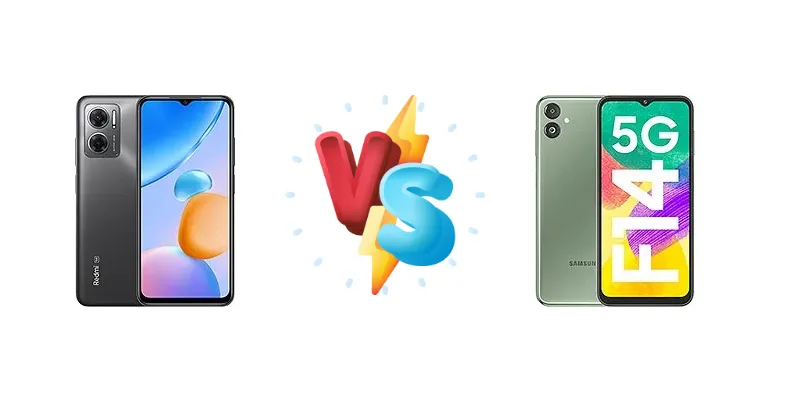
|
🏆 Quick Verdict
The Samsung Galaxy F14 edges out the Redmi 11 Prime 5G thanks to its more powerful Exynos 1330 chipset, faster charging, and generally smoother performance. While the Redmi offers decent value, the F14 provides a more premium experience for a slight price increase.
| PHONES | ||
|---|---|---|
| Phone Names | Xiaomi Redmi 11 Prime 5G | Samsung Galaxy F14 |
| Network | ||
|---|---|---|
| 2G bands | GSM 850 / 900 / 1800 / 1900 | GSM 850 / 900 / 1800 / 1900 |
| 3G bands | HSDPA 850 / 900 / 1700(AWS) / 1900 / 2100 | HSDPA 850 / 900 / 1700(AWS) / 1900 / 2100 |
| 4G bands | 1, 2, 3, 4, 5, 7, 8, 20, 28, 38, 40, 41 | 1, 2, 3, 4, 5, 7, 8, 12, 17, 20, 26, 28, 38, 40, 41, 66 |
| 5G bands | 1, 3, 5, 7, 8, 20, 28, 38, 40, 41, 77, 78 SA/NSA | 1, 3, 5, 7, 8, 20, 28, 38, 40, 41, 66, 77, 78 SA/NSA/Sub6 |
| Speed | HSPA, LTE, 5G | HSPA, LTE-А, 5G |
| Technology | GSM / HSPA / LTE / 5G | GSM / HSPA / LTE / 5G |
| Launch | ||
|---|---|---|
| Announced | 2022, September 06 | 2023, March 24 |
| Status | Available. Released 2022, September 09 | Available. Released 2023, March 30 |
| Body | ||
|---|---|---|
| Build | - | Glass front (Gorilla Glass 5), plastic back, plastic frame |
| Dimensions | 164 x 76.1 x 8.9 mm (6.46 x 3.00 x 0.35 in) | 166.8 x 77.2 x 9.4 mm (6.57 x 3.04 x 0.37 in) |
| SIM | Nano-SIM + Nano-SIM | Nano-SIM + Nano-SIM |
| Weight | 200 g (7.05 oz) | 206 g (7.27 oz) |
| Display | ||
|---|---|---|
| Protection | Corning Gorilla Glass 3 | Corning Gorilla Glass 5 |
| Resolution | 1080 x 2408 pixels, 20:9 ratio (~401 ppi density) | 1080 x 2408 pixels, 20:9 ratio (~400 ppi density) |
| Size | 6.58 inches, 104.3 cm2 (~83.6% screen-to-body ratio) | 6.6 inches, 104.9 cm2 (~81.5% screen-to-body ratio) |
| Type | IPS LCD, 90Hz | PLS LCD, 90Hz |
| Platform | ||
|---|---|---|
| CPU | Octa-core (2x2.2 GHz Cortex-A76 & 6x2.0 GHz Cortex-A55) | Octa-core (2x2.4 GHz Cortex-A78 & 6x2.0 GHz Cortex-A55) |
| Chipset | Mediatek Dimensity 700 (7 nm) | Exynos 1330 (5 nm) |
| GPU | Mali-G57 MC2 | Mali-G68 MP2 |
| OS | Android 12, MIUI 13 | Android 13, One UI Core 5.1 |
| Memory | ||
|---|---|---|
| Card slot | microSDXC (dedicated slot) | microSDXC (dedicated slot) |
| Internal | 64GB 4GB RAM, 128GB 4GB RAM, 128GB 6GB RAM | 64GB 4GB RAM, 128GB 4GB RAM, 128GB 6GB RAM |
| UFS 2.2 | - | |
| Main Camera | ||
|---|---|---|
| Dual | 50 MP, f/1.8, (wide), PDAF Auxiliary lens | 50 MP, f/1.8, (wide), PDAF 2 MP (macro) |
| Features | LED flash, HDR, panorama | LED flash, panorama, HDR |
| Video | 1080p@30fps | 1080p@30fps |
| Selfie camera | ||
|---|---|---|
| Features | HDR | - |
| Single | 5 MP, f/2.2 | 13 MP, f/2.0, (wide) |
| Video | 1080p@30fps | 1080p@30fps |
| Sound | ||
|---|---|---|
| 3.5mm jack | Yes | Yes |
| 35mm jack | Yes | Yes |
| Loudspeaker | Yes | Yes |
| 24-bit/192kHz audio | - | |
| Comms | ||
|---|---|---|
| Bluetooth | 5.1, A2DP, LE | 5.2, A2DP, LE |
| Infrared port | Yes | - |
| NFC | Yes | No |
| Positioning | GPS, GLONASS, BDS, GALILEO | GPS, GLONASS, GALILEO, BDS, QZSS, NavIC |
| Radio | FM radio | FM radio, recording |
| USB | USB Type-C 2.0, OTG | USB Type-C 2.0 |
| WLAN | Wi-Fi 802.11 a/b/g/n/ac, dual-band, Wi-Fi Direct | Wi-Fi 802.11 a/b/g/n/ac, dual-band, Wi-Fi Direct |
| Features | ||
|---|---|---|
| Sensors | Fingerprint (side-mounted), accelerometer, proximity, compass | Fingerprint (side-mounted), accelerometer, gyro, proximity, compass |
| Battery | ||
|---|---|---|
| Charging | 18W wired | 25W wired |
| Type | Li-Po 5000 mAh | Li-Po 6000 mAh |
| Misc | ||
|---|---|---|
| Colors | Thunder Black, Chrome Silver, Meadow Green | Black, Green, Purple |
| Models | - | SM-E146B, SM-E146B/DS |
| Price | About 180 EUR | About 150 EUR |
| SAR | - | 0.69 W/kg (head) |
Xiaomi Redmi 11 Prime 5G
- Affordable price
- 5G connectivity
- Large 6000mAh battery
- Decent main camera
- Less powerful chipset
- Slower charging
- Potentially less accurate display
- Xiaomi's MIUI can be bloated
Samsung Galaxy F14
- More powerful Exynos 1330 chipset
- Faster 25W charging
- Better display quality
- Reliable Samsung brand
- Generally smoother performance
- Slightly higher price
- Design may be less exciting to some
Display Comparison
Both phones feature a 6.67-inch FHD+ display, likely with a 120Hz refresh rate. However, Samsung often has slightly better display calibration and color accuracy, potentially giving the F14 a visual edge. The Redmi 11 Prime 5G might have a slightly higher peak brightness.
Camera Comparison
The Redmi 11 Prime 5G typically features a 50MP main camera, while the Galaxy F14 boasts a 50MP main camera as well. However, Samsung's image processing is generally superior, resulting in more vibrant and detailed photos. The F14 likely has better low-light performance. Both likely have ultrawide and macro lenses.
Performance
The Samsung Galaxy F14's Exynos 1330 (5nm) is significantly more powerful than the Redmi 11 Prime 5G's Dimensity 700 (7nm). Expect smoother multitasking, faster app loading times, and better gaming performance on the F14. The Cortex-A78 cores in the Exynos chip provide a noticeable boost.
Battery Life
Both phones likely have a 6000mAh battery, offering excellent battery life. However, the Galaxy F14's 25W charging is faster than the Redmi 11 Prime 5G's 18W charging, allowing for quicker top-ups.
Buying Guide
The Xiaomi Redmi 11 Prime 5G is a good choice for users prioritizing 5G connectivity and a slightly lower price point. The Samsung Galaxy F14 is ideal for those seeking better performance, faster charging, and the reliability of the Samsung brand.