
Xiaomi Redmi 11 Prime 5G vs OnePlus Nord CE 2 Lite 5G: Which Budget 5G Phone Wins?
| Phones Images | |||||
|---|---|---|---|---|---|
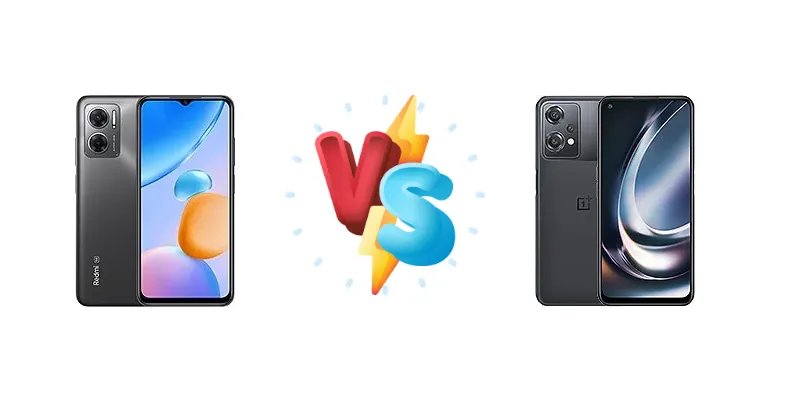
|
🏆 Quick Verdict
For the average user prioritizing faster charging and a slightly more efficient chipset, the OnePlus Nord CE 2 Lite 5G is the better choice. Its 33W charging significantly reduces downtime, and the Snapdragon 695’s 6nm process offers a modest efficiency advantage over the Redmi’s 7nm Dimensity 700.
| PHONES | ||
|---|---|---|
| Phone Names | Xiaomi Redmi 11 Prime 5G | OnePlus Nord CE 2 Lite 5G |
| Network | ||
|---|---|---|
| 2G bands | GSM 850 / 900 / 1800 / 1900 | GSM 850 / 900 / 1800 / 1900 |
| 3G bands | HSDPA 850 / 900 / 1700(AWS) / 1900 / 2100 | HSDPA 800 / 850 / 900 / 1700(AWS) / 1900 / 2100 |
| 4G bands | 1, 2, 3, 4, 5, 7, 8, 20, 28, 38, 40, 41 | 1, 2, 3, 4, 5, 7, 8, 12, 13, 17, 18, 19, 20, 26, 28, 38, 39, 40, 41, 66 - Europe |
| 5G bands | 1, 3, 5, 7, 8, 20, 28, 38, 40, 41, 77, 78 SA/NSA | 1, 3, 5, 7, 8, 20, 28, 38, 40, 41, 66, 77, 78 SA/NSA - Europe |
| Speed | HSPA, LTE, 5G | HSPA, LTE, 5G |
| Technology | GSM / HSPA / LTE / 5G | GSM / HSPA / LTE / 5G |
| Launch | ||
|---|---|---|
| Announced | 2022, September 06 | 2022, April 28 |
| Status | Available. Released 2022, September 09 | Available. Released 2022, April 30 |
| Body | ||
|---|---|---|
| Build | - | Glass front, plastic frame, plastic back |
| Dimensions | 164 x 76.1 x 8.9 mm (6.46 x 3.00 x 0.35 in) | 164.3 x 75.6 x 8.5 mm (6.47 x 2.98 x 0.33 in) |
| SIM | Nano-SIM + Nano-SIM | Nano-SIM + Nano-SIM |
| Weight | 200 g (7.05 oz) | 195 g (6.88 oz) |
| Display | ||
|---|---|---|
| Protection | Corning Gorilla Glass 3 | - |
| Resolution | 1080 x 2408 pixels, 20:9 ratio (~401 ppi density) | 1080 x 2412 pixels, 20:9 ratio (~401 ppi density) |
| Size | 6.58 inches, 104.3 cm2 (~83.6% screen-to-body ratio) | 6.59 inches, 104.5 cm2 (~84.1% screen-to-body ratio) |
| Type | IPS LCD, 90Hz | IPS LCD, 120Hz |
| Platform | ||
|---|---|---|
| CPU | Octa-core (2x2.2 GHz Cortex-A76 & 6x2.0 GHz Cortex-A55) | Octa-core (2x2.2 GHz Kryo 660 Gold & 6x1.7 GHz Kryo 660 Silver) |
| Chipset | Mediatek Dimensity 700 (7 nm) | Qualcomm SM6375 Snapdragon 695 5G (6 nm) |
| GPU | Mali-G57 MC2 | Adreno 619 |
| OS | Android 12, MIUI 13 | Android 12, upgradable to Android 13, OxygenOS 13 |
| Memory | ||
|---|---|---|
| Card slot | microSDXC (dedicated slot) | microSDXC (uses shared SIM slot) |
| Internal | 64GB 4GB RAM, 128GB 4GB RAM, 128GB 6GB RAM | 128GB 6GB RAM, 128GB 8GB RAM |
| UFS 2.2 | - | |
| Main Camera | ||
|---|---|---|
| Dual | 50 MP, f/1.8, (wide), PDAF Auxiliary lens | - |
| Features | LED flash, HDR, panorama | LED flash, HDR, panorama |
| Triple | - | 64 MP, f/1.7, 26mm (wide), 0.7µm, PDAF 2 MP (macro) Auxiliary lens |
| Video | 1080p@30fps | 1080p@30fps |
| Selfie camera | ||
|---|---|---|
| Features | HDR | HDR |
| Single | 5 MP, f/2.2 | 16 MP, f/2.0, (wide), 1/3.0", 1.0µm |
| Video | 1080p@30fps | 1080p@30fps |
| Sound | ||
|---|---|---|
| 3.5mm jack | Yes | Yes |
| 35mm jack | Yes | Yes |
| Loudspeaker | Yes | Yes |
| 24-bit/192kHz audio | - | |
| Comms | ||
|---|---|---|
| Bluetooth | 5.1, A2DP, LE | 5.2, A2DP, LE, aptX HD |
| Infrared port | Yes | - |
| NFC | Yes | Yes (market/region dependent) |
| Positioning | GPS, GLONASS, BDS, GALILEO | GPS, GLONASS, GALILEO, BDS, QZSS |
| Radio | FM radio | Unspecified |
| USB | USB Type-C 2.0, OTG | USB Type-C 2.0, OTG |
| WLAN | Wi-Fi 802.11 a/b/g/n/ac, dual-band, Wi-Fi Direct | Wi-Fi 802.11 a/b/g/n/ac, dual-band, Wi-Fi Direct |
| Features | ||
|---|---|---|
| Sensors | Fingerprint (side-mounted), accelerometer, proximity, compass | Fingerprint (side-mounted), accelerometer, gyro, proximity, compass |
| Battery | ||
|---|---|---|
| Charging | 18W wired | 33W wired |
| Type | Li-Po 5000 mAh | Li-Po 5000 mAh |
| Misc | ||
|---|---|---|
| Colors | Thunder Black, Chrome Silver, Meadow Green | Black Dusk, Blue Tide |
| Models | - | CPH2381, CPH2409 |
| Price | About 180 EUR | About 220 EUR |
| SAR | - | 1.19 W/kg (head) 0.71 W/kg (body) |
Xiaomi Redmi 11 Prime 5G
- Potentially lower price point
- Larger display size (likely)
- Reliable MediaTek Dimensity 700 chipset
- Slow 18W charging
- Less efficient 7nm chipset
- Potentially less refined camera processing
OnePlus Nord CE 2 Lite 5G
- Faster 33W SuperVOOC charging
- More efficient 6nm Snapdragon 695
- Potentially better camera image processing
- May be slightly more expensive
- Slightly smaller display size
- Qualcomm's software update track record can be inconsistent
Display Comparison
Neither device boasts a standout display. Both likely utilize LCD panels, a common cost-saving measure in this segment. The focus here isn't on visual fidelity, but on basic usability. While specific display specs (resolution, brightness) are missing, the Redmi 11 Prime 5G’s larger size (typically 6.59 inches vs the Nord’s 6.58 inches) might offer a slightly more immersive viewing experience. However, without knowing the peak brightness levels, it’s difficult to assess outdoor visibility.
Camera Comparison
Without detailed camera specs, a direct comparison is challenging. However, both phones likely feature a primary camera paired with depth and macro sensors (the latter often being of limited utility). The Snapdragon 695’s ISP (Image Signal Processor) generally offers more advanced image processing capabilities, potentially resulting in better dynamic range and noise reduction in photos taken with the Nord CE 2 Lite 5G. The Redmi 11 Prime 5G’s camera performance will likely be adequate for social media sharing, but the OnePlus has the potential for slightly more refined image quality.
Performance
The core difference lies in the chipsets. The OnePlus Nord CE 2 Lite 5G features the Qualcomm Snapdragon 695 5G (6nm), while the Redmi 11 Prime 5G uses the MediaTek Dimensity 700 (7nm). The Snapdragon 695, built on a smaller 6nm node, generally exhibits better power efficiency, translating to potentially longer battery life during sustained use. Both CPUs feature a similar core configuration – 2x2.2 GHz performance cores and 6x lower-clocked efficiency cores – but Qualcomm’s Kryo cores often demonstrate superior single-core performance, impacting app launch speeds and responsiveness. The Redmi’s Dimensity 700 is still capable, but the Snapdragon 695 has a slight edge in overall processing power.
Battery Life
The Redmi 11 Prime 5G’s 18W charging is a significant disadvantage compared to the Nord CE 2 Lite 5G’s 33W SuperVOOC charging. While battery capacity isn’t specified, the faster charging on the OnePlus will drastically reduce the time spent tethered to a wall outlet. A full charge on the Nord CE 2 Lite 5G is likely to take under an hour, while the Redmi 11 Prime 5G could easily take over two hours. This difference is crucial for users who need to quickly top up their battery throughout the day.
Buying Guide
Buy the Xiaomi Redmi 11 Prime 5G if you prioritize a potentially lower price point and are comfortable with slower charging speeds. It’s a solid option for users who don’t heavily rely on their phone throughout the day. Buy the OnePlus Nord CE 2 Lite 5G if you value faster charging, a more modern chipset fabrication process, and a generally smoother user experience, even if it means spending a little more.