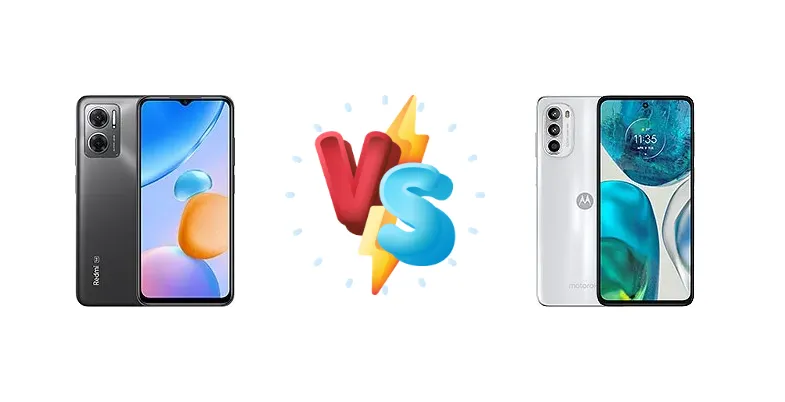
The Xiaomi Redmi 11 Prime 5G and Motorola Moto G52 represent compelling options in the crowded budget smartphone space. The Redmi 11 Prime 5G prioritizes 5G connectivity with the Mediatek Dimensity 700, while the Moto G52 focuses on efficiency and a faster charging experience with the Qualcomm Snapdragon 680. This comparison dissects their key differences to help you choose the right device.
🏆 Quick Verdict
For users prioritizing 5G access and occasional performance boosts, the Xiaomi Redmi 11 Prime 5G is the better choice. However, the Motorola Moto G52 wins for those seeking longer battery life and significantly faster 30W charging, making it ideal for everyday users who don't heavily rely on 5G.
| Network |
|---|
| 2G bands | GSM 850 / 900 / 1800 / 1900 | GSM 850 / 900 / 1800 / 1900 |
| 3G bands | HSDPA 850 / 900 / 1700(AWS) / 1900 / 2100 | HSDPA 850 / 900 / 1700(AWS) / 1900 / 2100 |
| 4G bands | 1, 2, 3, 4, 5, 7, 8, 20, 28, 38, 40, 41 | LTE |
| 5G bands | 1, 3, 5, 7, 8, 20, 28, 38, 40, 41, 77, 78 SA/NSA | - |
| Speed | HSPA, LTE, 5G | HSPA, LTE |
| Technology | GSM / HSPA / LTE / 5G | GSM / HSPA / LTE |
| Launch |
|---|
| Announced | 2022, September 06 | 2022, April 12 |
| Status | Available. Released 2022, September 09 | Available. Released 2022, April 20 |
| Body |
|---|
| Dimensions | 164 x 76.1 x 8.9 mm (6.46 x 3.00 x 0.35 in) | 160.1 x 74.5 x 8 mm (6.30 x 2.93 x 0.31 in) |
| SIM | Nano-SIM + Nano-SIM | Nano-SIM + Nano-SIM |
| Weight | 200 g (7.05 oz) | 169 g (5.96 oz) |
| | - | Water-repellent design |
| Display |
|---|
| Protection | Corning Gorilla Glass 3 | - |
| Resolution | 1080 x 2408 pixels, 20:9 ratio (~401 ppi density) | 1080 x 2400 pixels, 20:9 ratio (~402 ppi density) |
| Size | 6.58 inches, 104.3 cm2 (~83.6% screen-to-body ratio) | 6.6 inches, 103.6 cm2 (~86.9% screen-to-body ratio) |
| Type | IPS LCD, 90Hz | AMOLED, 90Hz |
| Platform |
|---|
| CPU | Octa-core (2x2.2 GHz Cortex-A76 & 6x2.0 GHz Cortex-A55) | Octa-core (4x2.4 GHz Kryo 265 Gold & 4x1.9 GHz Kryo 265 Silver) |
| Chipset | Mediatek Dimensity 700 (7 nm) | Qualcomm SM6225 Snapdragon 680 4G (6 nm) |
| GPU | Mali-G57 MC2 | Adreno 610 |
| OS | Android 12, MIUI 13 | Android 12, planned upgrade to Android 13 |
| Memory |
|---|
| Card slot | microSDXC (dedicated slot) | microSDXC (uses shared SIM slot) |
| Internal | 64GB 4GB RAM, 128GB 4GB RAM, 128GB 6GB RAM | 64GB 4GB RAM, 128GB 4GB RAM, 128GB 6GB RAM, 256GB 6GB RAM |
| | UFS 2.2 | - |
| Main Camera |
|---|
| Dual | 50 MP, f/1.8, (wide), PDAF
Auxiliary lens | - |
| Features | LED flash, HDR, panorama | LED flash, HDR, panorama |
| Triple | - | 50 MP, f/1.8 (wide), 1/2.76", 0.64µm, PDAF
8 MP, f/2.2, 118˚ (ultrawide), 1/4.0", 1.12µm
2 MP (macro) |
| Video | 1080p@30fps | 1080p@30fps |
| Selfie camera |
|---|
| Features | HDR | - |
| Single | 5 MP, f/2.2 | 16 MP, f/2.5, (wide), 1.0µm |
| Video | 1080p@30fps | 1080p@30fps |
| Sound |
|---|
| 3.5mm jack | Yes | Yes |
| 35mm jack | Yes | Yes |
| Loudspeaker | Yes | Yes, with stereo speakers |
| | 24-bit/192kHz audio | - |
| Comms |
|---|
| Bluetooth | 5.1, A2DP, LE | 5.0, A2DP, LE |
| Infrared port | Yes | - |
| NFC | Yes | Yes (market/region dependent) |
| Positioning | GPS, GLONASS, BDS, GALILEO | GPS, GLONASS, GALILEO |
| Radio | FM radio | Unspecified |
| USB | USB Type-C 2.0, OTG | USB Type-C 2.0 |
| WLAN | Wi-Fi 802.11 a/b/g/n/ac, dual-band, Wi-Fi Direct | Wi-Fi 802.11 a/b/g/n/ac, dual-band, Wi-Fi Direct |
| Features |
|---|
| Sensors | Fingerprint (side-mounted), accelerometer, proximity, compass | Fingerprint (side-mounted), accelerometer, gyro, proximity, compass |
| Battery |
|---|
| Charging | 18W wired | 30W wired |
| Type | Li-Po 5000 mAh | Li-Po 5000 mAh |
| Misc |
|---|
| Colors | Thunder Black, Chrome Silver, Meadow Green | Charcoal Gray, Porcelain White |
| Models | - | XT2221-1, XT2221-2 |
| Price | About 180 EUR | About 470 EUR |
Xiaomi Redmi 11 Prime 5G
- 5G Connectivity for faster data speeds
- Potentially higher CPU performance for multitasking
- Xiaomi’s MIUI offers extensive customization options
- Slower 18W charging
- Potentially lower battery life due to 7nm process
- MIUI can be resource-intensive
Motorola Moto G52
- Faster 30W wired charging
- More power-efficient Snapdragon 680 (6nm)
- Clean, near-stock Android experience
- Lacks 5G connectivity
- Lower peak CPU performance
- Motorola’s software update support is less consistent than Xiaomi’s
Display Comparison
Neither device boasts a standout display. While specific display specs (resolution, refresh rate) are missing, the core difference lies in the chipsets powering them. Display quality will likely be similar, focusing on adequate brightness for indoor use. The absence of high refresh rates on either device suggests a focus on power efficiency rather than visual fluidity.
Camera Comparison
Without detailed camera sensor information, a direct comparison is difficult. However, the market segment suggests both phones will feature primary sensors around the 50MP mark. The image processing style will likely differ – Xiaomi often leans towards vibrant, saturated images, while Motorola typically aims for more natural color reproduction. The absence of optical image stabilization (OIS) on either device suggests a reliance on software stabilization, which may struggle in low-light conditions. The inclusion of 2MP macro lenses on both phones is largely a marketing tactic, offering limited practical benefit.
Performance
The Mediatek Dimensity 700 (7nm) in the Redmi 11 Prime 5G and the Qualcomm Snapdragon 680 (6nm) in the Moto G52 represent different design philosophies. The Dimensity 700’s Cortex-A76 cores offer a performance edge in CPU-intensive tasks, benefiting users who multitask or play moderately demanding games. However, the Snapdragon 680, built on a more efficient 6nm process, likely delivers superior sustained performance and thermal management. The Snapdragon 680’s Kryo 265 Gold cores, clocked at 2.4 GHz, are designed for responsiveness, while the Dimensity 700 prioritizes peak performance. The 5G modem in the Dimensity 700 is a key differentiator, but its impact is limited without widespread 5G availability.
Battery Life
The Motorola Moto G52’s 30W wired charging is a significant advantage over the Redmi 11 Prime 5G’s 18W charging. This translates to substantially faster top-up times, crucial for users who frequently find themselves with low battery. While the Redmi 11 Prime 5G may have a slightly larger battery capacity (spec not provided), the Snapdragon 680’s efficiency in the Moto G52 likely results in longer real-world battery life. The 6nm process node contributes to lower power consumption during everyday tasks.
Buying Guide
Buy the Xiaomi Redmi 11 Prime 5G if you need 5G connectivity for streaming, downloading, or future-proofing, and are willing to trade some battery life for it. Buy the Motorola Moto G52 if you prioritize all-day battery life, faster charging speeds, and a consistently smooth experience for everyday tasks like browsing, social media, and communication.
Frequently Asked Questions
❓ Will the Dimensity 700 in the Redmi 11 Prime 5G noticeably improve gaming performance compared to the Snapdragon 680?
While the Dimensity 700 offers a performance advantage in CPU-intensive tasks, the Snapdragon 680’s efficiency and thermal management may result in more consistent frame rates during extended gaming sessions. The difference will be most noticeable in graphically demanding titles, but both phones are best suited for casual gaming.
❓ How long will it take to fully charge the Motorola Moto G52 with the 30W charger?
The Motorola Moto G52’s 30W charging should take approximately 60-75 minutes to fully charge from 0% to 100%, significantly faster than the Redmi 11 Prime 5G’s 18W charging. This makes it ideal for users who need a quick top-up before heading out.
❓ Does the Redmi 11 Prime 5G actually benefit from 5G if my carrier's 5G coverage is limited?
The benefit of 5G on the Redmi 11 Prime 5G is directly tied to 5G network availability. If 5G coverage is sparse in your area, you won’t experience the faster data speeds. In such cases, the phone will fall back to 4G, negating the primary advantage of the Dimensity 700.