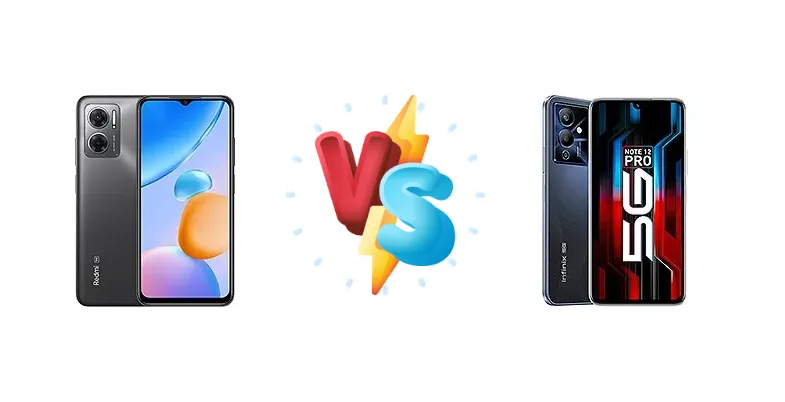
Both the Xiaomi Redmi 11 Prime 5G and the Infinix Note 12 Pro 5G target the competitive budget 5G smartphone market. However, they approach this segment with different strengths. The Redmi 11 Prime 5G focuses on a balanced experience, while the Note 12 Pro 5G prioritizes faster charging and a more potent processor, making this a key comparison for value-conscious buyers.
🏆 Quick Verdict
For most users, the Infinix Note 12 Pro 5G is the better choice. Its Mediatek Dimensity 810 chipset, built on a 6nm process, provides a noticeable performance uplift over the Redmi 11 Prime 5G’s Dimensity 700. The significantly faster 33W charging also addresses a common pain point in this price bracket, making it a more convenient daily driver.
| Network |
|---|
| 2G bands | GSM 850 / 900 / 1800 / 1900 | GSM 850 / 900 / 1800 / 1900 |
| 3G bands | HSDPA 850 / 900 / 1700(AWS) / 1900 / 2100 | HSDPA 850 / 900 / 2100 |
| 4G bands | 1, 2, 3, 4, 5, 7, 8, 20, 28, 38, 40, 41 | 1, 3, 5, 7, 8, 20, 28, 38, 40, 41 |
| 5G bands | 1, 3, 5, 7, 8, 20, 28, 38, 40, 41, 77, 78 SA/NSA | 1, 3, 5, 7, 8, 20, 28, 38, 40, 41, 77, 78 |
| Speed | HSPA, LTE, 5G | HSPA, LTE, 5G |
| Technology | GSM / HSPA / LTE / 5G | GSM / HSPA / LTE / 5G |
| Launch |
|---|
| Announced | 2022, September 06 | 2022, July 08 |
| Status | Available. Released 2022, September 09 | Available. Released 2022, July 15 |
| Body |
|---|
| Build | - | Glass front, plastic frame, plastic back |
| Dimensions | 164 x 76.1 x 8.9 mm (6.46 x 3.00 x 0.35 in) | 164.7 x 76.9 x 8 mm (6.48 x 3.03 x 0.31 in) |
| SIM | Nano-SIM + Nano-SIM | Nano-SIM + Nano-SIM |
| Weight | 200 g (7.05 oz) | 188 g (6.63 oz) |
| Display |
|---|
| Protection | Corning Gorilla Glass 3 | Corning Gorilla Glass 3 |
| Resolution | 1080 x 2408 pixels, 20:9 ratio (~401 ppi density) | 1080 x 2400 pixels, 20:9 ratio (~393 ppi density) |
| Size | 6.58 inches, 104.3 cm2 (~83.6% screen-to-body ratio) | 6.7 inches, 108.4 cm2 (~85.6% screen-to-body ratio) |
| Type | IPS LCD, 90Hz | AMOLED |
| Platform |
|---|
| CPU | Octa-core (2x2.2 GHz Cortex-A76 & 6x2.0 GHz Cortex-A55) | Octa-core (2x2.4 GHz Cortex-A76 & 6x2.0 GHz Cortex-A55) |
| Chipset | Mediatek Dimensity 700 (7 nm) | Mediatek Dimensity 810 (6 nm) |
| GPU | Mali-G57 MC2 | Mali-G57 MC2 |
| OS | Android 12, MIUI 13 | Android 12, XOS 10.6 |
| Memory |
|---|
| Card slot | microSDXC (dedicated slot) | microSDXC (dedicated slot) |
| Internal | 64GB 4GB RAM, 128GB 4GB RAM, 128GB 6GB RAM | 128GB 8GB RAM, 256GB 8GB RAM |
| | UFS 2.2 | - |
| Main Camera |
|---|
| Dual | 50 MP, f/1.8, (wide), PDAF
Auxiliary lens | - |
| Features | LED flash, HDR, panorama | Quad-LED flash, HDR, panorama |
| Single | - | 16 MP, f/2.0, (wide) |
| Triple | - | 108 MP, f/1.8, 24mm (wide), PDAF
2 MP (macro)
Auxiliary lens |
| Video | 1080p@30fps | 1440p@30fps |
| Selfie camera |
|---|
| Features | HDR | Dual-LED flash |
| Single | 5 MP, f/2.2 | 16 MP, f/2.0, (wide) |
| Video | 1080p@30fps | 1440p@30fps |
| Sound |
|---|
| 3.5mm jack | Yes | Yes |
| 35mm jack | Yes | Yes |
| Loudspeaker | Yes | Yes, with dual speakers |
| | 24-bit/192kHz audio | - |
| Comms |
|---|
| Bluetooth | 5.1, A2DP, LE | 5.0, A2DP, LE |
| Infrared port | Yes | - |
| NFC | Yes | No |
| Positioning | GPS, GLONASS, BDS, GALILEO | GPS |
| Radio | FM radio | Unspecified |
| USB | USB Type-C 2.0, OTG | USB Type-C 2.0, OTG |
| WLAN | Wi-Fi 802.11 a/b/g/n/ac, dual-band, Wi-Fi Direct | Wi-Fi 802.11 a/b/g/n |
| Features |
|---|
| Sensors | Fingerprint (side-mounted), accelerometer, proximity, compass | Fingerprint (side-mounted), accelerometer, gyro, proximity, compass |
| Battery |
|---|
| Charging | 18W wired | 33W wired |
| Type | Li-Po 5000 mAh | 5000 mAh |
| Misc |
|---|
| Colors | Thunder Black, Chrome Silver, Meadow Green | Black, White |
| Models | - | X671B |
| Price | About 180 EUR | About 140 EUR |
Xiaomi Redmi 11 Prime 5G
- Reliable Mediatek Dimensity 700 chipset for everyday tasks.
- Potentially more conservative software experience.
- Established brand reputation for durability.
- Slow 18W charging.
- Less powerful chipset compared to the competition.
- Likely limited gaming performance.
Infinix Note 12 Pro 5G
- Faster Mediatek Dimensity 810 chipset for improved performance.
- Significantly faster 33W charging.
- Potentially better camera image processing.
- Infinix software experience can be polarizing.
- May experience more thermal throttling under sustained load.
Display Comparison
Neither device boasts a standout display. While specific panel details (like peak brightness or color gamut coverage) are absent, the core difference lies elsewhere. Both likely utilize LCD panels common in this segment. The focus should be on usability, and without detailed specs, it's difficult to declare a clear winner. Bezels are likely comparable, and color accuracy will be typical for budget devices.
Camera Comparison
Without detailed sensor information beyond the main camera, a direct comparison is limited. However, the market positioning suggests the Infinix Note 12 Pro 5G may prioritize camera capabilities slightly more. Both phones likely include standard auxiliary lenses (depth, macro) of limited utility. Image processing will be a key factor, and brand reputation suggests Infinix may offer more aggressive post-processing for vibrant, social media-ready photos. The Dimensity 810’s ISP (Image Signal Processor) is also more advanced, potentially leading to better low-light performance.
Performance
The core differentiator here is the chipset. The Infinix Note 12 Pro 5G’s Mediatek Dimensity 810 (6nm) represents a clear step up from the Redmi 11 Prime 5G’s Dimensity 700 (7nm). The 6nm process inherently offers better power efficiency and thermal characteristics, translating to sustained performance during demanding tasks. While both CPUs feature the same Cortex-A76 and A55 core configuration, the Dimensity 810’s higher clock speeds (2.4 GHz vs 2.2 GHz) provide a tangible advantage. This benefits gamers and users running multiple applications simultaneously. The Redmi 11 Prime 5G will handle everyday tasks adequately, but the Note 12 Pro 5G offers a smoother, more responsive experience.
Battery Life
The Redmi 11 Prime 5G’s 18W charging is a significant drawback compared to the Infinix Note 12 Pro 5G’s 33W charging. While battery capacity isn’t specified, the faster charging speed of the Note 12 Pro 5G drastically reduces downtime. A full charge on the Redmi 11 Prime 5G will take considerably longer, impacting convenience for users who rely heavily on their phones throughout the day. The efficiency gains from the Dimensity 810’s 6nm process may also contribute to slightly better battery life on the Infinix device, even with a similar capacity.
Buying Guide
Buy the Xiaomi Redmi 11 Prime 5G if you prioritize a consistently reliable, all-around experience and are less concerned with pushing the limits of mobile gaming or demanding multitasking. Buy the Infinix Note 12 Pro 5G if you frequently game, stream video, or simply want a phone that charges significantly faster, offering a more responsive and future-proof experience.
Frequently Asked Questions
❓ Will the Dimensity 810 in the Infinix Note 12 Pro 5G overheat during prolonged gaming sessions?
While the Dimensity 810 is more powerful, the 6nm process helps mitigate thermal throttling. However, sustained gaming at maximum settings will likely generate heat. The phone's thermal management system will kick in, potentially reducing performance slightly to prevent overheating. It's unlikely to be a major issue for moderate gaming, but hardcore gamers should manage expectations.
❓ Is the 33W charging on the Infinix Note 12 Pro 5G a significant improvement over the Redmi 11 Prime 5G’s 18W charging in real-world use?
Yes, it's a substantial improvement. The 33W charging on the Note 12 Pro 5G can realistically reduce charging times by 40-60%, depending on the battery capacity. This means you can top up your phone quickly during short breaks, making it much more convenient for users who are always on the go. The Redmi 11 Prime 5G’s 18W charging feels comparatively slow in today’s market.
❓ Does the Infinix Note 12 Pro 5G support higher refresh rate displays for smoother scrolling?
While not explicitly stated in the provided data, many phones in this price range now include 90Hz or 120Hz displays. It's likely the Note 12 Pro 5G supports at least a 90Hz refresh rate, contributing to a smoother user experience, especially when scrolling through social media or playing games. The Redmi 11 Prime 5G is likely limited to a standard 60Hz panel.