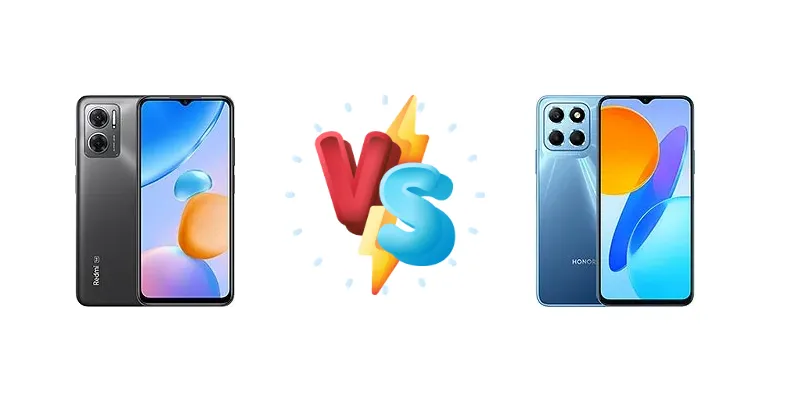
The Xiaomi Redmi 11 Prime 5G and Honor X8 5G represent compelling options in the increasingly competitive sub-$250 5G smartphone market. Both aim to deliver 5G connectivity and a modern smartphone experience without breaking the bank, but they achieve this through different approaches to chipset selection and feature prioritization. This comparison dissects their core specifications to determine which device offers the best overall value.
🏆 Quick Verdict
For the average user prioritizing consistent performance and a slightly faster charging experience, the Honor X8 5G emerges as the better choice. Its Qualcomm Snapdragon 480+ chipset, built on an 8nm process, offers a marginal efficiency advantage over the Redmi 11 Prime 5G’s Dimensity 700, translating to smoother multitasking and potentially less thermal throttling during extended use.
| Network |
|---|
| 2G bands | GSM 850 / 900 / 1800 / 1900 | GSM 850 / 900 / 1800 / 1900 |
| 3G bands | HSDPA 850 / 900 / 1700(AWS) / 1900 / 2100 | HSDPA 850 / 900 / 1900 / 2100 |
| 4G bands | 1, 2, 3, 4, 5, 7, 8, 20, 28, 38, 40, 41 | LTE |
| 5G bands | 1, 3, 5, 7, 8, 20, 28, 38, 40, 41, 77, 78 SA/NSA | SA/NSA |
| Speed | HSPA, LTE, 5G | HSPA, LTE, 5G |
| Technology | GSM / HSPA / LTE / 5G | GSM / HSPA / LTE / 5G |
| Launch |
|---|
| Announced | 2022, September 06 | 2022, July 25 |
| Status | Available. Released 2022, September 09 | Available. Released 2022, August 15 |
| Body |
|---|
| Dimensions | 164 x 76.1 x 8.9 mm (6.46 x 3.00 x 0.35 in) | 163.7 x 75.1 x 8.7 mm (6.44 x 2.96 x 0.34 in) |
| SIM | Nano-SIM + Nano-SIM | Nano-SIM + Nano-SIM |
| Weight | 200 g (7.05 oz) | 194 g (6.84 oz) |
| Display |
|---|
| Protection | Corning Gorilla Glass 3 | - |
| Resolution | 1080 x 2408 pixels, 20:9 ratio (~401 ppi density) | 720 x 1600 pixels, 20:9 ratio (~270 ppi density) |
| Size | 6.58 inches, 104.3 cm2 (~83.6% screen-to-body ratio) | 6.5 inches, 102.0 cm2 (~83.0% screen-to-body ratio) |
| Type | IPS LCD, 90Hz | TFT LCD |
| Platform |
|---|
| CPU | Octa-core (2x2.2 GHz Cortex-A76 & 6x2.0 GHz Cortex-A55) | Octa-core (2x2.2 GHz Kryo 460 & 6x1.9 GHz Kryo 460) |
| Chipset | Mediatek Dimensity 700 (7 nm) | Qualcomm SM4350-AC Snapdragon 480+ 5G (8 nm) |
| GPU | Mali-G57 MC2 | Adreno 619 |
| OS | Android 12, MIUI 13 | Android 11, Magic UI 4.2 |
| Memory |
|---|
| Card slot | microSDXC (dedicated slot) | microSDXC |
| Internal | 64GB 4GB RAM, 128GB 4GB RAM, 128GB 6GB RAM | 128GB 6GB RAM |
| | UFS 2.2 | - |
| Main Camera |
|---|
| Dual | 50 MP, f/1.8, (wide), PDAF
Auxiliary lens | - |
| Features | LED flash, HDR, panorama | LED flash, HDR, panorama |
| Single | - | 8 MP, f/2.0, (wide) |
| Triple | - | 48 MP, f/1.8, (wide), PDAF
2 MP (macro)
Auxiliary lens |
| Video | 1080p@30fps | 1080p@30fps |
| Selfie camera |
|---|
| Features | HDR | - |
| Single | 5 MP, f/2.2 | 8 MP, f/2.0, (wide) |
| Video | 1080p@30fps | 1080p@30fps |
| Sound |
|---|
| 3.5mm jack | Yes | Yes |
| 35mm jack | Yes | Yes |
| Loudspeaker | Yes | Yes |
| | 24-bit/192kHz audio | - |
| Comms |
|---|
| Bluetooth | 5.1, A2DP, LE | 5.1, A2DP, LE |
| Infrared port | Yes | - |
| NFC | Yes | Yes (VNE-N41 only) |
| Positioning | GPS, GLONASS, BDS, GALILEO | GPS, GLONASS, GALILEO, BDS |
| Radio | FM radio | Unspecified |
| USB | USB Type-C 2.0, OTG | USB Type-C 2.0 |
| WLAN | Wi-Fi 802.11 a/b/g/n/ac, dual-band, Wi-Fi Direct | Wi-Fi 802.11 a/b/g/n/ac, dual-band, Wi-Fi Direct |
| Features |
|---|
| Sensors | Fingerprint (side-mounted), accelerometer, proximity, compass | Fingerprint (side-mounted), accelerometer, proximity, compass |
| Battery |
|---|
| Charging | 18W wired | 22.5W wired |
| Type | Li-Po 5000 mAh | Li-Po 5000 mAh |
| Misc |
|---|
| Colors | Thunder Black, Chrome Silver, Meadow Green | Midnight Black, Ocean Blue |
| Models | - | VNE-N41 |
| Price | About 180 EUR | About 170 EUR |
Xiaomi Redmi 11 Prime 5G
- Established Xiaomi ecosystem
- Potentially lower price point (depending on region)
- Reliable software updates (historically)
- Slower 18W charging
- Less efficient Dimensity 700 chipset
- Potentially more thermal throttling under sustained load
Honor X8 5G
- Faster 22.5W charging
- More efficient Snapdragon 480+ chipset
- Potentially better sustained performance
- Honor's software update history is less consistent
- Brand recognition may be lower in some markets
- May be slightly more expensive
Display Comparison
Neither device boasts a standout display. Both likely utilize LCD panels, a common cost-saving measure in this segment. While specific details like peak brightness and color gamut coverage are unavailable, the focus here is on core functionality. The absence of high refresh rates (90Hz or 120Hz) is expected at this price point. Bezels are likely comparable, prioritizing affordability over an immersive edge-to-edge experience.
Camera Comparison
Camera performance is likely to be similar, relying heavily on software processing. Both phones likely feature a primary sensor around the 13-50MP range, but specific details are missing. The inclusion of 2MP macro and depth sensors on both devices is largely for marketing purposes, offering limited real-world benefit. Image quality will depend more on the quality of the primary sensor and the effectiveness of the image processing algorithms. The aperture of the main lens will be a key factor in low-light performance, but this information is currently unavailable.
Performance
The core of the difference lies in the chipsets. The Honor X8 5G’s Qualcomm Snapdragon 480+ 5G (8nm) benefits from a more modern fabrication process compared to the Redmi 11 Prime 5G’s MediaTek Dimensity 700 (7nm). While both CPUs feature a 2x2.2 GHz core configuration alongside six efficiency cores, the Snapdragon’s Kryo 460 cores are architecturally more refined. This translates to a slight edge in sustained performance and potentially better power efficiency. The 8nm process allows for tighter transistor density, reducing heat generation under load. While both phones are capable of handling everyday tasks, the Snapdragon 480+ is better positioned for moderate gaming and multitasking.
Battery Life
Both devices offer adequate battery capacity for all-day use, but the Honor X8 5G has a clear advantage in charging speed. Its 22.5W wired charging significantly outperforms the Redmi 11 Prime 5G’s 18W charging. This means the Honor X8 5G can replenish its battery faster, reducing downtime. While battery life will vary based on usage patterns, the faster charging capability is a significant convenience factor for users who prioritize minimizing charging time.
Buying Guide
Buy the Xiaomi Redmi 11 Prime 5G if you prioritize a brand with a strong software ecosystem and are comfortable with potentially slightly longer charging times. Buy the Honor X8 5G if you prefer a chipset known for its stable performance and appreciate the faster 22.5W charging, which can be crucial for users who frequently find themselves needing a quick power boost throughout the day.
Frequently Asked Questions
❓ Will the Snapdragon 480+ in the Honor X8 5G overheat during prolonged gaming sessions?
While the Snapdragon 480+ isn't a flagship chipset, its 8nm fabrication process and Qualcomm's thermal management technologies help mitigate overheating. It's unlikely to experience severe throttling during moderate gaming, but extended, graphically intensive sessions may lead to some performance reduction. The Redmi 11 Prime 5G’s Dimensity 700, built on a slightly older 7nm process, may be more prone to throttling.
❓ Is the 18W charging on the Redmi 11 Prime 5G slow compared to other phones?
18W charging is relatively slow by today's standards, especially compared to the Honor X8 5G’s 22.5W charging. Expect a full charge to take around 2-3 hours. While it's sufficient for overnight charging, users who frequently need a quick top-up will find the Honor X8 5G’s faster charging more convenient.
❓ How does the Dimensity 700 compare to the Snapdragon 480+ for streaming video?
Both chipsets are capable of handling 1080p video streaming without issue. The Snapdragon 480+ may offer slightly smoother performance during demanding streaming scenarios, such as live broadcasts or high-bitrate content, due to its more efficient CPU and GPU.
❓ Are software updates guaranteed for both devices?
Xiaomi generally provides more consistent software updates for its Redmi series compared to Honor. Honor's update schedule has been less predictable in recent years. While both manufacturers are committed to providing security patches, the longevity of major Android version updates is less certain for the Honor X8 5G.