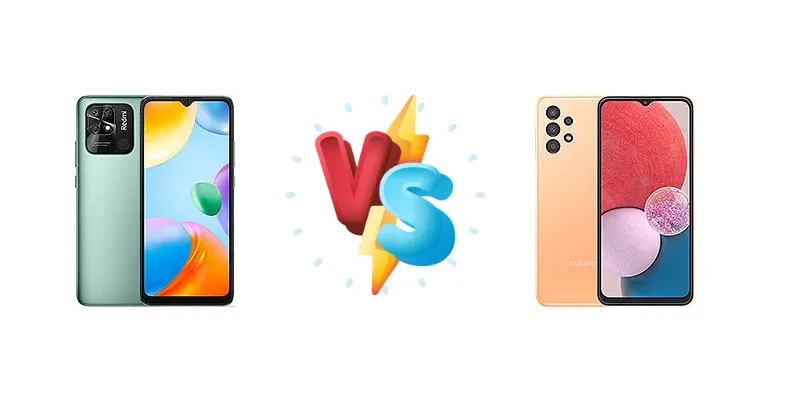
The budget smartphone market is fiercely competitive, and the Xiaomi Redmi 10C and Samsung Galaxy A13 are two strong contenders. Both offer compelling features at affordable prices, but which one delivers the best overall experience? Let's dive into a detailed comparison to help you decide.
🏆 Quick Verdict
The Samsung Galaxy A13 edges out the Redmi 10C thanks to its brighter display, slightly more refined software, and longer software support. While the Redmi 10C boasts a more efficient chipset, the A13's overall package provides a more polished user experience for most.
| Network |
|---|
| 2G bands | GSM 850 / 900 / 1800 / 1900 | GSM 850 / 900 / 1800 / 1900 |
| 3G bands | HSDPA 850 / 900 / 1700(AWS) / 1900 / 2100 | HSDPA 850 / 900 / 2100 |
| 4G bands | 1, 2, 3, 4, 5, 7, 8, 20, 28, 38, 40, 41 | 1, 3, 5, 7, 8, 20, 28, 38, 40, 41 |
| Speed | HSPA, LTE | HSPA, LTE |
| Technology | GSM / HSPA / LTE | GSM / HSPA / LTE |
| Launch |
|---|
| Announced | 2022, March 21 | 2022, March 04 |
| Status | Available. Released 2022, March 23 | Available. Released 2022, March 23 |
| Body |
|---|
| Build | - | Glass front (Gorilla Glass 5), plastic frame, plastic back |
| Dimensions | 169.6 x 76.6 x 8.3 mm (6.68 x 3.02 x 0.33 in) | 165.1 x 76.4 x 8.8 mm (6.5 x 3.01 x 0.35 in) |
| SIM | Nano-SIM + Nano-SIM | · Nano-SIM· Nano-SIM + Nano-SIM |
| Weight | 190 g (6.70 oz) | 195 g (6.88 oz) |
| Display |
|---|
| Protection | Corning Gorilla Glass | Corning Gorilla Glass 5 |
| Resolution | 720 x 1650 pixels (~268 ppi density) | 1080 x 2408 pixels, 20:9 ratio (~400 ppi density) |
| Size | 6.71 inches, 106.5 cm2 (~82.0% screen-to-body ratio) | 6.6 inches, 104.9 cm2 (~83.2% screen-to-body ratio) |
| Type | IPS LCD | PLS LCD |
| Platform |
|---|
| CPU | Octa-core (4x2.4 GHz Kryo 265 Gold & 4x1.9 GHz Kryo 265 Silver) | Octa-core (4x2.0 GHz Cortex-A55 & 4x2.0 GHz Cortex-A55) |
| Chipset | Qualcomm SM6225 Snapdragon 680 4G (6 nm) | Exynos 850 (8 nm) |
| GPU | Adreno 610 | Mali-G52 |
| OS | Android 11, MIUI 13 | Android 12, upgradable to Android 14, One UI 6.1 |
| Memory |
|---|
| Card slot | microSDXC (dedicated slot) | microSDXC (dedicated slot) |
| Internal | 64GB 3GB RAM, 64GB 4GB RAM, 128GB 3GB RAM, 128GB 4GB RAM | 32GB 3GB RAM, 32GB 4GB RAM, 64GB 4GB RAM, 128GB 3GB RAM, 128GB 4GB RAM, 128GB 6GB RAM |
| | UFS 2.2 | eMMC 5.1 |
| Main Camera |
|---|
| Dual | 50 MP, f/1.8, 26mm (wide), PDAF
Auxiliary lens | - |
| Features | LED flash, HDR, panorama | LED flash, panorama, HDR |
| Quad | - | 50 MP, f/1.8, (wide), PDAF
5 MP, f/2.2, 123˚ (ultrawide), 1/5.0", 1.12µm
2 MP (macro)
Auxiliary lens |
| Single | 5 MP, f/2.2 | 8 MP, f/2.2, (wide) |
| Video | 1080p@30fps | 1080p@30fps |
| Selfie camera |
|---|
| Single | 5 MP, f/2.2 | 8 MP, f/2.2, (wide) |
| Video | 1080p@30fps | 1080p@30fps |
| Sound |
|---|
| 3.5mm jack | Yes | Yes |
| 35mm jack | Yes | Yes |
| Loudspeaker | Yes | Yes |
| Comms |
|---|
| Bluetooth | 5.0, A2DP, LE | 5.0, A2DP, LE |
| NFC | Yes (market/region dependent) | Yes (market/region dependent) |
| Positioning | GPS, GLONASS, BDS, GALILEO | GPS, GLONASS, GALILEO, BDS |
| Radio | FM radio | No |
| USB | USB Type-C 2.0, OTG | USB Type-C 2.0, OTG |
| WLAN | Wi-Fi 802.11 a/b/g/n/ac, dual-band, Wi-Fi Direct | Wi-Fi 802.11 a/b/g/n/ac, dual-band, Wi-Fi Direct |
| Features |
|---|
| Sensors | Fingerprint (rear-mounted), accelerometer, proximity | Fingerprint (side-mounted), accelerometer, compass |
| | - | Virtual proximity sensing |
| Battery |
|---|
| Charging | 18W wired | 15W wired |
| Type | Li-Po 5000 mAh | Li-Po 5000 mAh |
| Misc |
|---|
| Colors | Graphite Gray, Ocean Blue, Mint Green | Black, White, Peach, Blue |
| Models | 220333QAG, 220333QBI, 220333QNY, 220333QL | SM-A135F, SM-A135F/DS, SM-A135M, SM-A135U, SM-A135U1, SM-A135N |
| Price | £ 99.00 / € 109.86 | € 94.99 / $ 129.99 / £ 89.00 |
| SAR | 0.96 W/kg (head) 1.02 W/kg (body) | 0.49 W/kg (head) |
| SAR EU | 0.57 W/kg (head) 0.96 W/kg (body) | 0.37 W/kg (head) 1.39 W/kg (body) |
| Tests |
|---|
| Battery life | - |
Endurance rating 114h
|
| Camera | - |
Photo / Video |
| Display | - |
Contrast ratio: 1324:1 (nominal) |
| Loudspeaker | - |
-29.7 LUFS (Average)
|
| Performance | - |
AnTuTu: 122822 (v8), 136286 (v9)
GeekBench: 588 (v5.1)
GFXBench: 5.2fps (ES 3.1 onscreen) |
Xiaomi Redmi 10C
- More efficient chipset
- Slightly more modern design
- Competitive price
- Less bright display
- Potentially shorter software support
- Average camera performance
Samsung Galaxy A13
- Brighter display
- Longer battery life
- Reliable brand reputation
- Longer software support
- Less efficient chipset
- Slightly older design
- Average camera performance
Display Comparison
The Samsung Galaxy A13 takes the display crown. While both offer a 6.6-inch display, the A13's measured 587 nits peak brightness significantly outperforms the Redmi 10C, making it easier to view outdoors. The contrast ratio is similar, but the A13's brightness is a noticeable advantage. The Redmi 10C's display is adequate but lacks the vibrancy of the A13.
Camera Comparison
Camera performance is fairly comparable. Both offer multiple lenses, but image quality is decent rather than exceptional. The A13 might offer slightly better image processing in certain scenarios. Low-light performance is a weakness for both devices. Expect usable photos in good lighting conditions.
Performance
The Redmi 10C's Snapdragon 680 chipset, built on a 6nm process, offers a slight edge in efficiency and potentially smoother performance in some tasks compared to the Galaxy A13's Exynos 850 (8nm). However, in everyday use, the difference is often negligible. Both phones handle basic tasks and social media with ease.
Battery Life
The Galaxy A13 shines in battery life, boasting an impressive endurance rating of 114 hours. While the Redmi 10C also offers good battery life, it doesn't quite match the A13's longevity. Both support 18W charging, but the A13's larger battery means it will take longer to fully charge.
Buying Guide
The Xiaomi Redmi 10C is ideal for users prioritizing raw performance and a slightly more modern design on a tight budget. The Samsung Galaxy A13 is a better choice for those who value a vibrant display, reliable brand reputation, and longer software updates.
Frequently Asked Questions
❓ Which phone has better software support?
The Samsung Galaxy A13 generally receives longer software updates and security patches compared to the Xiaomi Redmi 10C.
❓ Is the Redmi 10C's chipset faster?
The Redmi 10C's Snapdragon 680 is slightly more efficient and potentially faster in some benchmarks, but the real-world difference is often minimal.