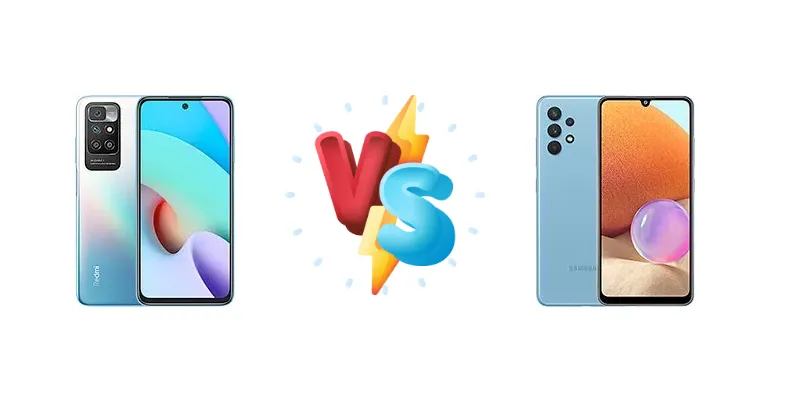
The Xiaomi Redmi 10 and Samsung Galaxy A32 represent compelling options in the crowded budget smartphone market. Both aim to deliver essential features at an accessible price point, but they take different approaches. This comparison dives deep into their specifications to determine which device offers the best value for your money, focusing on display quality, performance, and battery endurance.
🏆 Quick Verdict
For most users, the Xiaomi Redmi 10 emerges as the stronger choice. Its significantly brighter display (477 nits vs 814 nits) and longer endurance rating (127h vs 119h) provide a better overall user experience, despite the similar chipsets. The Redmi 10 offers a more visible screen outdoors and will likely last longer on a single charge.
| Network |
|---|
| 2G bands | GSM 850 / 900 / 1800 / 1900 | GSM 850 / 900 / 1800 / 1900 |
| 3G bands | HSDPA 850 / 900 / 1900 / 2100 | HSDPA 850 / 900 / 1900 / 2100 |
| 4G bands | 1, 2, 3, 4, 5, 7, 8, 20, 28, 38, 40, 41 | 1, 2, 3, 5, 7, 8, 20, 28, 38, 40, 41 |
| Speed | HSPA, LTE | HSPA, LTE |
| Technology | GSM / HSPA / LTE | GSM / HSPA / LTE |
| Launch |
|---|
| Announced | 2021, August 18 | 2021, February 25 |
| Status | Available. Released 2021, August 20 | Available. Released 2021, February 25 |
| Body |
|---|
| Build | - | Glass front (Gorilla Glass 5), plastic frame, plastic back |
| Dimensions | 162 x 75.5 x 8.9 mm (6.38 x 2.97 x 0.35 in) | 158.9 x 73.6 x 8.4 mm (6.26 x 2.90 x 0.33 in) |
| SIM | Nano-SIM + Nano-SIM | · Nano-SIM· Nano-SIM + Nano-SIM |
| Weight | 181 g (6.38 oz) | 184 g (6.49 oz) |
| Display |
|---|
| Protection | Corning Gorilla Glass 3 | Corning Gorilla Glass 5 |
| Resolution | 1080 x 2400 pixels, 20:9 ratio (~405 ppi density) | 1080 x 2400 pixels, 20:9 ratio (~411 ppi density) |
| Size | 6.5 inches, 102.0 cm2 (~83.4% screen-to-body ratio) | 6.4 inches, 98.9 cm2 (~84.6% screen-to-body ratio) |
| Type | LCD, 90Hz | Super AMOLED, 90Hz, 800 nits (HBM) |
| Platform |
|---|
| CPU | Octa-core (2x2.0 GHz Cortex-A75 & 6x1.8 GHz Cortex-A55) | Octa-core (2x2.0 GHz Cortex-A75 & 6x1.8 GHz Cortex-A55) |
| Chipset | Mediatek MT6769H Helio G88 (12 nm) | Mediatek MT6769V/CU Helio G80 (12 nm) |
| GPU | Mali-G52 MC2 | Mali-G52 MC2 |
| OS | Android 11, upgradable to Android 13, MIUI 14 | Android 11, upgradable to Android 13, One UI 5 |
| Memory |
|---|
| Card slot | microSDXC (dedicated slot) | microSDXC (dedicated slot) |
| Internal | 64GB 4GB RAM, 128GB 4GB RAM, 128GB 6GB RAM | 64GB 4GB RAM, 64GB 6GB RAM, 128GB 4GB RAM, 128GB 6GB RAM, 128GB 8GB RAM |
| Main Camera |
|---|
| Features | LED flash, HDR, panorama | LED flash, panorama, HDR |
| Quad | 50 MP, f/1.8, (wide), PDAF
8 MP, f/2.2, 120˚ (ultrawide)
2 MP (macro)
Auxiliary lens | 64 MP, f/1.8, 26mm (wide), PDAF
8 MP, f/2.2, 123˚, (ultrawide), 1/4.0", 1.12µm
5 MP (macro)
Auxiliary lens |
| Single | - | 20 MP, f/2.2, (wide) |
| Video | 1080p@30fps | 1080p@30fps |
| Selfie camera |
|---|
| Features | HDR, panorama | - |
| Single | 8 MP, f/2.0, (wide), 1/4.0”, 1.12µm | 20 MP, f/2.2, (wide) |
| Video | 1080p@30fps | 1080p@30fps |
| Sound |
|---|
| 3.5mm jack | - | Yes |
| 35mm jack | Yes | Yes |
| Loudspeaker | Yes, with stereo speakers | Yes |
| Comms |
|---|
| Bluetooth | 5.1, A2DP, LE | 5.0, A2DP, LE |
| Infrared port | Yes | - |
| NFC | Yes (market/region dependent) | Yes (market/region dependent) |
| Positioning | GPS, GLONASS, GALILEO, BDS | GPS, GLONASS, BDS, GALILEO |
| Radio | FM radio | FM radio, RDS, recording |
| USB | USB Type-C 2.0 | USB Type-C 2.0, OTG |
| WLAN | Wi-Fi 802.11 a/b/g/n/ac, dual-band, Wi-Fi Direct | Wi-Fi 802.11 a/b/g/n/ac, dual-band, Wi-Fi Direct |
| Features |
|---|
| Sensors | Fingerprint (side-mounted), accelerometer, proximity, compass | Fingerprint (under display, optical), accelerometer, gyro, compass |
| | - | Virtual proximity sensing |
| Battery |
|---|
| Charging | 18W wired
9W reverse wired | 15W wired |
| Type | Li-Po 5000 mAh | Li-Ion 5000 mAh |
| Misc |
|---|
| Colors | Carbon Gray, Pebble White, Sea Blue | Awesome Black, Awesome White, Awesome Blue, Awesome Violet |
| Models | 21061119AG, 21061119DG, 21061119AL | SM-A325F, SM-A325F/DS, SM-A325M, SM-A325N |
| Price | € 104.99 / $ 139.99 / £ 107.27 | € 124.99 / £ 89.38 |
| SAR EU | - | 0.45 W/kg (head) 1.30 W/kg (body) |
| Tests |
|---|
| Battery life | - |
Endurance rating 119h
|
| Camera | - |
Photo / Video |
| Display | - |
Contrast ratio: Infinite (nominal) |
| Loudspeaker | - |
-30.3 LUFS (Below average)
|
| Performance | - |
AnTuTu: 286666 (v8)
GeekBench: 1277 (v5.1)
GFXBench: 8.1fps (ES 3.1 onscreen) |
Xiaomi Redmi 10
- Longer battery life (127h endurance)
- Brighter display for outdoor visibility
- Faster charging (18W) and reverse charging
- Display brightness still moderate compared to flagships
- Camera specs unknown, potential for average image quality
Samsung Galaxy A32
- Samsung’s One UI software experience
- Potentially wider accessory availability
- Higher peak display brightness (814 nits)
- Shorter battery life (119h endurance)
- Slower charging (15W)
- Similar chipset performance to Redmi 10
Display Comparison
The Samsung Galaxy A32 boasts a higher peak brightness of 814 nits compared to the Redmi 10’s 477 nits. This translates to superior visibility under direct sunlight, a crucial advantage for outdoor users. However, the Redmi 10’s 1494:1 contrast ratio, while not explicitly defined for the A32 (Samsung lists it as 'Infinite' which is a nominal value), suggests deeper blacks and a more vibrant image. The difference in brightness is the most significant differentiator, impacting readability and overall visual experience. The A32's larger screen size (not specified in the data, but generally known) may also be a factor for media consumption.
Camera Comparison
Both devices feature photo and video capabilities, but the provided data offers no specifics on sensor size, aperture, or image processing algorithms. Without this information, a meaningful camera comparison is impossible. It’s safe to assume both phones will perform adequately in well-lit conditions, but low-light performance will likely be a weak point. The inclusion of a 2MP macro camera on both devices is largely a marketing gimmick, offering limited practical benefit due to the small sensor size and lack of optical image stabilization (OIS).
Performance
Both the Redmi 10 and Galaxy A32 utilize Mediatek’s Helio G88 and Helio G80 chipsets respectively, both built on a 12nm process. Both CPUs share the same core configuration: an octa-core setup with 2x2.0 GHz Cortex-A75 and 6x1.8 GHz Cortex-A55 cores. While the G88 is a slightly newer iteration, the real-world performance difference is likely to be minimal for everyday tasks. Both phones will handle social media, web browsing, and light gaming adequately. The lack of information on RAM speed (LPDDR4X is likely on both) and storage type (eMMC vs UFS) prevents a more granular performance analysis. Thermal throttling, while not directly measurable from the provided data, is a potential concern with both chipsets under sustained load.
Battery Life
The Redmi 10’s endurance rating of 127 hours slightly surpasses the Galaxy A32’s 119 hours. This suggests the Redmi 10 will last longer on a single charge under typical usage. While the A32 offers 15W wired charging, the Redmi 10 supports 18W wired charging and 9W reverse wired charging, providing faster charging speeds and the ability to top up other devices. The difference in charging wattage, combined with the slightly larger battery capacity (not specified, but likely similar), contributes to the Redmi 10’s superior endurance.
Buying Guide
Buy the Xiaomi Redmi 10 if you prioritize display visibility in bright conditions and longer battery life. It’s ideal for users who frequently consume media outdoors or rely heavily on their phone throughout the day. Buy the Samsung Galaxy A32 if you prefer Samsung’s One UI software experience and potentially benefit from a slightly wider availability of accessories, though the core hardware is largely comparable.
Frequently Asked Questions
❓ Does the Mediatek Helio G80/G88 chipset struggle with demanding games like PUBG or Call of Duty?
While both chipsets can run PUBG and Call of Duty, expect to play at medium settings to maintain a stable frame rate. The Helio G80/G88 are entry-level gaming chipsets and will likely exhibit some frame drops during intense scenes. Optimizing game settings and closing background apps is crucial for a smoother experience.
❓ Is the 9W reverse charging on the Redmi 10 useful for topping up accessories like earbuds?
Yes, the 9W reverse charging is a convenient feature for topping up small accessories like wireless earbuds or a smartwatch. It won't rapidly charge a phone, but it can provide a significant boost to smaller devices when you're away from a power outlet.
❓ How does Samsung's One UI compare to Xiaomi's MIUI in terms of bloatware and software updates?
Historically, Xiaomi's MIUI has been known for including more pre-installed apps (bloatware) than Samsung's One UI. However, both interfaces have improved in recent years. Samsung generally offers a more consistent and timely software update schedule, particularly for security patches, compared to Xiaomi.