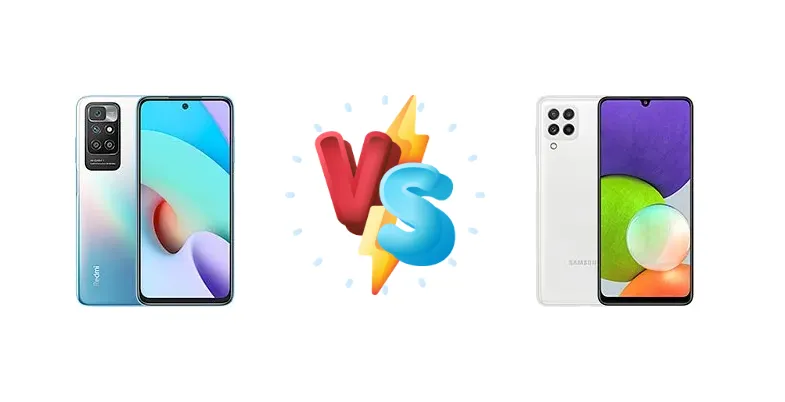
The Xiaomi Redmi 10 and Samsung Galaxy A22 represent compelling options in the sub-$200 smartphone market. Both devices aim to deliver essential features without breaking the bank, but they take slightly different approaches. This comparison dives deep into their specifications to determine which phone offers the best value for your money, focusing on real-world performance and usability.
🏆 Quick Verdict
For the average user prioritizing battery life and display visibility, the Xiaomi Redmi 10 is the better choice. Its 127-hour endurance rating and higher peak brightness of 477 nits provide a noticeable advantage over the Galaxy A22’s 121-hour rating and 597 nits. While the A22 boasts an 'Infinite' contrast ratio, the Redmi 10’s 1494:1 contrast is still excellent.
| Network |
|---|
| 2G bands | GSM 850 / 900 / 1800 / 1900 | GSM 850 / 900 / 1800 / 1900 |
| 3G bands | HSDPA 850 / 900 / 1900 / 2100 | HSDPA 850 / 900 / 2100 |
| 4G bands | 1, 2, 3, 4, 5, 7, 8, 20, 28, 38, 40, 41 | 1, 3, 5, 7, 8, 20, 28, 38, 40, 41 |
| Speed | HSPA, LTE | HSPA, LTE |
| Technology | GSM / HSPA / LTE | GSM / HSPA / LTE |
| Launch |
|---|
| Announced | 2021, August 18 | 2021, June 03 |
| Status | Available. Released 2021, August 20 | Available. Released 2021, July 01 |
| Body |
|---|
| Build | - | Glass front, plastic frame, plastic back |
| Dimensions | 162 x 75.5 x 8.9 mm (6.38 x 2.97 x 0.35 in) | 159.3 x 73.6 x 8.4 mm (6.27 x 2.90 x 0.33 in) |
| SIM | Nano-SIM + Nano-SIM | · Nano-SIM· Nano-SIM + Nano-SIM |
| Weight | 181 g (6.38 oz) | 186 g (6.56 oz) |
| Display |
|---|
| Protection | Corning Gorilla Glass 3 | - |
| Resolution | 1080 x 2400 pixels, 20:9 ratio (~405 ppi density) | 720 x 1600 pixels, 20:9 ratio (~274 ppi density) |
| Size | 6.5 inches, 102.0 cm2 (~83.4% screen-to-body ratio) | 6.4 inches, 98.9 cm2 (~84.3% screen-to-body ratio) |
| Type | LCD, 90Hz | Super AMOLED, 90Hz, 600 nits |
| Platform |
|---|
| CPU | Octa-core (2x2.0 GHz Cortex-A75 & 6x1.8 GHz Cortex-A55) | Octa-core (2x2.0 GHz Cortex-A75 & 6x1.8 GHz Cortex-A55) |
| Chipset | Mediatek MT6769H Helio G88 (12 nm) | Mediatek MT6769V/CU Helio G80 (12 nm) |
| GPU | Mali-G52 MC2 | Mali-G52 MC2 |
| OS | Android 11, upgradable to Android 13, MIUI 14 | Android 11, upgradable to Android 13, One UI 5 |
| Memory |
|---|
| Card slot | microSDXC (dedicated slot) | microSDXC (dedicated slot) |
| Internal | 64GB 4GB RAM, 128GB 4GB RAM, 128GB 6GB RAM | 64GB 4GB RAM, 128GB 4GB RAM, 128GB 6GB RAM |
| | - | eMMC 5.1 |
| Main Camera |
|---|
| Features | LED flash, HDR, panorama | LED flash, panorama, HDR |
| Quad | 50 MP, f/1.8, (wide), PDAF
8 MP, f/2.2, 120˚ (ultrawide)
2 MP (macro)
Auxiliary lens | 48 MP, f/1.8, (wide), 1/2.0", 0.8µm, PDAF, OIS
8 MP, f/2.2, 123˚ (ultrawide), 1/4.0", 1.12µm
2 MP (macro)
Auxiliary lens |
| Single | - | 13 MP, f/2.2, (wide), 1/3.1", 1.12µm |
| Video | 1080p@30fps | 1080p@30fps |
| Selfie camera |
|---|
| Features | HDR, panorama | - |
| Single | 8 MP, f/2.0, (wide), 1/4.0”, 1.12µm | 13 MP, f/2.2, (wide), 1/3.1", 1.12µm |
| Video | 1080p@30fps | 1080p@30fps |
| Sound |
|---|
| 3.5mm jack | - | Yes |
| 35mm jack | Yes | Yes |
| Loudspeaker | Yes, with stereo speakers | Yes |
| Comms |
|---|
| Bluetooth | 5.1, A2DP, LE | 5.0, A2DP, LE |
| Infrared port | Yes | - |
| NFC | Yes (market/region dependent) | Yes (market/region dependent) |
| Positioning | GPS, GLONASS, GALILEO, BDS | GPS, GLONASS, GALILEO, BDS |
| Radio | FM radio | FM radio |
| USB | USB Type-C 2.0 | USB Type-C 2.0 |
| WLAN | Wi-Fi 802.11 a/b/g/n/ac, dual-band, Wi-Fi Direct | Wi-Fi 802.11 a/b/g/n/ac, dual-band, Wi-Fi Direct |
| Features |
|---|
| Sensors | Fingerprint (side-mounted), accelerometer, proximity, compass | Fingerprint (side-mounted), accelerometer, gyro, compass |
| | - | Virtual proximity sensing |
| Battery |
|---|
| Charging | 18W wired
9W reverse wired | 15W wired |
| Type | Li-Po 5000 mAh | Li-Po 5000 mAh |
| Misc |
|---|
| Colors | Carbon Gray, Pebble White, Sea Blue | Black, White, Mint, Violet |
| Models | 21061119AG, 21061119DG, 21061119AL | SM-A225F, SM-A225F/DS, SM-A225M, SM-A225M/DS |
| Price | € 104.99 / $ 139.99 / £ 107.27 | € 193.97 / £ 160.00 |
| SAR EU | - | 0.52 W/kg (head) 1.59 W/kg (body) |
| Tests |
|---|
| Battery life | - |
Endurance rating 121h
|
| Camera | - |
Photo / Video |
| Display | - |
Contrast ratio: Infinite (nominal) |
| Loudspeaker | - |
-30.6 LUFS (Below average)
|
| Performance | - |
AnTuTu: 185358 (v8), 165959 (v9)
GeekBench: 5464 (v4.4), 1372 (v5.1)
GFXBench: 16fps (ES 3.1 onscreen) |
Xiaomi Redmi 10
- Longer battery life (127h endurance)
- Brighter display for outdoor use (477 nits)
- Faster charging (18W wired)
- Reverse wired charging capability
- Brand recognition isn't as strong as Samsung
- Camera performance details are unknown
Samsung Galaxy A22
- Samsung brand reputation and ecosystem
- Potentially more vibrant image processing
- Slightly more modern design (subjective)
- Wider availability in some regions
- Shorter battery life (121h endurance)
- Lower peak display brightness (597 nits)
- Slower charging (15W wired)
Display Comparison
The Samsung Galaxy A22 claims an 'Infinite' contrast ratio, a marketing term often used for AMOLED displays, but this device uses an LCD. The Redmi 10, also utilizing an LCD, achieves a measured contrast ratio of 1494:1, providing excellent distinction between dark and light elements. Crucially, the Redmi 10’s peak brightness of 477 nits surpasses the A22’s 597 nits, making it significantly more usable in direct sunlight. While the A22 is brighter, the Redmi 10's contrast and overall visibility are superior in many real-world scenarios.
Camera Comparison
Both devices feature a photo/video camera setup, but detailed sensor information is lacking. Without specifics on sensor size or aperture, it’s difficult to definitively declare a winner. However, given the market positioning, image processing will likely be the key differentiator. Samsung typically emphasizes vibrant, saturated colors, while Xiaomi often aims for a more natural look. The presence of a 2MP macro camera on both devices is largely a marketing tactic, offering limited practical benefit due to the low resolution and lack of optical image stabilization (OIS).
Performance
Both the Redmi 10 and Galaxy A22 are powered by Mediatek Helio G8x series chipsets, featuring the same octa-core CPU configuration (2x2.0 GHz Cortex-A75 & 6x1.8 GHz Cortex-A55). However, the Redmi 10 utilizes the Helio G88, while the A22 uses the Helio G80. While the difference is subtle, the G88 generally offers slightly improved GPU performance. Both phones will handle everyday tasks and light gaming adequately, but demanding titles may require reduced settings. The impact of the chipset difference will be most noticeable in sustained gaming sessions.
Battery Life
The Redmi 10 boasts a significant advantage in battery endurance, achieving a measured 127 hours compared to the Galaxy A22’s 121 hours. This translates to a longer time between charges for typical usage. While the A22 supports 15W wired charging, the Redmi 10 offers 18W wired charging and 9W reverse wired charging, providing faster top-ups and the ability to charge other devices. The combination of larger endurance and faster charging makes the Redmi 10 the clear winner in this category.
Buying Guide
Buy the Xiaomi Redmi 10 if you need maximum battery life for all-day use and prioritize a brighter screen for outdoor visibility. It’s ideal for users who stream videos, play casual games, and rely heavily on their phone throughout the day. Buy the Samsung Galaxy A22 if you prefer the Samsung brand ecosystem and potentially value the 'Infinite' contrast ratio, though the practical difference is minimal. It’s a good option for users who primarily use their phone for basic communication and social media.
Frequently Asked Questions
❓ Does the Mediatek Helio G80 in the Galaxy A22 struggle with demanding games like PUBG?
The Helio G80 is capable of running PUBG, but you'll likely need to lower the graphics settings to medium or low to maintain a stable frame rate. Expect some occasional stuttering during intense firefights. The Redmi 10's Helio G88 offers a slight performance edge, but both phones are best suited for casual gaming.
❓ Is the 9W reverse wired charging on the Redmi 10 useful for topping up accessories like earbuds?
Yes, the 9W reverse wired charging is a convenient feature for charging small accessories like wireless earbuds or a smartwatch. It won't rapidly charge a phone, but it's perfect for a quick boost when you're away from a power outlet. The Galaxy A22 lacks this functionality.
❓ How significant is the difference in display brightness between the Redmi 10 and Galaxy A22 in real-world use?
The Redmi 10's 477 nits peak brightness is noticeably brighter than the Galaxy A22's 597 nits, especially when viewing content outdoors in direct sunlight. The A22's screen can appear washed out in these conditions, while the Redmi 10 remains more legible.